Deep in the heart of Central Asia, where the desolate black-sand dunes of Turkmenistan’s Karakum Desert stretch to the horizon under a pitch-black night sky, an ominous orange glow fractures the darkness.
Approach the rim on foot, and the frigid desert air suddenly transforms into a wall of blistering radiant heat accompanied by a low, persistent roar resembling a jet engine. This is the Darvaza Gas Crater, known universally to locals and global expeditioners as “The Gates of Hell” (Jahannam Derwezesi).
Spanning nearly 70 meters (230 feet) wide and plunging 30 meters (98 feet) into the earth, this subterranean amphitheater has burned continuously with thousands of individual methane flames for more than five decades.
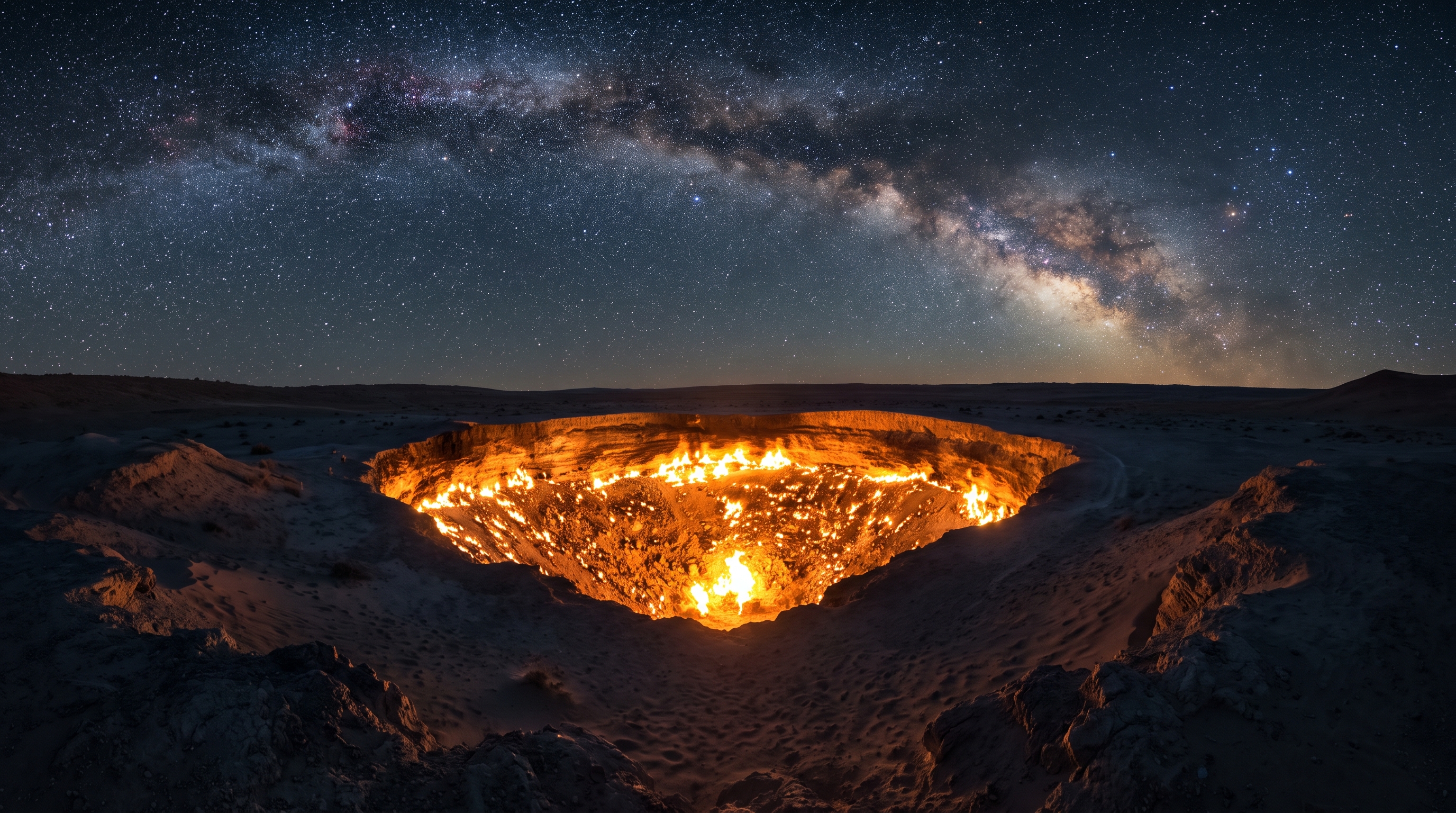 The incandescent inferno of the Darvaza crater illuminates the vast emptiness of the Karakum Desert at midnight.
The Soviet Blunder: The 1971 Miscalculation
The genesis of the Gates of Hell is not volcanic, but a dramatic clash between aggressive industrial exploitation and unstable subterranean geology. In 1971, during the height of the Soviet Union’s energy expansion, a team of Soviet geologists set up a massive drilling rig near the isolated village of Darvaza to tap into what they believed was an immense oil reservoir.
Disaster struck shortly after the drill bits punctured the sub-surface strata:
- The Sinkhole Collapse: The ground beneath the heavy drilling equipment consisted of a hollow, fragile limestone cavern filled with pocketed natural gas. Under the rig’s weight, the earth liquefied and collapsed inward, swallowing the drilling machinery, camp structures, and pipe infrastructure into a gaping crater.
- The Poison Gas Threat: While no human lives were lost in the collapse, high concentrations of odorless, poisonous methane, alongside foul sulfur dioxide, began venting violently into the open atmosphere, threatening nearby desert nomadic settlements and livestock.
- The Flaring Decision: Soviet engineers faced a dilemma. To prevent toxic gas buildup, they chose to “flare” the pocket—tossing an incendiary flare into the cavern. They calculated that the localized pocket of natural gas would burn itself out within two to three weeks.
That was in 1971. Fifty-five years later, the inferno burns with unaltered ferocity, fed by a seemingly inexhaustible deep-seated hydrocarbon reservoir.
Into the Abyss: Extremophile Life at 400°C
For decades, scientists assumed the superheated floor of the crater was an absolute biological wasteland. In November 2013, Canadian explorer George Kourounis, funded by the National Geographic Society, became the first human being to descend to the bottom of the burning abyss.
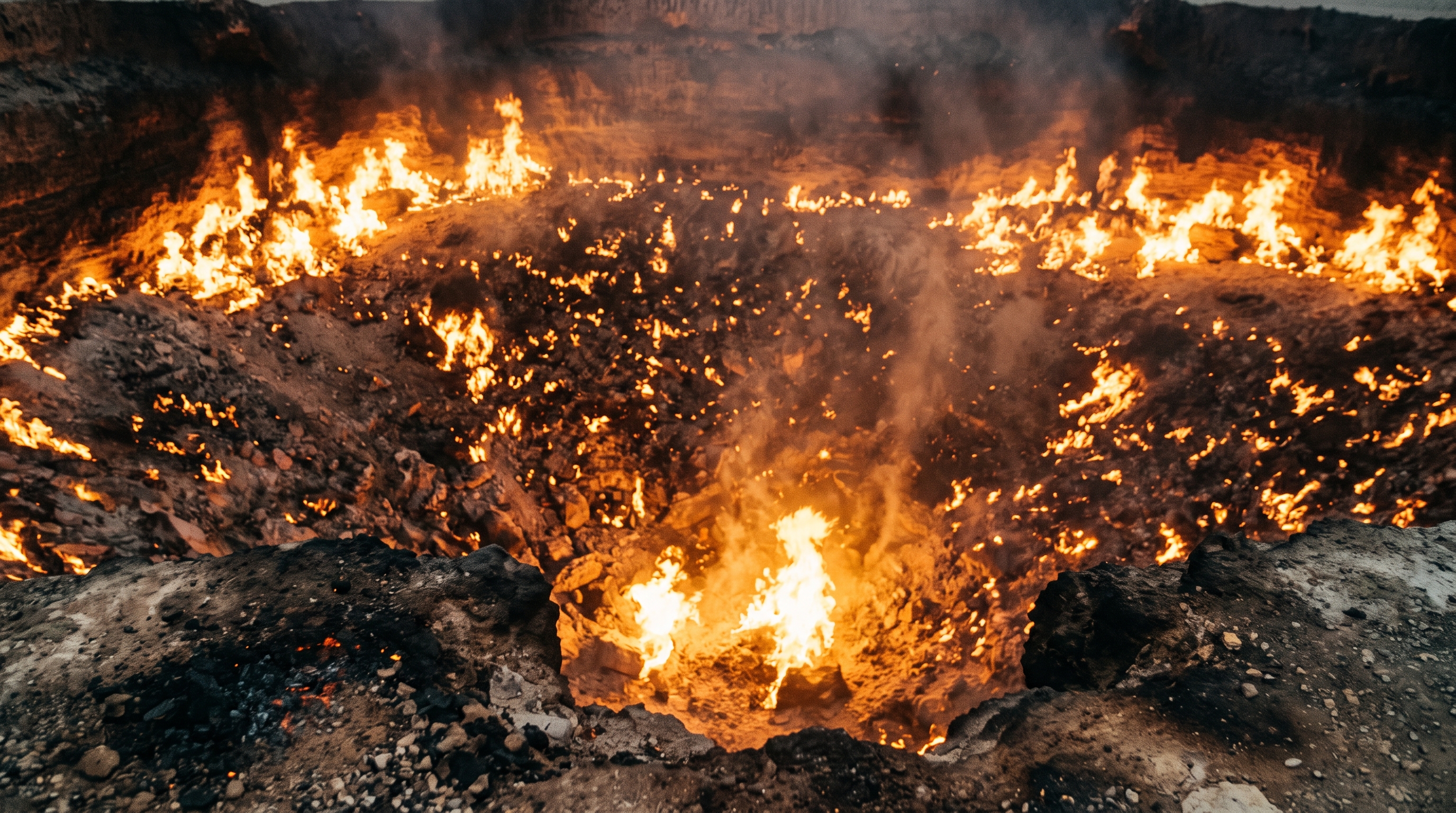 Molten rock, charred limestone, and hundreds of individual natural gas fissures burning across the crater floor.
Clad in a custom, heat-reflective Kevlar and aluminized suit and tethered to a high-tensile harness system suspended across the center of the crater, Kourounis spent seventeen minutes collecting core soil samples from the bottom edge:
- Thermal Extremes: Temperatures near the bottom floor easily exceeded 400°C (752°F), with winds generating violent micro-convection air currents capable of melting standard exploration nylon lines.
- Microbial Discovery: DNA analysis of the extracted mineral soil revealed unique species of extremophile bacteria thriving directly inside the superheated, methane-rich dirt. These organisms did not exist in the surrounding desert topsoil, proving that life could survive under conditions previously thought impossible on Earth—and offering clues for astrobiologists hunting for life on harsh exoplanets.
The Closing of the Gates?
The fiery landmark attracts thousands of daring international travelers each year, standing as Turkmenistan’s most famous natural wonder. However, its future remains uncertain.
In 2022, the government of Turkmenistan announced intentions to extinguish the crater permanently. State authorities cite two major motivations:
- Economic Gas Capture: The uncontrolled venting burns billions of cubic feet of high-grade natural gas annually that could otherwise be purified, piped, and exported to international energy markets.
- Environmental & Health Concerns: Prolonged flaring disperses volatile greenhouse gases into the regional atmosphere and slowly drains the pressure of adjacent commercial gas extraction fields.
Extinguishing a raging, subterranean network of fractured rock over 200 feet wide is an unprecedented engineering nightmare. Past Soviet attempts to plug runaway gas fires involved subterranean nuclear detonations—a drastic solution unlikely to be replicated today. For now, the crater continues to blaze undisturbed.
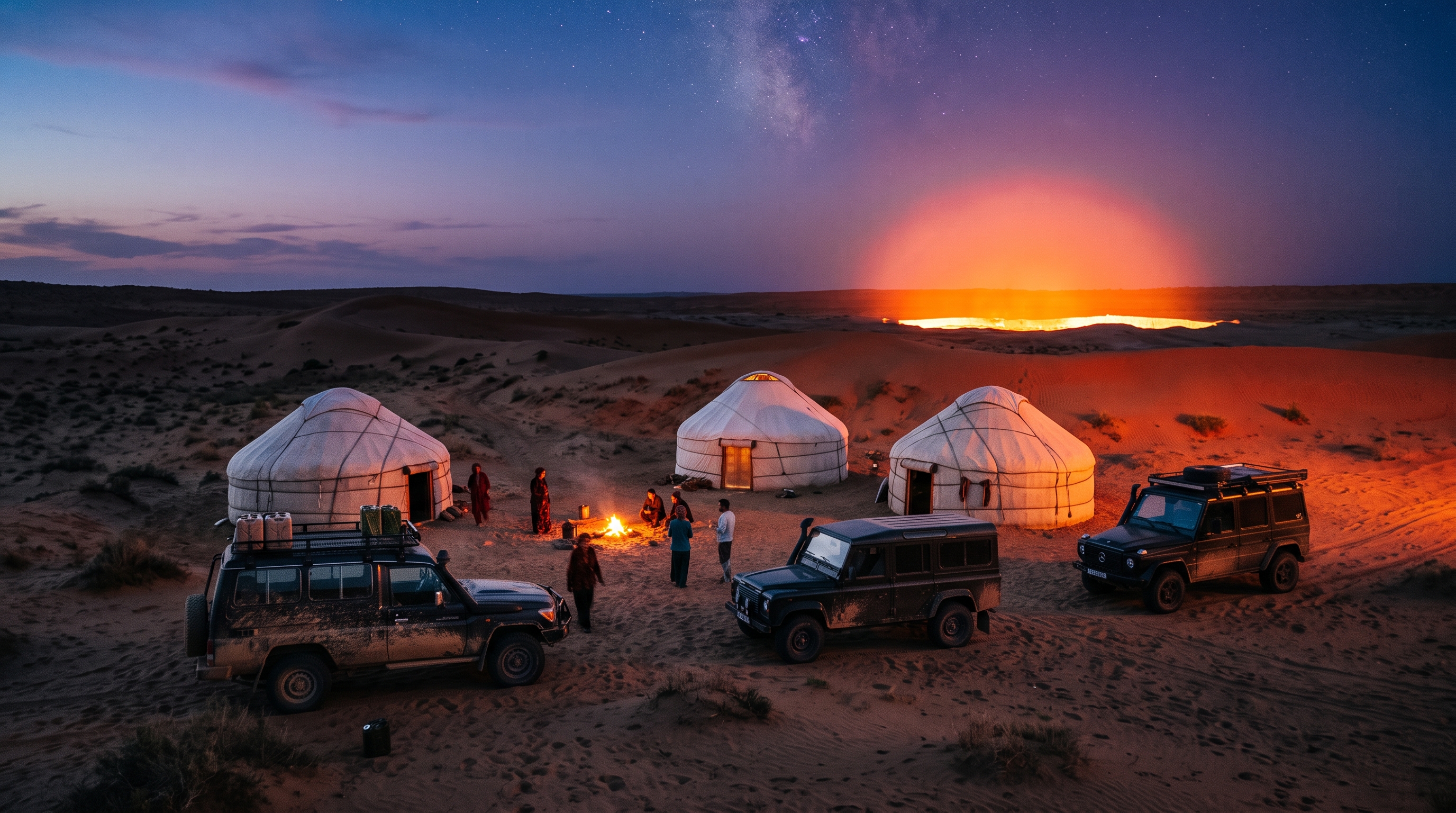 Nomadic white felt yurts pitched on the desert plateau, sheltered under the surreal ambient orange glow of the burning pit.
Expedition Field Guide: Journey into the Karakum
Visiting the Darvaza Gas Crater is an arduous expedition requiring bureaucratic navigation and specialized desert transport.
Logistical Access
- Visas & Permits: Turkmenistan remains one of the world’s most restrictive countries to enter. Independent travel is generally prohibited; you must arrange travel through a government-licensed tour agency that secures a Letter of Invitation (LOI) and provides an official guide.
- The Desert Transit: Darvaza lies roughly 260 kilometers (160 miles) north of the capital city, Ashgabat. While the main highway is paved, the final leg requires rugged 4x4 vehicles capable of carving through deep, shifting desert sand tracks.
Field Safety Protocols
- Perimeter Fencing: Authorities have erected a simple perimeter barrier around parts of the rim. Never jump the fence or stand on overhanging, crumbling sandy edges—thermal convection and sudden wind shifts can cause vertigo or destabilize the loose limestone shelf.
- Wind Direction Awareness: Methane is lighter than air, but toxic sulfur fumes linger at downwind points. Always pitch desert tents or position yourself upwind of the crater’s smoke trail to avoid respiratory irritation and carbon monoxide poisoning.
- The Optimal Experience: Plan to arrive at the crater two hours before sunset. Watch the crater transform from a smoky beige bowl in the twilight into a roaring, hypnotic furnace that illuminates the desert sky until dawn.
The Verdict
The Darvaza Gas Crater is a sublime monument to human miscalculation—a moment where an industrial drill cracked open the crust of the earth and unleashed an elemental force that refuses to be tamed. To stand on its wind-whipped rim in the dead of the Central Asian night is to peer directly into the raw, smoldering power of the planet’s hidden depths.