High in the rugged Garhwal Himalayas of Uttarakhand, India, cradled within a desolate cirque beneath the sheer snowbound massif of Mount Trishul, lies one of the planet’s most baffling anthropological riddles: Roopkund Lake.
Perched at an oxygen-deprived elevation of 5,029 meters (16,499 feet) above sea level, this tiny alpine tarn—measuring barely forty meters across—remains locked beneath solid blue ice and snowdrifts for ten months of the year.
Yet for a fleeting window during late summer, when high-altitude temperatures rise and the glacial crust recedes, the pristine turquoise waters expose a scene straight out of a nightmare: the bleached, articulated skeletal remains, preserved footwear, and fractured craniums of over five hundred human beings littering the rocky lakeshore and resting visibly beneath the crystal-clear water.
Known worldwide as “The Skeleton Lake,” Roopkund has puzzled forensic scientists, archaeologists, and alpine mountaineers for nearly a century. What drove hundreds of travelers to die simultaneously in this uninhabitable high-altitude pass, and how did genetic lineages separated by thousands of miles and an entire millennium end up in the exact same icy tomb?
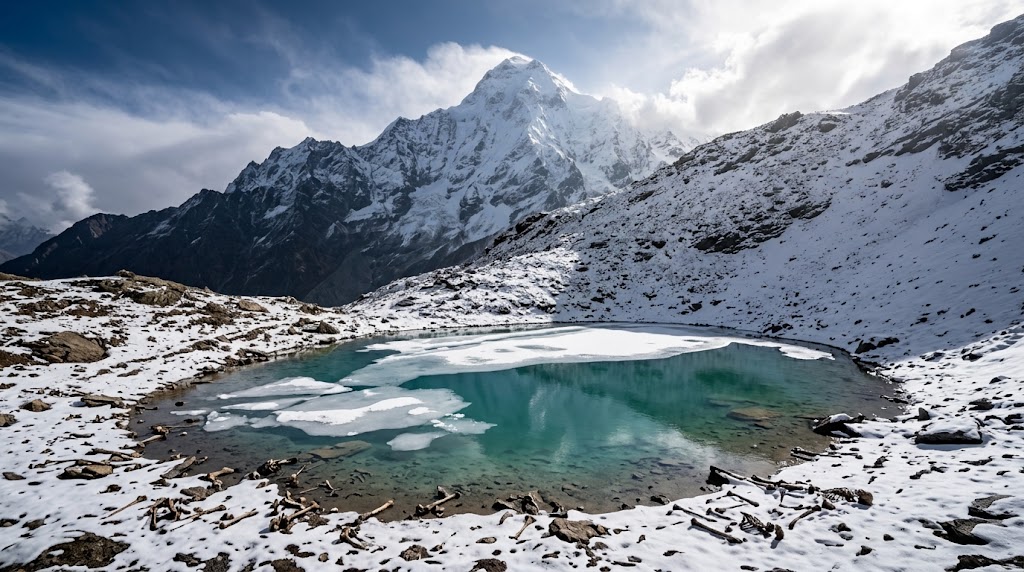 Roopkund Lake cradled at 16,500 feet beneath Mount Trishul, surrounded by glaciers and rocky moraine ridges.
The Wartime Panic of 1942: The Phantom Invasion
Although local shepherds had passed down hushed folktales of a bone-filled tarn for generations, Roopkund’s modern discovery arrived amidst global warfare:
- The Forest Ranger’s Discovery: In 1942, British forest ranger Hari Kishan Madhwal was trekking through the remote Chamoli district when he crested the ridge of Roopkund and peered into the thawing meltwater. He found the shore strewn with hundreds of bleached skeletons, some retaining fragments of hair, fingernails, and desiccated flesh.
- The Imperial Panic: At the height of World War II, the British colonial administration feared the worst. Military intelligence suspected the remains belonged to a covert Imperial Japanese infantry strike force attempting a high-altitude flanking invasion through Tibet into India.
- The Autopsy of Antiquity: British military surgical teams dispatched to the site quickly dismissed the invasion theory. The bone artifacts were ancient; wood-and-leather footwear, bamboo staffs, and woven textile remnants indicated the dead had perished long before the advent of mechanized warfare.
The Wrath of Nanda Devi: Legend of the King’s Pilgrimage
In the high valleys of Garhwal, local villagers preserve an ancient folk ballad that has been sung for hundreds of years:
- The Pilgrimage of King Jasdhawal: The legend recounts that in medieval times, King Jasdhawal of Kanauj embarked on the arduous Nanda Devi Raj Jat pilgrimage to honor the mountain goddess Nanda Devi, accompanied by his pregnant queen, Balampa, their royal court, and an entourage of dancers and musicians.
- The Transgression: Disregarding monastic traditions of humility and purity in sacred alpine spaces, the king held lavish festivities, while his musicians danced upon holy rocks. Offended by their vanity, the goddess Nanda Devi unleashed a sudden, apocalyptic tempest.
- The “Iron Hail”: The ballad describes how the heavens turned black and rained down lahaul—massive stones of “iron hail” harder than rock—striking the pilgrims down upon the lakeshore without a single crevice in which to shelter.
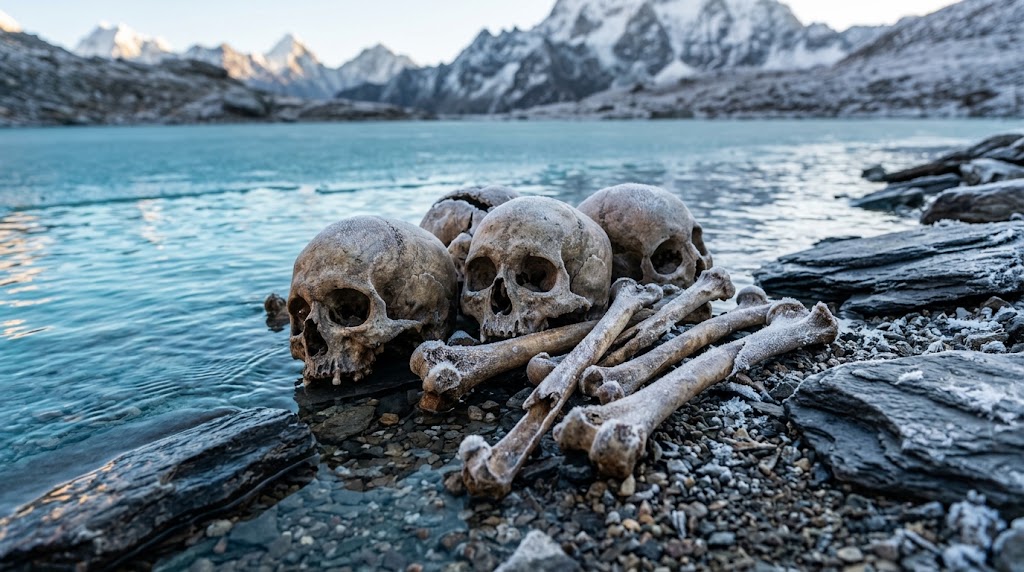 Ancient skulls and limb bones resting among the alpine slate and glacial gravel along the water’s edge.
The Forensic Revelation: The 2019 Genomic Shock
For decades, modern science attempted to explain the catastrophe: mass epidemic, an unexpected blizzard, ritual suicide, or a high-altitude avalanche.
Forensic physical anthropological surveys conducted by the Archaeological Survey of India (ASI) in the 2000s revealed a crucial anatomical detail: nearly all the recovered skulls possessed unhealed compression fractures caused by blunt-force impacts from directly above. The wounds were not consistent with swords, arrows, or tumbling boulders, but rather deep, rounded fractures matching baseball-sized or grapefruit-sized hailstones falling at terminal velocity.
However, in August 2019, an international landmark genetic study published in Nature Communications completely rewrote the Roopkund narrative:
- The Multi-Centennial Puzzle: A multidisciplinary team led by Harvard University, the Centre for Cellular and Molecular Biology (CCMB) in Hyderabad, and the Max Planck Institute sequenced the ancient DNA of thirty-eight individual skeletons.
- Two Distinct Groups: The genomic analysis proved that the skeletons did not perish in a single event:
- Group A (South Asian): Twenty-three individuals carrying genetic affinities typical of northern and southern India. Radiocarbon dating placed their deaths around 800–900 AD (matching the era of medieval Hindu pilgrimage routes).
- Group B (The Mediterranean Enigma): Fourteen individuals possessing genetic signatures directly linked to the eastern Mediterranean—specifically modern Crete and mainland Greece. Astonishingly, radiocarbon testing revealed they died roughly 1,000 years later, around 1800 AD.
- The Unsolved Mystery: While the 9th-century pilgrims likely fell victim to a catastrophic high-altitude hailstorm, science has no historical record or definitive explanation for why a cohort of Mediterranean travelers was crossing an isolated 16,500-foot Himalayan pass during the early 19th century.
Vanishing Antiquities: Looting and Ecological Pressure
Roopkund’s global notoriety has exposed the fragile sacred site to severe modern threats:
- Artifact Trophy Hunting: For decades, unregulated trekkers and souvenir collectors pocketed human bones, wooden umbrella handles, and brass rings, significantly depleting the archaeological integrity of the lakeshore.
- The Vanishing Permafrost: Accelerating Himalayan climatic warming causes earlier seasonal melts, exposing delicate organic artifacts to wind oxidation, UV radiation, and rapid biological decomposition.
- The 2018 Uttarakhand High Court Ban: Recognizing the rapid environmental degradation of alpine meadows (bugyals) and sensitive archaeological zones, the Uttarakhand High Court issued a sweeping ruling in August 2018, banning commercial overnight camping and large-scale trekking groups across high-altitude meadows, drastically curtailing mass foot traffic to Roopkund.
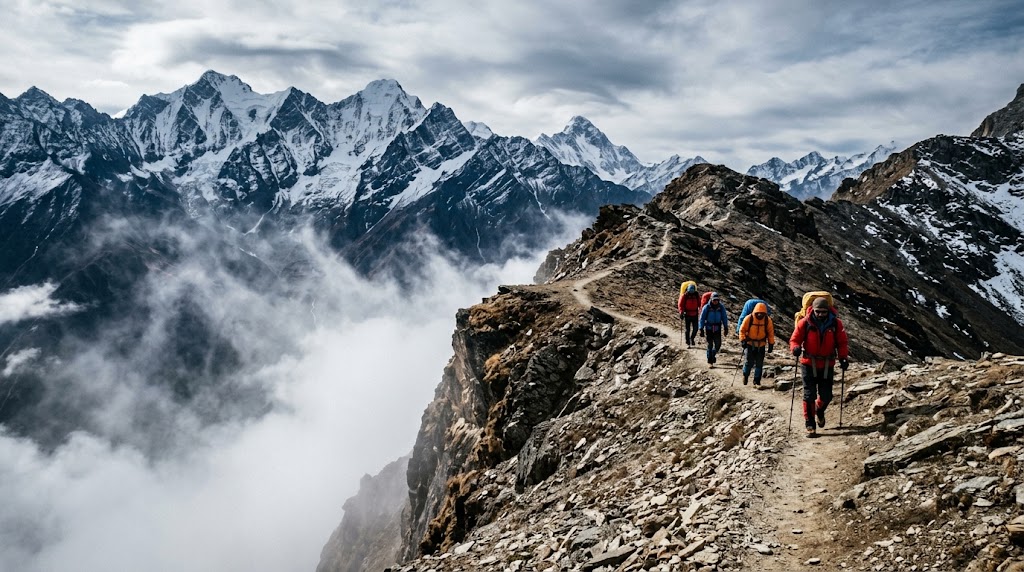 Expedition trails winding through the rugged snowfields and high alpine passes leading toward Mount Trishul.
Expedition Field Guide: How to Approach Roopkund
Reaching Roopkund is a demanding, high-altitude alpine expedition requiring excellent physical fitness, acclimatization discipline, and authorized trekking permits.
The Route & Staging Camps
- Gateway Hub: The primary expedition staging village is Lohajung, located in Uttarakhand’s Chamoli district, reachable via a ten-hour mountain drive from Rishikesh or Kathgodam railway station.
- The Trekking Route:
- Lohajung to Didna Village (2,450 m): Winding through dense rhododendron and oak forests.
- Didna to Ali Bugyal & Bedni Bugyal (3,350 m): Emerging onto rolling alpine grasslands offering panoramic views of Trishul and Nanda Ghunti.
- Bedni Bugyal to Bhagwabasa (4,300 m): Traversing rocky moraines and barren boulder fields, where temperatures drop well below freezing at night.
- The Final Ascent: A steep, dawn push from Bhagwabasa across snow gullies to reach Roopkund (5,029 m) and the towering viewing saddle of Junargali (5,150 m).
Vital Safety & Regulatory Protocols
- Permits & Guided Outfits: Independent trekking without a registered local guide and forest department permits is prohibited. Only certified Himalayan expedition operators (such as local Garhwal mountain collectives) can secure authorized transit permits.
- Acute Mountain Sickness (AMS): Ascent to 5,000+ meters exposes hikers to severe altitude hazards. Gradual acclimatization days at Bedni Bugyal and carrying prophylactic medications (like Diamox), pulse oximeters, and portable oxygen are mandatory.
- Seasonal Windows: The route is accessible exclusively during two tight seasons: May to June (snowfields receding, partial ice melt) and September to early October (clearest skies, though night temperatures plummet). Avoid July and August due to devastating Himalayan monsoon landslides.
- Strict “Leave No Trace” Sacred Code: Roopkund remains sacred ground to the regional devotees of Nanda Devi. It is strictly forbidden to touch, handle, disturb, or displace any human bones or archaeological artifacts.
The Verdict
Roopkund Lake is where science, myth, and high-altitude wilderness converge in breathtaking solemnity. Standing upon the frozen edge of this Himalayan amphitheater as icy gales whistle past Mount Trishul, travelers gaze into the silent gaze of hundreds of ancient wanderers—an enduring reminder of nature’s raw, unpredictable fury and humanity’s eternal quest into the unknown.