Deep within the swampy, mist-draped spruce forests of the Masurian Lake District in northeastern Poland, eight kilometers east of Kętrzyn, lies one of the most monolithic and sinister ruins of the Second World War: Wolf’s Lair (Wolfsschanze).
Veiled beneath dense canopy and artificial camouflage for five years, this gargantuan 250-hectare fortress was Adolf Hitler’s primary military headquarters on the Eastern Front. From this concealed forest citadel, Hitler spent over eight hundred days directing the bloody mechanized thrust of Operation Barbarossa into the Soviet Union.
Today, Wolf’s Lair is a landscape of shattered cyclopean concrete. Colossal bunker roofs, eight meters thick and weighing thousands of tons, rest at unnatural angles in the damp earth, cleaved apart by internal dynamite blasts. Ferns, weeping willows, and thick emerald moss now carpet the scorched corridors where Nazi leadership commanded total war—and where a brass briefcase bomb nearly altered the course of human history.
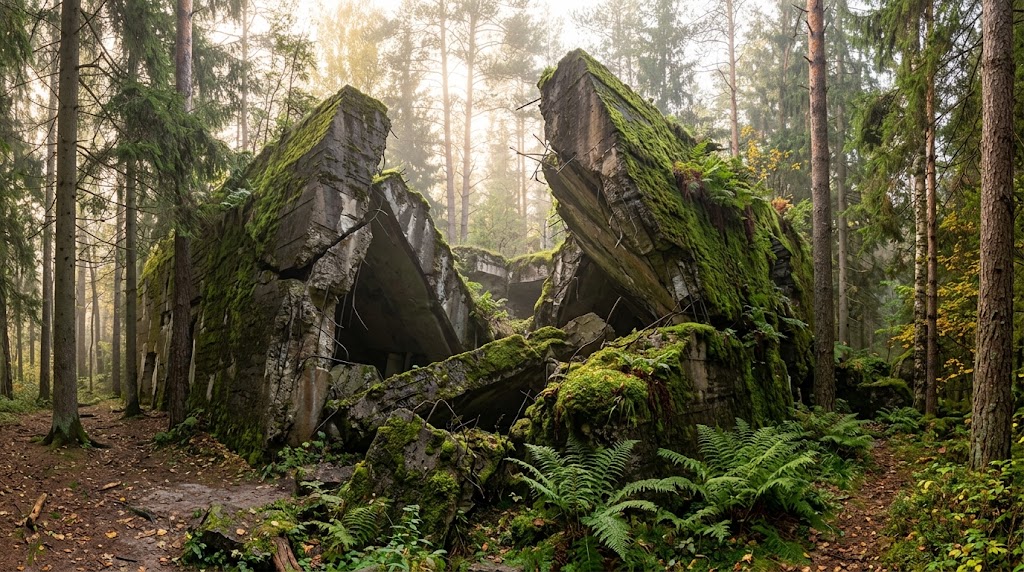 The colossal remains of a heavy bunker at Wolf’s Lair, cleaved apart by dynamite and reclaimed by the Masurian forest.
The Invisible Fortress: Engineering Paranoia (1940–1944)
Construction of Wolf’s Lair began in total secrecy in autumn 1940, masked as an agricultural research facility named Askania:
- The Strategic Location: Hidden in the isolated borderlands of East Prussia, surrounded by lakes and impassable swamps, the location placed command within striking distance of the Soviet frontier while remaining completely invisible from Allied reconnaissance aircraft.
- The Layered Camouflage: Engineering organization Todt pioneered radical camouflage techniques:
- Roofs were lined with shallow soil beds planted with living birch trees and shrubs.
- Aerial wire mesh strung between forest branches was woven with artificial seaweed and compressed wood-fiber netting, repainted seasonally to match changing forest foliage.
- External concrete walls were coated with rough green-and-brown plaster mixed with ground granite and seaweed to eliminate all optical reflection.
- The Tri-Zone Security Ring: The base was ringed by concentric security cordons (Sperrkreise), fortified by machine-gun pillboxes, razor wire, and a perimeter minefield containing over 54,000 anti-personnel and anti-tank mines.
Operation Valkyrie: The July 20, 1944 Assassination Plot
Wolf’s Lair is etched into history as the ground zero of the most coordinated internal coup against Nazi rule: Operation Valkyrie.
On the sweltering morning of July 20, 1944, aristocratic German Colonel Claus von Stauffenberg, chief of staff of the Reserve Army, arrived at the base carrying a briefcase packed with two kilograms of plastic explosive primed with chemical pencil detonators:
- The Altered Venue: Because of ongoing maintenance on the subterranean bunker, the daily military situation briefing was moved to an above-ground wooden conference hut (Lagebaracke).
- The Positioning: Stauffenberg entered the briefing room, placed the briefcase under the heavy oak table just feet from Hitler, and excused himself under the pretext of making an urgent phone call. Minutes later, an officer unknowingly kicked the briefcase and shifted it behind a massive, solid oak support leg.
- The Detonation: At 12:42 PM, the bomb exploded, obliterating the building, blowing out windows, and killing four officers. However, the open windows dissipated the blast wave, and the thick oak table leg deflected the primary concussive force upward. Hitler survived with singed trousers, minor eardrum ruptures, and surface abrasions.
- The Brutal Purge: Convinced of his own supernatural destiny, Hitler launched a merciless purge. Over 7,000 individuals linked to the resistance were arrested by the Gestapo, and nearly 5,000 were executed—many strangled with piano wire suspended from meat hooks.
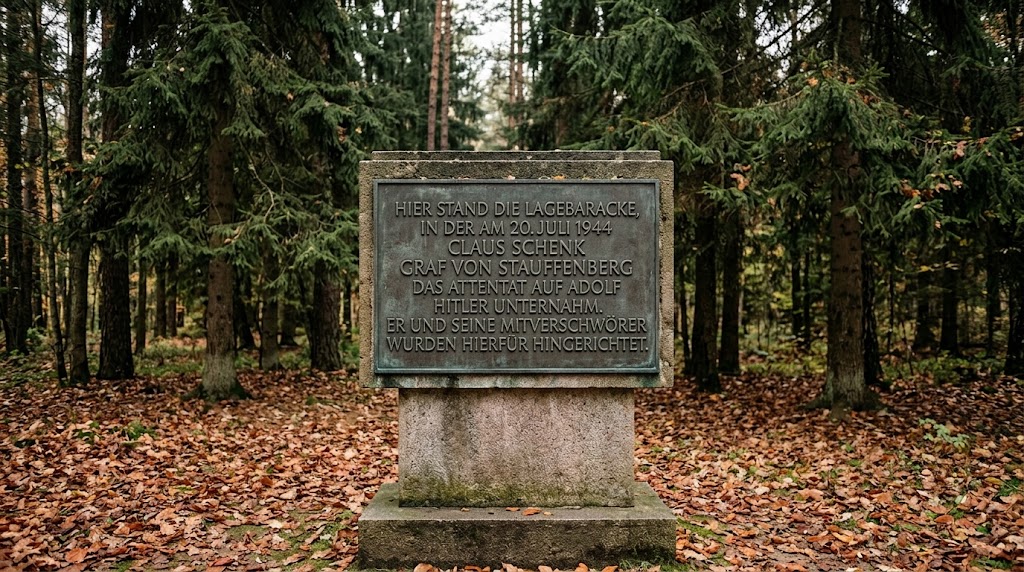 The bronze memorial plaque marking the site of the conference barracks where Claus von Stauffenberg detonated the briefcase bomb.
The Apocalypse of Concrete: Operation Island (January 1945)
By January 1945, the Soviet Red Army breached the defenses of East Prussia during the East Prussian Offensive:
- The Order to Destroy: Refusing to allow his personal bastion to fall into Soviet hands intact, Field Marshal Wilhelm Keitel issued orders for its complete destruction (Operation Island).
- The Demolition: Over forty-eight hours, German combat engineers drilled shafts into the reinforced concrete structures and packed them with explosives—using an average of eight to ten tons of TNT per bunker.
- The Resulting Ruins: On the night of January 24–25, 1945, the earth shook for thirty miles as Wolf’s Lair detonated. Yet such was the integrity of the concrete that many vaults refused to pulverize; instead, eight-meter-thick ceilings lifted into the air and collapsed back onto shattered walls, creating the surreal monoliths visible today.
- The De-Mining Operation: Following the war, Polish military sappers spent ten years (1945–1955) demining the surrounding swamps, neutralizing over 54,000 landmines and recovery thousands of explosive devices before the site could safely admit historical researchers.
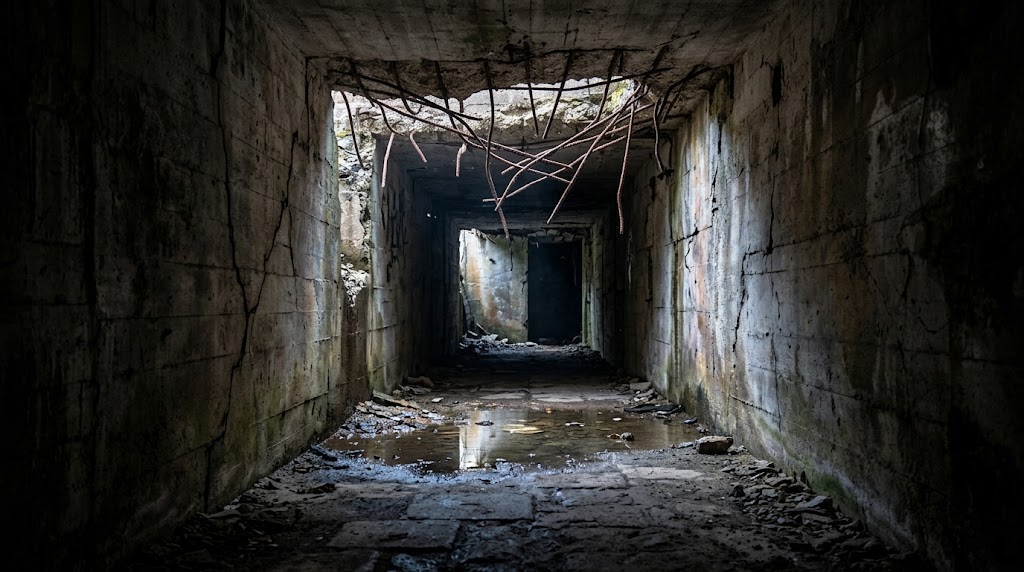 Inside the ruins: collapsed reinforced ceilings, jagged iron rebar, and waterlogged subterranean passageways.
The Anatomy of the Monoliths: Hitler’s Personal Bunker
Of the two hundred structures documented across Wolf’s Lair, the most massive is Bunker 13—Hitler’s private bomb shelter:
- The Double-Shell Architecture: As Allied heavy bunker-buster bombs increased in destructive tonnage, engineers encased the original 1941 bunker inside an enormous secondary concrete outer shell.
- The Dead Air Cushion: A half-meter air gap was left between the outer explosive-protection wall and the inner living quarters to absorb the seismic shockwave of a direct bomb strike.
- A Windowless Tomb: The structure had no exterior windows, ventilated through specialized chemical filtration systems to protect against potential chlorine or mustard gas warfare.
Expedition Field Guide: How to Journey to Wolf’s Lair
Wolf’s Lair is located near the village of Gierłoż, accessible via the Masurian towns of Kętrzyn, Giżycko, or Olsztyn.
Transit & Directions
- Base Hub: The town of Kętrzyn sits 8 kilometers west. Regular regional trains connect Warsaw Centralna and Gdańsk Główny to Olsztyn, with local rail and bus connections to Kętrzyn.
- From Kętrzyn to Gierłoż: Local minibuses, taxis, and seasonal bicycle rentals operate directly along the tree-lined route to the site entrance.
- By Car: Drive along the Route 592 / Route 63 corridor through the scenic Masurian Lake District. Dedicated paid parking facilities are situated directly outside the visitor pavilion.
Practical Protocols & Safety Recommendations
- Stick Strictly to Marked Trails: The interior ruins are inherently unstable. Large concrete slabs weighing dozens of tons rest balanced on rusted rebar. Entering off-trail collapsed corridors or climbing onto bunker roofs is strictly prohibited.
- Carry High-Lumen Flashlights: While outdoor walking trails are maintained, examining bunker entrances, gun embrasures, and interior blast rooms requires a reliable torch.
- Footwear & Seasonality: Masurian forests are damp and humid. Wear sturdy, waterproof hiking boots with non-slip traction. Summer visits require insect repellent to combat dense mosquito and tick populations in the surrounding marshes.
- On-Site Museum & Audio Guides: The state forest administration operates a modern visitor center offering comprehensive audio headsets and exhibits displaying original blueprints, wartime artifacts, and a detailed 1:1 scale model of the July 20 conference room.
The Verdict
Wolf’s Lair is a haunting monument to total war and the delusions of unchecked power. Standing in the cool shadow of these cracked concrete leviathans as wind rustles through the Masurian pines, travelers witness the ultimate futility of tyranny: an empire’s mightiest subterranean citadel, obliterated by its own architects and swallowed whole by the silence of the forest.