Rising from the sun-scorched, arid plains of Aragon in northeastern Spain, forty kilometers south of Zaragoza, lies one of the most visceral and tragic open-air monuments to modern conflict: Pueblo Viejo de Belchite (Old Belchite).
Unlike European villages that were rebuilt brick by brick after the devastation of warfare, Belchite was deliberately left to rot. Walking beneath its ruined triumphal gate (Arco de la Villa), travelers do not enter a manicured memorial; they step into a ghost town frozen in the immediate aftermath of complete artillery annihilation.
Shattered Mudéjar-Gothic brick bell towers pierced by high-explosive tank shells jut into the deep blue Aragonese sky. Collapsed arches of centuries-old cathedrals reveal empty altars littered with calcified mortar, while dusty, weed-choked avenues are lined with facades pockmarked by thousands of heavy machine-gun rounds. Belchite is Spain’s collective open wound—a city martyred in fourteen days of unrelenting brother-against-brother slaughter.
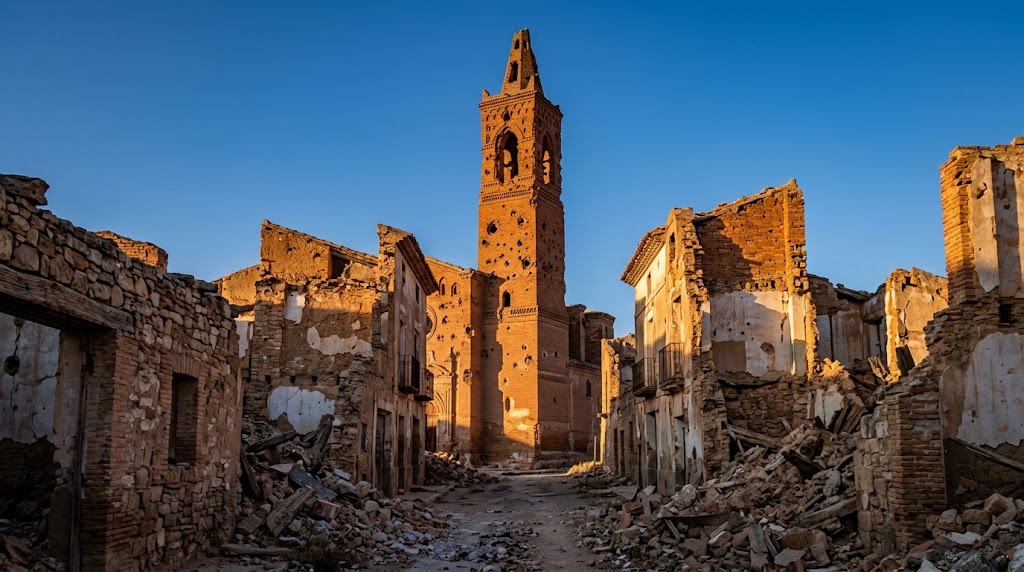 Pueblo Viejo de Belchite: skeletal church towers and collapsed masonry frozen in time under the Aragonese sun.
The Battle of Belchite: Fourteen Days of Hell (1937)
By the summer of 1937, the Spanish Civil War had descended into an ideological war of attrition between General Francisco Franco’s Nationalist forces and the Left-wing Spanish Republican government:
- The Strategic Offensive: Seeking to relieve pressure on the besieged northern front of Santander and capture the strategic provincial capital of Zaragoza, the Republican Army launched a massive surprise counter-offensive across the Ebro valley, deploying 80,000 troops, Soviet-supplied BT-5 tanks, and Polikarpov fighter aircraft.
- The Bastion in the Sun: The heavily fortified town of Belchite, defended by roughly 7,000 Nationalist soldiers and civilian Falangist volunteers, refused to surrender. Between August 24 and September 6, 1937, the town became a cauldron of urban combat.
- House-to-House Butchery: Republican artillery rained thousands of shells into the medieval center. When water mains were severed in the 40°C (104°F) summer heat, survivors drank stagnant sewage water. Combatants blasted through adjoining living-room walls with pickaxes, fighting hand-to-hand from bedroom to kitchen with bayonets and sticks of dynamite.
- The Fall & Human Toll: When Republican forces finally breached the central plaza, over 5,000 soldiers and civilians lay dead amid the smoking rubble. Hundreds of unburied corpses were hastily bulldozed into mass lime pits along the town perimeter.
Franco’s Decree: The Creation of a Living Tomb
Following Franco’s ultimate victory in 1939, local survivors anticipated that the state would clear the thousands of tons of masonry and reconstruct their ancestral homes:
- The Propagandistic Decree: General Franco personally intervened, issuing an ideological decree: Belchite must never be rebuilt. Franco intended to preserve the devastated town as a permanent, living symbol of what he termed “Red barbarism.”
- The Construction of Belchite Nuevo: A brand-new town, Belchite Nuevo, was constructed immediately adjacent to the ruins using Republican political prisoners as forced penal labor.
- The Gradual Exodus: For nearly two decades, destitute families continued living in the precarious, half-collapsed cellars and cracked ground floors of Old Belchite without running water or electricity. It was not until 1964 that the final resident was relocated to the new town, and the heavy iron gates of Pueblo Viejo were closed forever.
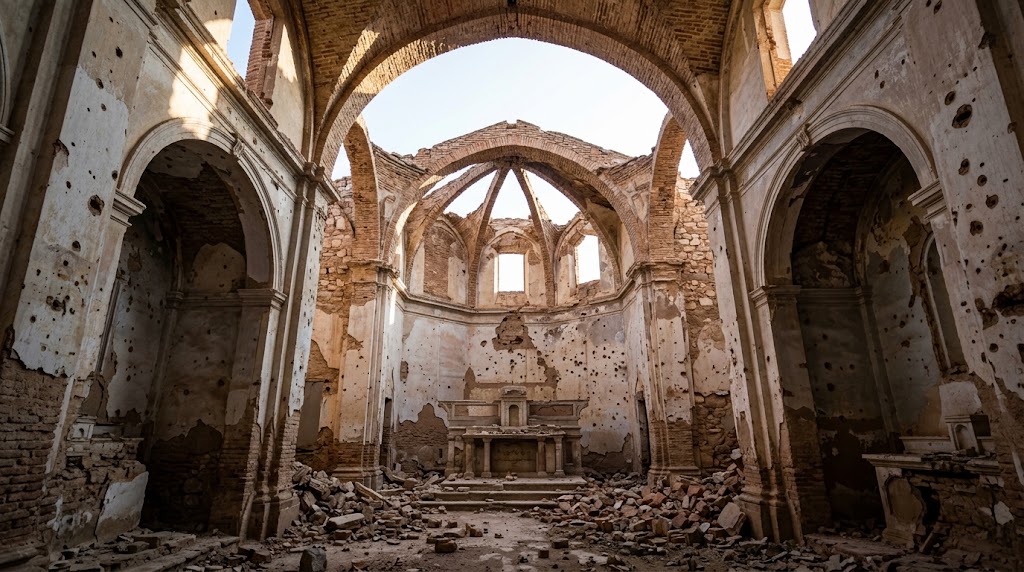 Inside the ruined Church of San Martín de Tours: collapsed Mudéjar brick vaulting open to the open sky.
Architectural Ghosts: The Wounded Sanctuaries
Exploring the crumbling grid of Pueblo Viejo reveals the skeletal remains of monumental Aragonese architecture:
- Church of San Martín de Tours (15th Century): The spiritual core of the city, this magnificent church combined Gothic vaulting with Aragonese Mudéjar brickwork. Its soaring multi-tiered bell tower took direct artillery hits, gouging massive jagged voids through its masonry without toppling. Inside, the nave is completely roofless; an unexploded artillery shell remained embedded in the facade for decades before modern demining teams neutralized it.
- Convent of San Agustín (18th Century): Served as the final stronghold for Nationalist fighters. The baroque clock tower still stands peppered with bullet sprays, its bells silent since the morning artillery batteries opened fire.
- The Calle Mayor: The primary commercial avenue, once lined with bakeries, pharmacies, and family residences, now resembles an archaeological trench. Wrought-iron balcony railings hang twisted like rusted ribbons over piles of sun-baked rubble.
Acoustic Anomalies and the Cinematic Veil
Decades of silence have transformed Belchite into an international magnet for parapsychological investigators and filmmakers:
- The 1986 EVP Recordings: In 1986, celebrated Spanish journalist and radio researcher Germán de Argumosa conducted electronic voice phenomenon (EVP) sound recordings inside the ruined cathedral at midnight. The resulting tapes captured chilling, unexplained audio frequencies resembling the high-pitched drone of German Stuka dive-bombers, artillery concussions, and screams of wounded soldiers echoing through empty air.
- Cinematic Masterpieces: The raw, dystopian texture of Belchite has served as an iconic set for international directors. Terry Gilliam filmed surreal battle sequences for The Adventures of Baron Munchausen (1988) amidst its collapsed arches, while Guillermo del Toro drew direct visual inspiration from its war-torn facades for his dark fantasy masterpiece Pan’s Labyrinth (2006).
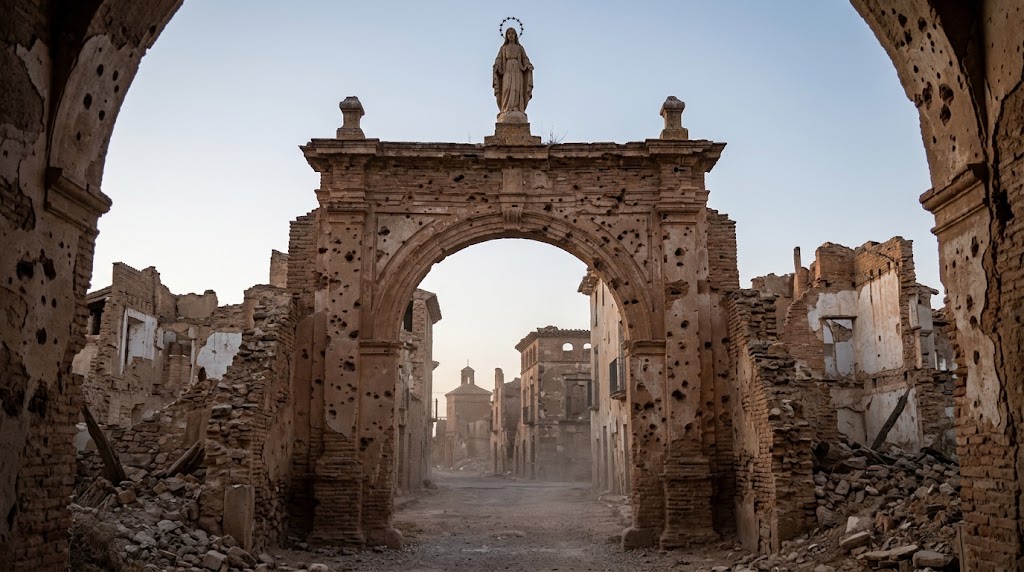 The Arco de la Villa: the historic baroque town gateway, peppered with rifle and machine gun fire.
Expedition Field Guide: How to Journey to Belchite
Following decades of unregulated urban exploration, the municipal government of Belchite enclosed the perimeter to protect travelers from falling masonry and preserve the fragile ruins.
Transit & Directions
- Base City: The historic Aragonese capital of Zaragoza sits 48 kilometers northwest of Belchite. Zaragoza is connected to Madrid and Barcelona via high-speed AVE trains (under 1.5 hours from either city).
- By Bus from Zaragoza: Automóviles Zaragoza operates daily regional coaches from Zaragoza’s Central Bus Station (Delicias) directly to the Belchite bus stop (approx. 45 to 55 minutes).
- By Car: Drive south from Zaragoza along the scenic A-222 highway cutting through the stark, rolling plains of the Campo de Belchite region. Dedicated visitor parking sits right at the entrance of Belchite Nuevo.
Essential Visitor Protocols & Tour Operations
- Guided Access Mandatory: To prevent vandalism and accidents caused by unstable walls, Pueblo Viejo is enclosed by security fencing and accessible exclusively via authorized guided tours. Tickets can be booked online via the official Belchite municipal tourism portal (belchite.es) or at the visitor office in Belchite Nuevo.
- Day Tours vs. Night Tours:
- Historical Day Tours: Focus heavily on the tactical urban combat of 1937, architectural details, and the daily life of residents before the catastrophe.
- Night Ghost & Legend Tours: Conducted under lantern light, these tours explore Belchite’s acoustic phenomena, civil war folklore, and nighttime atmospheric ruin photography.
- Safety & Protective Gear: Walking paths are uneven and strewn with loose gravel and broken tiles. Sturdy closed-toe hiking shoes are required; avoid leaning against leaning brick walls or entering taped-off structural zones.
- Hydration & Sun Protection: The Aragonese desert climate is notoriously unforgiving. Summer temperatures regularly exceed 38°C with zero shade inside the roofless ruins. Carry at least two liters of water, sunscreen, and wide-brimmed hats.
The Verdict
Pueblo Viejo de Belchite is a haunting, unvarnished testament to the catastrophic toll of human division. Standing amidst the bullet-shattered arches of San Martín as the desert wind whistles through hollow bell towers, travelers confront an unforgettable warning from the past: that peace is fragile, and the scars of brother fighting brother can outlive the stones of the cities they destroy.