Where the towering, rust-orange sand dunes of the ancient Namib Desert plunge directly into the frigid, churning surf of the South Atlantic Ocean lies one of the most hostile and haunting coastlines on Earth: The Skeleton Coast.
Stretching over five hundred kilometers (three hundred miles) along northwestern Namibia—from the Swakop River north to the Kunene River on the Angolan border—this windswept wilderness earned terrifying monikers throughout human history:
- Portuguese navigators in the Age of Discovery christened it “As Portas do Inferno” (The Gates of Hell).
- Indigenous San Bushmen hunters who skirted its desolate inland fringes called it “The Land God Made in Anger.”
From the air, the shoreline appears like an open-air necropolis of steel and bone. Rusted cargo freighters sit upright in deep sand hundreds of meters inland from the tide. Bleached ribcages of southern right whales arc out of dunes like primeval cathedral arches, while desert-adapted hyenas and jackals patrol desolate beaches through dense blankets of freezing ocean fog.
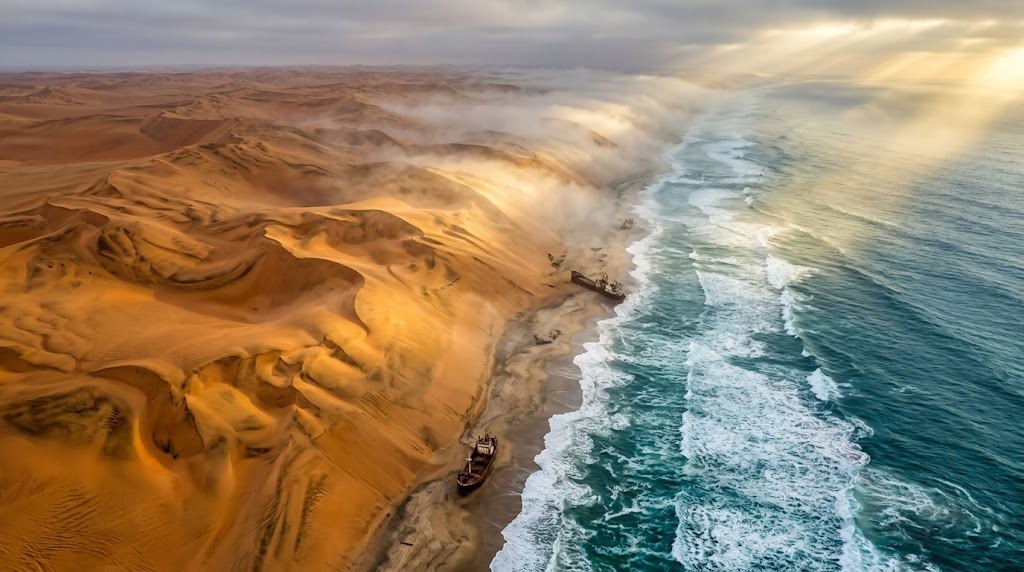 Where the desert meets the sea: the towering sand dunes of the Namib collapsing into the Atlantic surf along the Skeleton Coast.
The Maritime Trap: The Science of the “Gates of Hell”
For centuries, navigators regarded the coast of northern Namibia with unbridled dread. The region forms a lethal natural trap engineered by unique oceanographic and meteorological forces:
- The Benguela Current & Perpetual Fog: The powerful, icy Benguela Current sweeps northward from the Antarctic along the African coast. When this freezing seawater collides with the scorching thermal updrafts of the Namib Desert, it generates an impenetrable, blinding sea fog known locally as the cassimbo.
- Deceptive Longshore Drift: Violent southwest swells and ferocious cross-currents constantly push vessels toward the shallows. Navigators navigating by dead reckoning were regularly dragged miles off course without realizing they had drifted toward the breakers.
- The Shoreline Prison: If a vessel struck the sandbars and disintegrated, surviving sailors who swam through the punishing surf faced a fate far worse than drowning. They stepped onto a coastline with zero surface freshwater, zero edible vegetation, and hundreds of miles of impassable sand dunes separating them from human civilization. Thousands perished of dehydration within days.
The Ghost Ship in the Dunes: The Eduard Bohlen
Among the estimated one thousand vessels that met their end along this coast, one wreck has become an international dark tourism icon: the SS Eduard Bohlen.
Constructed in Hamburg in 1891, the Eduard Bohlen was a 2,272-ton German cargo-passenger liner measuring 310 feet in length, serving regional shipping lines between Europe and German South West Africa:
- The Stranding (September 5, 1909): While navigating through dense morning fog near Conception Bay, the liner ran hard aground on a submerged sandbar. Although crew members and passengers were safely evacuated to shore and rescued by a passing freighter, salvage tugs were unable to pull the massive iron hull back into deep water.
- Swallowed by the Desert: Over the ensuing century, the dynamic wind patterns of the Namib Desert deposited millions of tons of sand along the shoreline. The coastline steadily advanced westward, receding from the wreck.
- The Mirage of Steel: Today, the skeletal, rusted superstructure of the Eduard Bohlen rests stranded nearly 500 meters (a third of a mile) inland. Surrounded by rolling sand dunes rather than water, the ship sits upright like a phantom vessel sailing across an ocean of dry sand—its boilers, winches, and rusted hull slowly being swallowed by encroaching desert drifts.
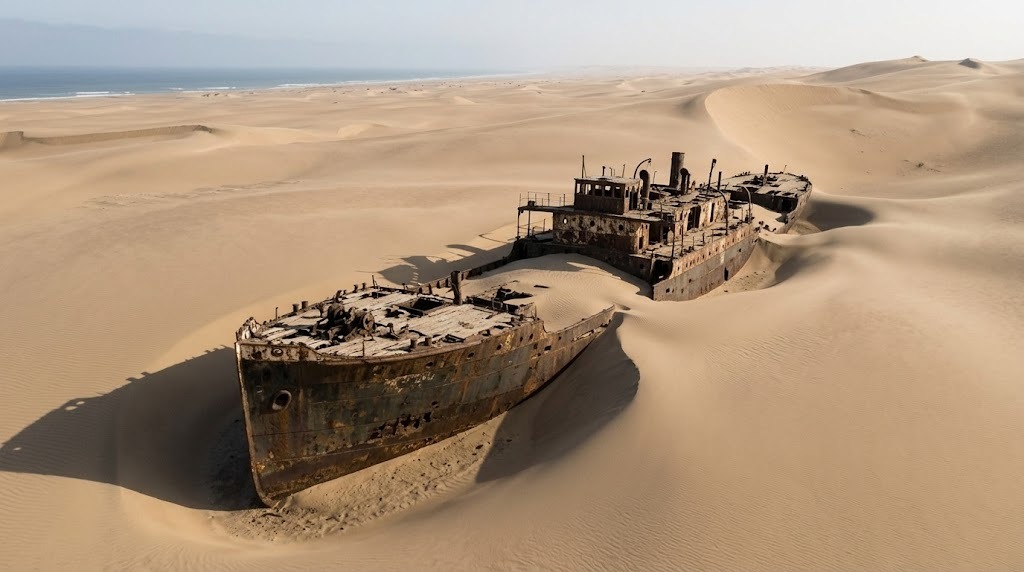 The SS Eduard Bohlen: a 310-foot ocean liner stranded deep within the Namib sand dunes, half a kilometer from the sea.
The Wrecks of Modern Memory: From the Dunedin Star to the Zeila
The Skeleton Coast’s appetite for iron did not end with the steamship era:
- The MV Dunedin Star (1942): A 12,000-ton British motor merchant carrying war munitions and sixty-three passengers from Liverpool to Egypt. After striking an underwater reef, the captain ran the vessel aground to save the passengers. The subsequent rescue operation turned into an epic survival saga involving stranded tugboats, a crashed Lockheed Ventura rescue bomber, and a overland desert convoy taking weeks to pull the survivors out of the wilderness.
- The Zeila (2008): Located just south of Henties Bay, this fishing trawler broke its towline on August 25, 2008, while being hauled to a scrap yard in Mumbai. Within hours, the heavy surf deposited the trawler sixty meters off the beach, where it now sits intact, serving as a roosting perch for thousands of Cape cormorants.
The Bone Coast: Whaling Relics and Seal Sanctuaries
The region did not earn the name “Skeleton Coast” solely from ships; its origin is biological:
- The Whaling Graveyard: In the 18th and 19th centuries, American, British, and Norwegian whalers slaughtered thousands of humpback and southern right whales along these waters. Once blubber was stripped, massive carcasses drifted ashore. For miles, the beaches were choked with enormous rib bones, jawbones, and vertebrae bleached ivory-white by the sun. Early desert pastoralists used these whale ribs as structural rafters to erect coastal shelters.
- The Colony of Cape Cross: Just south of the national park boundary lies Cape Cross, where Portuguese explorer Diogo Cão erected a stone cross (padrão) in 1486. Today, it hosts one of the largest breeding colonies of Cape fur seals in the world—over 200,000 seals congregating on the rocky promontory, filling the cold air with guttural roars and the pungent, raw odor of marine wilderness.
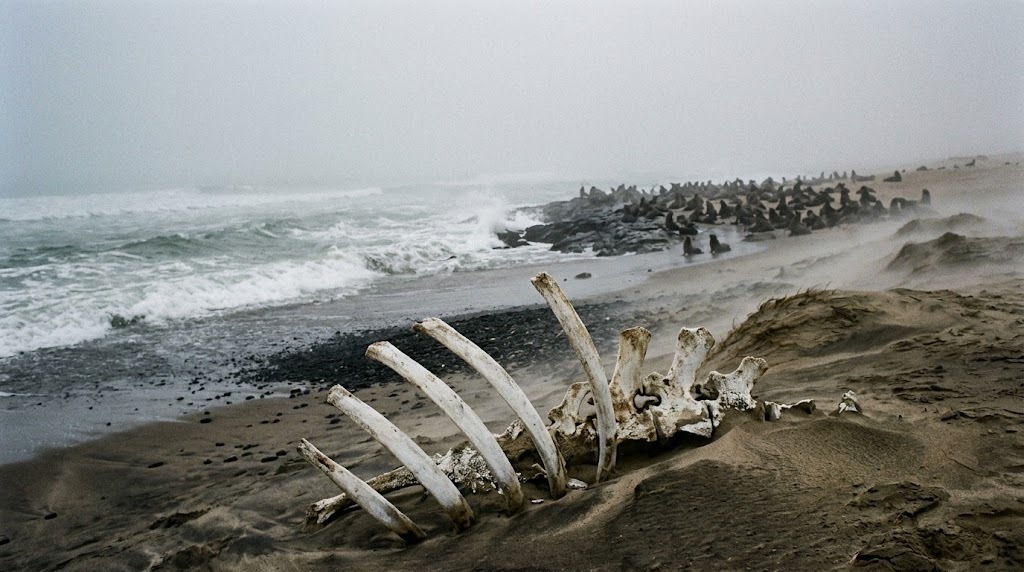 A bleached whale rib protruding from the desert sand, an ancient symbol of the coast that gives the region its name.
The Ghostly Diamond Camps and Mineral Ghosts
Venturing slightly inland from the sand dunes reveals scattered industrial ghost camps from early 20th-century prospecting rushes:
- Abandoned Oil Rigs: In the late 1960s, commercial oil companies erected towering steel drilling rigs near Toscanini. Abandoned after dry holes were struck, these steel towers have rusted into skeletal needles, colonized by nesting desert birds.
- Diamond Outposts: Rusted iron wheelbarrows, decayed corrugated shacks, and sun-shattered glass bottles litter former diamond claims where prospectors sifted gravels before water shortages forced total retreat.
Expedition Field Guide: How to Journey into the Skeleton Coast
Exploring the Skeleton Coast is a serious overland undertaking requiring specialized vehicles, survival preparation, and official permits.
Park Geography & Entry Gates
The area is divided into two distinct administrative zones:
- The Southern Section (Accessible to Self-Drivers): Extends from the Ugab River Gate north to Torra Bay. Open to standard four-wheel-drive tourism with paid permits obtainable at the gate.
- The Northern Wilderness (Strictly Restricted): Extends from the Hoanib River north to the Kunene River. Accessible exclusively via authorized fly-in safari operators or licensed guided expedition convoys. Public self-driving is illegal to protect fragile gravel plains and desert lion habitats.
Overland Driving Logistics
- Base Hub: The coastal resort towns of Swakopmund and Walvis Bay serve as the primary staging points for expeditions, located roughly 200 kilometers south of the park gate via the scenic salt-paved C34 highway.
- Vehicle Requirements: A high-clearance 4x4 vehicle with low-range capability is mandatory. Standard two-wheel-drive sedans are prohibited beyond entry gates.
- Tire Management: Lower tire pressure to 1.2–1.5 bar (17–22 psi) when traversing deep sand tracks to avoid bogging down. Carry two spare tires, a high-lift jack, recovery sand tracks, and a 12V air compressor.
- Autonomous Survival Prep: There are no fuel stations, mechanical workshops, or freshwater stores between Henties Bay and Terrace Bay. Carry at least twenty liters of drinking water per person, reserve diesel/petrol jerrycans, and a satellite phone (cellular reception disappears minutes after crossing the Ugab gate).
The Verdict
The Skeleton Coast is nature in its purest, most uncompromising majesty. Walking between the rusted iron ribs of stranded steamships and the bleached bones of ancient sea giants, travelers confront the sheer indifference of time and the elements—a stark, unforgettable reminder of human fragility on the wild edge of the world.