Just three hundred yards off the industrial shoreline of the South Bronx, surrounded by the swirling, treacherous tidal currents of the East River’s Hell Gate channel, lies New York City’s most forbidden geographical paradox: North Brother Island.
While the glass and steel spires of Manhattan gleam on the southern horizon, this uninhabited twenty-acre island looks like a forgotten Mayan temple reclaimed by nature. Colossal ivy vines, kudzu, and thick groves of weeping willows tear through the collapsed roofs of Victorian hospitals, red-brick tuberculosis pavilions, Romanesque boiler houses, and rusted morgue vaults.
Closed to the public and patrolled by harbor police, North Brother Island was once the municipal fortress of human isolation. For nearly a century, it was the place where New York cast out those it feared most: thousands of citizens stricken with virulent plagues, the site of the city’s deadliest maritime catastrophe before September 11, and the involuntary lifelong prison of America’s most infamous medical enigma: Typhoid Mary.
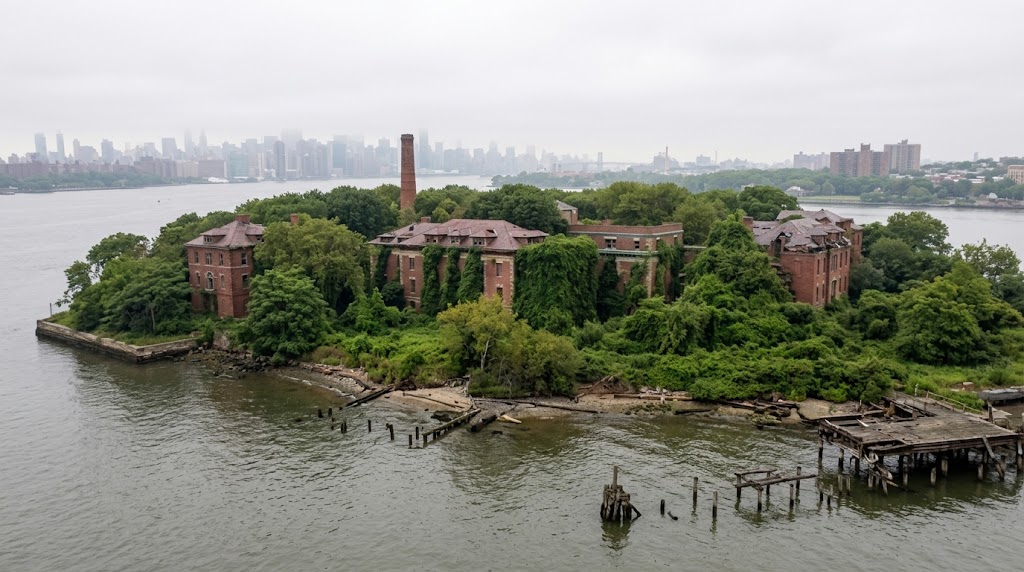 The skeletal remains of Riverside Hospital on North Brother Island, swallowed by dense temperate jungle in the East River.
Riverside Hospital: The City’s Island of Contagion
Prior to 1885, North Brother Island was largely uninhabited. But as millions of European immigrants flooded through New York Harbor, tenement districts across the Lower East Side became incubators for lethal biological outbreaks: typhus, scarlet fever, yellow fever, cholera, and smallpox.
To protect the broader population, the New York City Health Department acquired the island and opened Riverside Hospital:
- The Isolation Protocol: Anyone diagnosed with a quarantinable communicable disease was forcibly removed from their families. Municipal health officers, accompanied by armed police, transported feverish patients aboard river barges to North Brother Island.
- The Architecture of Quarantine: The island expanded into a dense city of treatment. Pavilions were organized by pathogen: smallpox patients on one side, leprosy wards sequestered in wooden huts, and sprawling four-story brick sanatoriums for advanced pulmonary tuberculosis.
- The High Mortality: For thousands of children and working-class immigrants who boarded the ferry barges at East 138th Street, the trip was one-way. Those who succumbed were wheeled into the island’s stone mortuary and transferred across the water to Hart Island for mass burial in potter’s fields.
The Prisoner of Bacteriology: Mary Mallon (Typhoid Mary)
North Brother Island’s most legendary resident was Mary Mallon, an Irish immigrant cook who became the first healthy carrier of Salmonella typhi ever identified in North America:
- The Asymptomatic Vector: Mallon worked as a private domestic cook for affluent families across New York. Everywhere she worked, typhoid outbreaks struck, killing several employers and infecting dozens. Yet Mallon felt completely healthy, displaying zero clinical symptoms of the disease.
- The First Arrest (1907): Tracked down by sanitary engineer George Soper, Mallon was seized by health authorities and exiled to North Brother Island. She was confined to a small, two-room wooden cottage constructed beside the medical superintendent’s residence.
- The Broken Covenant: After three years of isolation and a bitter supreme court appeal, health authorities released her in 1910 under the strict legal condition that she never work as a cook again. Struggling to earn a living as a laundress, Mallon adopted the alias “Mary Brown” and returned to cooking, eventually taking a position in the kitchen of Sloane Maternity Hospital in Manhattan, where she infected twenty-five doctors and nurses, killing two.
- The Lifelong Exile: In 1915, police arrested Mallon a second time. She was banished back to North Brother Island for the remainder of her life. For twenty-three consecutive years, Mallon lived inside her cottage, working in the island’s laboratory washing test tubes until she died alone in 1938 at the age of sixty-nine.
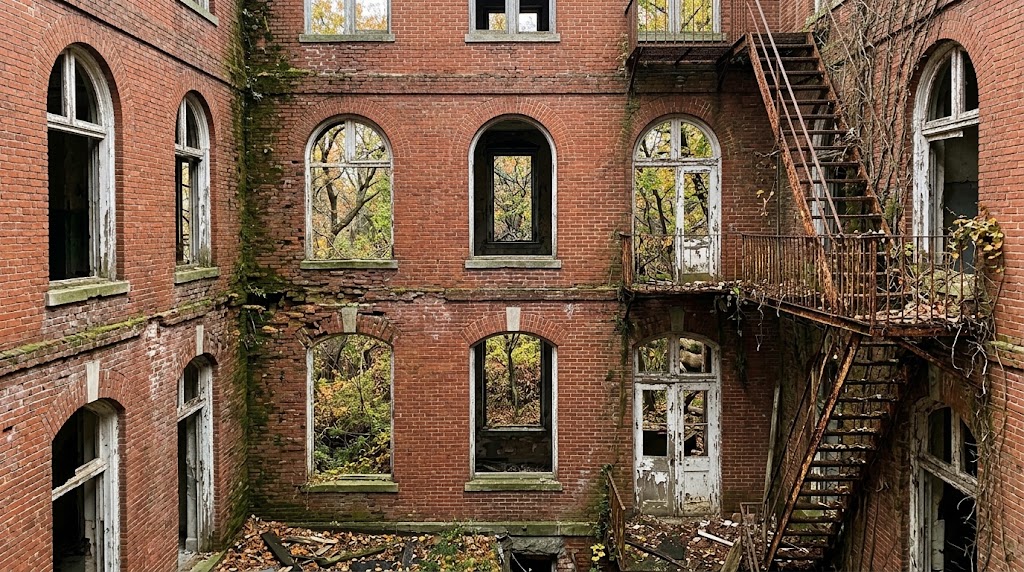 The historic Tuberculosis Pavilion (Staff House), its arched windows engulfed by mature forest canopy.
The General Slocum Disaster: Hell Gate’s Morning of Horror
The island’s dark heritage is marked not only by disease, but by one of the worst maritime tragedies in maritime history: the burning of the PS General Slocum.
On the morning of June 15, 1904, the wooden paddle steamer General Slocum departed Manhattan carrying over 1,300 passengers—predominantly German-American women and children attending the annual picnic of St. Mark’s Evangelical Lutheran Church:
- The Blaze: As the steamship navigated Hell Gate, a fire erupted in a forward storage locker crammed with hay and lamp oil. Fanned by fierce headwinds, the wooden ship became a roaring inferno within minutes.
- Rotten Safety Equipment: Crew members panicked. Fire hoses burst under water pressure, lifeboats were wired to the deck and immovable, and life jackets made of cheap cork rotted to powder, dragging children down into the cold river currents.
- Beachhead of Corpses: Captain William Van Schaick ran the burning vessel aground on the rocky southern shore of North Brother Island to prevent it from sinking in deep water. Nurses, doctors, and recovering patients from Riverside Hospital rushed into the river, desperately hauling burned survivors and corpses from the flaming wreck.
- The Toll: Over 1,021 souls died that morning. For days, the beaches of North Brother Island were covered in rows of white canvas sheets covering the bodies of mothers and children awaiting recovery by city coroners.
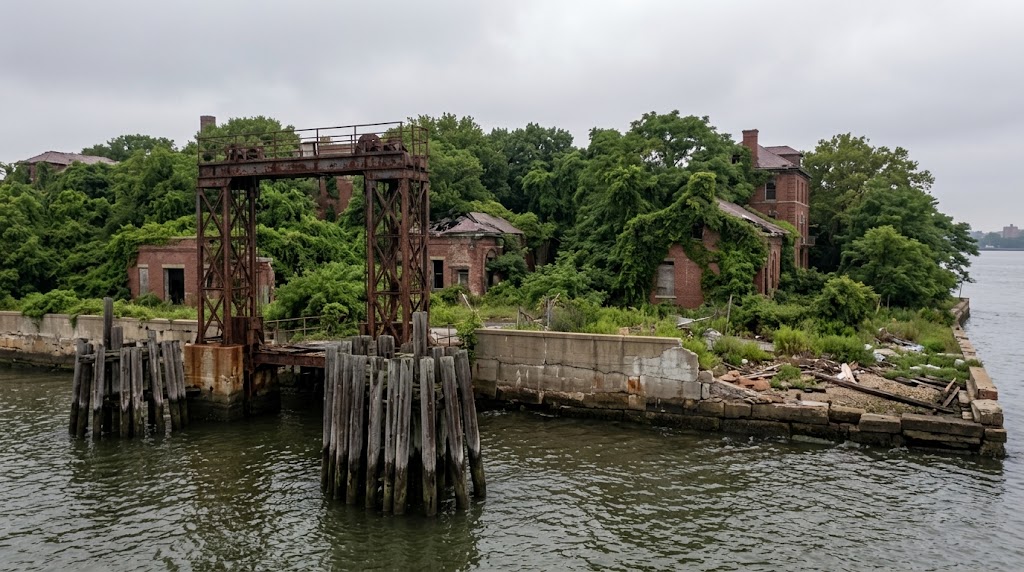 The rusted ferry dock gantry where quarantine transport barges once offloaded infected patients.
The Twilight, Rehabilitation, and Abandonment
Following World War II, Riverside Hospital’s mission shifted. The discovery of modern antibiotics rendered mass quarantine wards obsolete:
- The G.I. Student Housing (1946–1951): The island briefly housed returning veterans and their families enrolled at local universities under the G.I. Bill.
- The Adolescent Drug Clinic (1952–1963): The complex was repurposed as a pioneering treatment center for teenage heroin addicts. However, the facility was plagued by widespread staff corruption, high patient recidivism, and fiscal mismanagement.
- The Great Evacuation (1963): In 1963, the city abruptly closed the facility. The staff walked out, power and water mains running from the Bronx mainland were severed, and North Brother Island was abandoned to the elements.
Over the ensuing six decades, native vegetation staged an aggressive reconquest. Black walnut, locust, and ailanthus trees rooted into fourth-floor hospital wards. Floors gave way beneath moss blankets, and rare colonial wading birds—most notably the Black-crowned Night Heron—established one of the largest nesting rookeries in the eastern United States within the asylum ruins.
Expedition Field Guide: How to Witness North Brother Island
Landing on North Brother Island without explicit administrative clearance is strictly illegal and enforced under federal and municipal law.
Legal Status & Access Regulations
- Protected Bird Sanctuary: Managed by the New York City Department of Parks and Recreation, North Brother Island is designated an environmentally sensitive bird sanctuary.
- Zero Public Landing: Stepping foot on the island without a scientific research permit is considered trespassing. The NYPD Harbor Unit monitors the island’s perimeter via thermal radar and automated motion-activated shoreline cameras; trespassers face arrest, boat confiscation, and heavy federal fines.
- Permitted Academic Expeditions: Limited municipal permits are occasionally granted to accredited academic institutions, botanical surveyors, and historical preservation photographers outside the heron nesting season (October through March only).
How Travelers Can Experience the Island Legally
- Historic Boat & Harbor Cruises: The most immersive and legal way to view the ruins is from the water. Organizations such as the Center for Urban Pedagogy, Classic Harbor Line, and the Working Harbor Committee periodically organize narrated architectural cruises navigating the East River, bringing passengers within dozens of yards of the rusted ferry dock, the coal gantry, and the hollow hospital facades.
- Kayaking Hell Gate: Experienced sea kayakers launch from Long Island City or the Manhattan Canoe Club to circumnavigate North and South Brother Islands. Caution: Hell Gate currents are among the most dangerous tidal waterways on the Atlantic seaboard; paddle only with certified local marine guides during slack water tide windows.
- Shoreline Binocular Vantage Points: You can view North Brother Island with telephoto lenses or binoculars from Barretto Point Park in the Hunts Point neighborhood of the Bronx, or along the coastal greenways of Astoria Park in Queens.
The Verdict
North Brother Island is a breathtaking monument to human vulnerability and nature’s unstoppable resilience. Standing visible yet untouchable in the heart of New York City, its crumbling stone towers remind travelers of the fragile boundary separating civic order from epidemic chaos—a silent, overgrown green tomb where thousands of forgotten souls fought for survival against the currents of history.