Beneath the glassy, turquoise waters of a secluded tropical atoll in the central Pacific Ocean, 1,800 kilometers northeast of New Guinea, lies the greatest underwater military graveyard on Earth: Chuuk Lagoon (historically known as Truk Lagoon).
From the surface, Chuuk appears as a tranquil South Seas paradise—fringed by coral barrier reefs, swaying coconut palms, and emerald volcanic peaks. But descend thirty feet beneath the waves, and sunlight gives way to a gargantuan shadowland of naval devastation.
Resting across the lagoon seabed are the skeletal, coral-encrusted hulks of more than sixty Imperial Japanese warships, armed merchant freighters, and tankers, surrounded by the fragmented wreckage of over 250 combat aircraft.
Far from sanitized museum artifacts, these wrecks are preserved war graves frozen in their violent final moments: light tanks still chained to listing decks, intact torpedoes stacked in cargo bays, crates of unopened beer bottles, gas masks half-buried in ocean silt, and engine rooms that entombed hundreds of young sailors during the fiery inferno of Operation Hailstone.
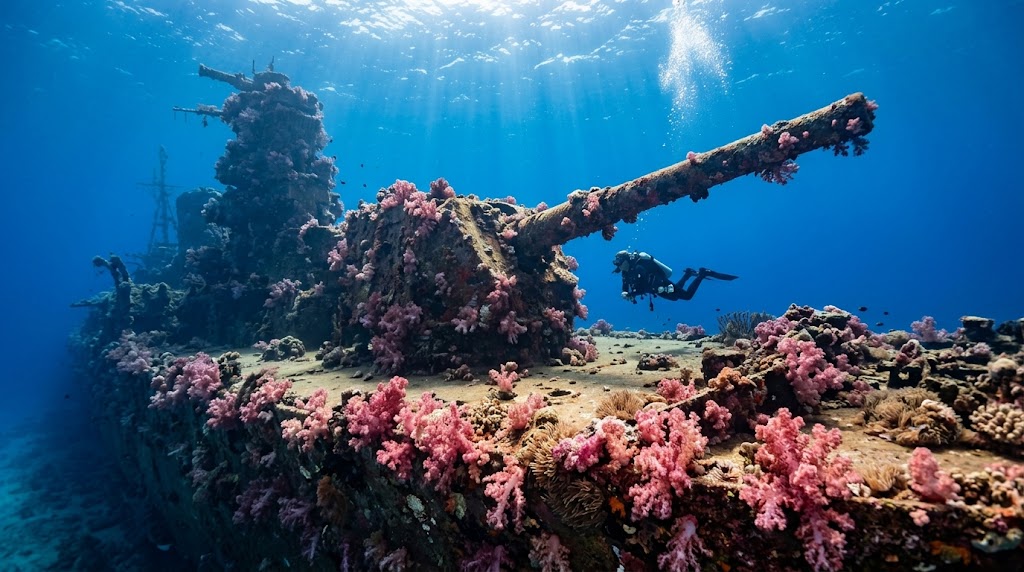 A diver glides past the massive bow deck gun of a sunken Japanese auxiliary cruiser in the clear blue depths of Chuuk Lagoon.
The Gibraltar of the Pacific: Japan’s Secret Bastion
During the interwar period following the Treaty of Versailles, the islands of Chuuk were administered by Japan under a League of Nations mandate.
Recognizing the atoll’s unmatched geography—a sheltered 64-kilometer-wide deepwater lagoon protected by a nearly continuous ring of coral barrier reefs with only five narrow, mineable passage channels—the Imperial Japanese Navy turned Truk into an impregnable naval bastion:
- The Heart of the Combined Fleet: Truk served as the primary forward staging base for Admiral Isoroku Yamamoto and the Combined Fleet during campaigns across the Solomon Islands and New Guinea. Battleships Yamato and Musashi anchored in its deep anchorages.
- The Island Fortifications: Coastal artillery batteries were bored into volcanic cliff faces, five airstrips were carved across inner islands, and seaplane bases, submarine drydocks, and massive radar installations turned the atoll into the most fortified fortress in the Pacific theater.
Operation Hailstone: The Two-Day Apocalypse (February 17–18, 1944)
By early 1944, American intelligence decrypted Japanese naval codes, revealing that Truk was vulnerable. Although Japan’s heavy capital ships had slipped away to Palau days earlier, dozens of transport ships, ammunition vessels, and escorts remained trapped inside the anchorage.
At dawn on February 17, 1944, Vice Admiral Marc A. Mitscher’s Task Force 58 unleashed Operation Hailstone:
- The Carrier Onslaught: Nine American aircraft carriers deployed over thirty strike waves. Waves of Grumman F6F Hellcats, SB2C Helldivers, and TBF Avengers swept low over the lagoon, raining 500-pound bombs and aerial torpedoes onto unsuspecting vessels.
- The Devastation: Over forty-eight continuous hours, American flyers dropped 369 tons of bombs and torpedoes. Japanese anti-aircraft fire threw up walls of flak, but transport ships were incinerated where they swung at anchor.
- The Toll: When the smoke cleared, over 200,000 gross tons of merchant shipping and combat vessels were sent to the bottom, along with three light cruisers, four destroyers, and 250 aircraft. Truk was permanently crippled as a military base, completely bypassed and starved for the remainder of the war.
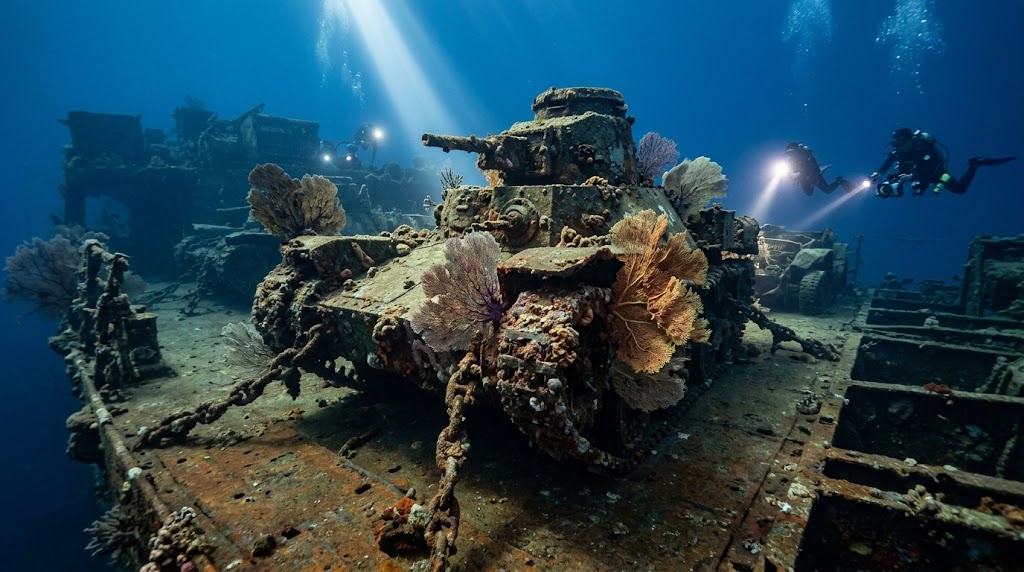 Type 95 Ha-Go light tanks still lashed to the cargo deck of the San Francisco Maru at a depth of 50 meters.
The Relics of the Deep: Legendary Wrecks
Chuuk Lagoon is a submerged time capsule where each wreck preserves a specific chapter of the Pacific conflict:
- The Fujikawa Maru: Perhaps the most famous wreck in the atoll, this 435-foot armed cargo ship rests upright in 34 meters of water. Inside Cargo Hold No. 2 sit the pristine fuselages and cockpits of four Mitsubishi A6M “Zero” fighters, their wing spars and radial engines clearly visible through turquoise water. Anemones and soft pink corals carpet its 6-inch bow gun.
- The San Francisco Maru (The Million-Dollar Wreck): Resting on a deep keel at 50 to 60 meters, this freighter is celebrated for the military hardware on its forward deck: three intact Type 95 Ha-Go light tanks remain lashed to the hull, their gun barrels pointed forward into the blue void. Its holds contain hemispherical naval mines, cordite charges, and stacks of artillery shells.
- The Shinkoku Maru: A massive 500-foot naval tanker, now transformed into one of the most prolific artificial coral reefs on the planet. Inside its superstructure lies an intact ship’s operating room, complete with an examination table, surgical bone instruments, and medicine vials encrusted with marine calcifications.
- The Hoki Maru: Carrying construction engineering material for airfields, this vessel sits with American-built Caterpillar steamrollers, dump trucks, and bulldozer chassis tumbled inside its fractured cargo holds.
War Grave Sanctuary and Repatriation
For decades following the war, Chuuk Lagoon remained a forgotten graveyard. In the 1960s and 1970s, pioneering oceanographer Jacques Cousteau filmed his historic television expedition Lagoon of Lost Ships (1969), bringing international attention to the underwater city of steel.
However, the human toll remains palpable:
- Skeletal Remains: An estimated 4,000 Japanese personnel and hundreds of indigenous Micronesian laborers lost their lives during Operation Hailstone. For decades, recreational divers frequently reported human skulls and leg bones resting near boiler rooms and machine shop benches.
- Official Repatriation: In recent decades, the Japanese Ministry of Health, Labour and Welfare, working in collaboration with the Chuukese government, deployed forensic recovery dive teams to repatriate hundreds of human remains for proper Shinto and Buddhist cremation rites in Japan.
- War Grave Law: Under Federated States of Micronesia law, Chuuk Lagoon is officially designated an underwater historical monument and sacred war grave. Removing a single shell casing, porcelain cup, or piece of shrapnel is a federal crime punishable by severe fines and imprisonment.
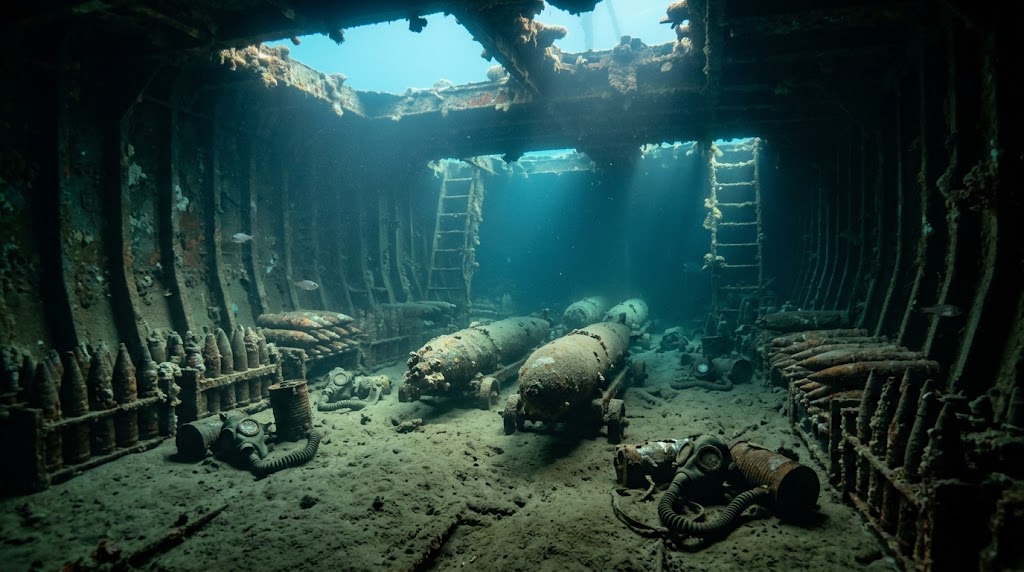 Stacked artillery shells, ammunition boxes, and corroded military hardware resting in the silent gloom of an interior cargo hold.
The Ecological Threat: The Ticking Oil Clock
While Chuuk Lagoon is an ecological wonder where lionfish, reef sharks, and sea turtles glide past coral-draped cannons, it faces an environmental crisis:
- Corroding Hull Steel: After more than eighty years submerged in saltwater, the steel plates of sixty sunken ships are thinning from electrochemical corrosion.
- Trapped Bunker Oil: Oceanographic surveys estimate that tens of thousands of tons of heavy bunker fuel, aviation gasoline, and lubricating oils remain trapped within deteriorating fuel bunkers. Unchecked structural collapses could unleash devastating oil slicks across pristine outer barrier reefs, threatening the indigenous fishing communities who depend on the lagoon for survival. International environmental organizations and naval salvage engineers are actively cataloging high-risk hulls for pump-extraction operations.
Expedition Field Guide: How to Journey to Chuuk Lagoon
Diving Chuuk Lagoon is widely considered the ultimate pilgrimage for advanced wreck divers and dark tourists.
Transit & Flight Routes
- The Island Hopper: The primary access route is via United Airlines’ legendary “Island Hopper” (Flight 154/155), operating between Guam (GUM) and Honolulu (HNL), touching down at Chuuk International Airport (TKK) on Weno Island several times weekly.
- Transit Visas: Travelers connecting through Guam require a valid US ESTA or American tourist visa before departure.
Dive Logistics & Protocols
- Diving Experience Required: While shallow wrecks (such as the Fujikawa Maru deck or Betty Bomber aircraft) are accessible to Advanced Open Water divers at 15–20 meters, the premier historical wrecks lie between 30 and 60 meters. Extensive deep-diving certifications, Wreck Diver certification, and Enriched Air (Nitrox) training are essential.
- Dive Resorts vs. Liveaboards:
- Land-Based Resorts: The historic Blue Lagoon Resort on Weno Island provides daily speedboats to wreck sites and houses an incredible on-site wartime museum.
- Liveaboard Vessels: Expedition vessels (such as the Pacific Explorer or Odyssey Liveaboard) allow divers to remain directly above outer lagoon wrecks, maximizing dive profiles with onboard technical gas blending (Trimix) and rebreather support.
- Strict No-Touch Preservation: Never touch unexploded ordnance (naval mines, torpedoes, and shells remain chemically volatile after eighty years in seawater). Avoid swimming inside silt-laden interior corridors without redundant gas supplies and continuous reel guidelines.
- Health & Tropical Medicine: Weno Island is a remote Pacific outpost with limited medical facilities and only one functional hyperbaric recompression chamber. Comprehensive dive accident evacuation insurance (such as DAN - Divers Alert Network) is strictly mandatory.
The Verdict
Chuuk Lagoon is a cathedral of rust, memory, and marine rebirth. Floating silently above the cockpit of a fighter plane or running a hand along the coral-cloaked steel of a sunken dreadnought, travelers witness the fleeting nature of human warfare: an empire’s mightiest armada swallowed whole by the ocean, transforming an arena of fire and slaughter into a breathtaking, eternal sanctuary of the deep.