Stepping beneath the heavy white marble archway inside the Church of St. Francis (Igreja de São Francisco) in the UNESCO-inscribed city of Évora, Portugal, travelers are immediately greeted by one of the most chilling inscriptions in European architectural history:
“Nós ossos que aqui estamos pelos vossos esperamos.”
(“We bones that are here, await yours.”)
Passing through this threshold leads directly into Capela dos Ossos (The Chapel of Bones)—a modest, three-bay hall measuring eighteen meters long by eleven meters wide. Yet within this compact space, the boundaries between architecture and human mortality dissolve entirely.
The walls, thick cruciform pillars, and vaulted archways are not lined with conventional plaster or gilded timber; they are completely paneled, cemented, and decorated with the articulated skeletal remains—femurs, ribs, vertebrae, and skulls—of an estimated 5,000 individuals.
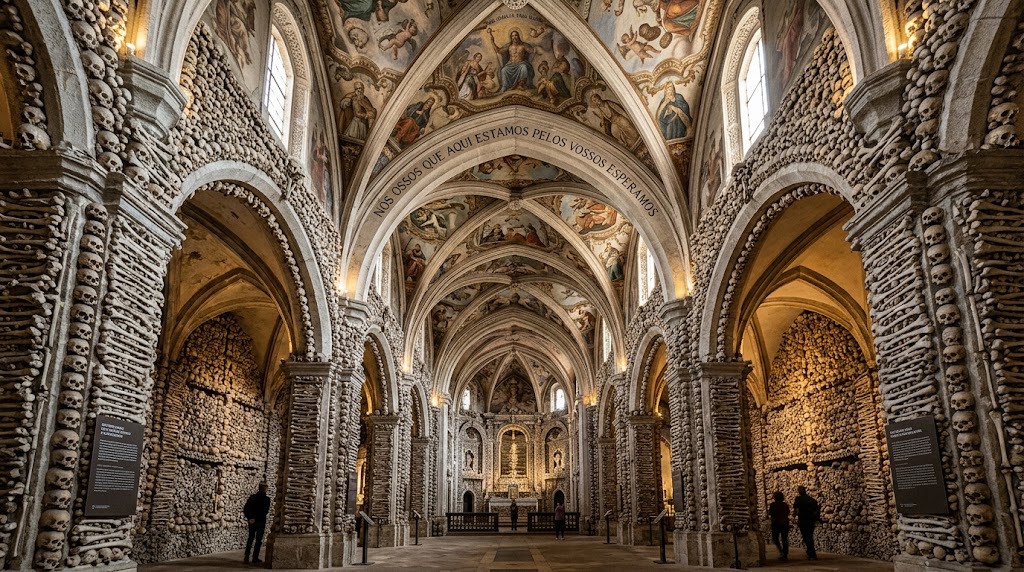 Inside Capela dos Ossos: structural stone pillars and walls faced entirely with five thousand human skulls and limb bones.
The Crisis of Évora: Forty-Two Overcrowded Graveyards
In the late 16th century, during the height of the Portuguese Renaissance, Évora was a flourishing royal enclave and trading hub. However, urban prosperity brought a severe mortuary crisis:
- The Land Squeeze: The municipality and surrounding monastic orders operated over forty-two separate churchyards and cemeteries. As the city expanded, these burial grounds occupied valuable arable and residential land.
- The Franciscan Solution: Rather than discarding the long-decayed skeletons of past citizens during the mass grave exhumations, three Franciscan friars conceived a profound theological design: gather the bones into a single consecrated ossuary.
- The Counter-Reformation Spirit: In the 1500s, Portuguese society was heavily preoccupied with material wealth amassed from maritime trade routes to the Indies and Americas. The Franciscans sought to construct a physical counterweight to mortal vanity—a visceral, unyielding physical reminder that worldly status, silks, and gold vanish the moment the heart ceases to beat.
The Architecture of Transience: Skulls as Masonry
The physical execution of the chapel combines somber mathematical precision with baroque ecclesiastical art:
- The Skeletal Scaffolding: Long limb bones (primarily humeri and femurs) were laid horizontally in alternating running-bond patterns, cemented together with dark lime mortar.
- Skulls as Accents: Hundreds of human craniums punctuate the brickwork, positioned in uniform geometric cornices, column capitals, and decorative rosettes. Over centuries, natural drafts and light have oxidized the bones into a warm, uniform sepia tone.
- The Painted Ceiling: Contrasting starkly with the skeletal walls, the vaulted white stucco ceiling is painted with delicate 18th-century allegorical murals depicting instruments of the Passion of Christ, crowns of thorns, and Biblical Latin verses illustrating eternal salvation.
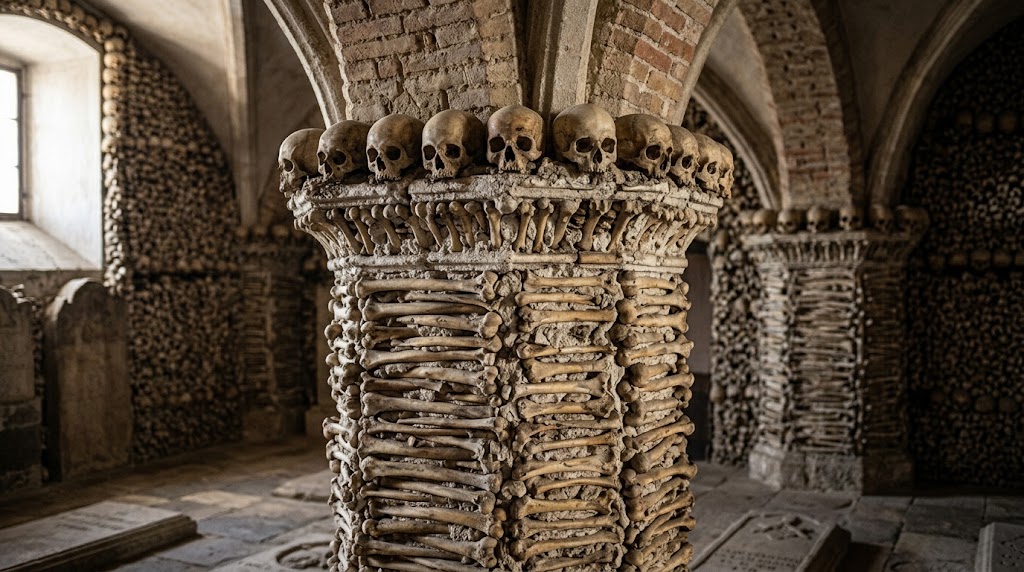 Intricate skeletal masonry: human skulls and femurs mortared into structural columns beneath vaulted painted arches.
The Desiccated Corpses and the Friar’s Sonnet
Until structural renovations in the early 21st century, the chapel featured an even more macabre spectacle: two desiccated, leathery mummified corpses—one an adult male and the other a small child—suspended from iron chains along the wall.
- The Local Folklore: Popular legend alleged that the adult was an abusive father and the child his son, cursed by a dying mother who declared: “May the earth refuse to receive your rotting flesh!”
- The Forensic Truth: Modern anthropological surveys revealed that the pair were simply naturally desiccated 17th-century bodies preserved by dry regional drafts, placed in the chapel to heighten contemplation of physical decay. Today, they rest respectfully inside protective glass vitrines adjacent to the altar.
On one of the central pillars hangs a wooden frame preserving an evocative 17th-century poem attributed to Father António da Ascenção Teles:
“Where are you going in such a hurry, traveler?
Stop… do not proceed further;
You have no greater concern than this one:
Direct your gaze upon these bones…
Reflect upon how many have passed this way,
Ponder that you, too, must become like this.”
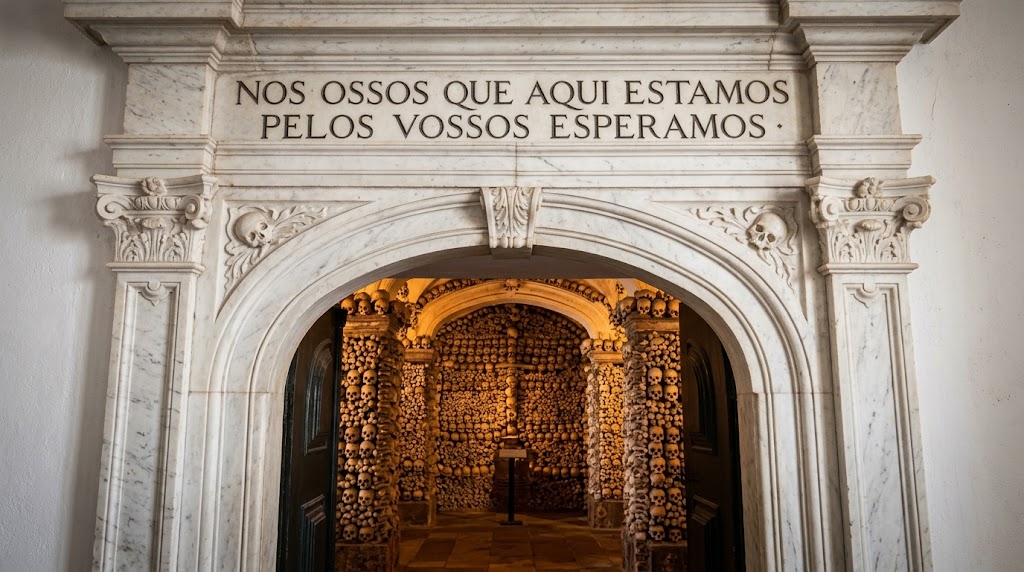 The carved stone entrance portal: “Nós ossos que aqui estamos pelos vossos esperamos.”
The Modern Sanctuary: Preservation and Atmosphere
Unlike abandoned catacombs subjected to damp decay, Capela dos Ossos is meticulously maintained as a living historical monument:
- The 2014 Stabilization: In 2014–2015, the Church of St. Francis underwent a comprehensive multi-million-euro conservation program. Specialist conservators used microscopic brushes and organic consolidants to remove surface soot, stabilize decaying bone marrow, and repair mortar without altering the original placements established five centuries ago.
- The Upper Museum: The chapel ticket also includes access to the expansive upper-floor museum of sacred art and the private collection of nativity scenes (Presépios) from across the globe, providing rich cultural context to Évora’s ecclesiastical heritage.
Expedition Field Guide: How to Journey to Évora
Évora is the crown jewel of Portugal’s sun-drenched Alentejo region, making it an ideal day or overnight trip from Lisbon.
Transit & Directions
- Location: Praça 1º de Maio, 7000-650 Évora, Portugal.
- By Train from Lisbon (Intercidades): Trains depart several times daily from Lisboa Oriente or Sete Rios stations directly to Évora (approx. 1 hour and 30 minutes). From Évora station, it is a pleasant 10-minute flat walk north to the Church of St. Francis.
- By Bus (Rede Expressos): Regular coaches run from Lisbon’s Sete Rios Bus Terminal to Évora Central Bus Station (approx. 1 hour and 45 minutes).
- By Car: Drive east from Lisbon across the Ponte 25 de Abril or Vasco da Gama Bridge onto the A6 highway, taking the exit for Évora (approx. 130 km / 1 hour 20 minutes).
Practical Visitor Protocols
- Operating Hours & Entry: Open daily from 9:00 AM to 6:30 PM (summer) or 9:00 AM to 5:00 PM (winter). Modest entry fees cover the Chapel of Bones, the St. Francis Museum, and the church terrace.
- Photography Etiquette: Non-flash handheld photography is permitted. Flash photography, selfie sticks, and tripods are strictly prohibited to prevent micro-vibrations and optical degradation of delicate bone surfaces.
- Respectful Decorum: This remains consecrated ground within an active parish. Maintain quiet, reverent voices, dress modestly (shoulders and knees covered), and avoid touching the skeletal masonry.
- Combine with Évora Roman Temple: After your visit, walk five minutes uphill through cobblestone alleys to the summit of the town to admire the Roman Temple of Évora (Temple of Diana), featuring fourteen intact Corinthian granite columns dating to the 1st century AD.
The Verdict
Capela dos Ossos is far from a macabre chamber of horrors; it is an intimate, serene monument of sublime philosophical clarity. Standing amidst the quiet gaze of five thousand ancestors, the noise of modern life falls away, leaving travelers with an enduring appreciation for the fragile, beautiful gift of the present moment.