Rising sheer from a jagged 200-foot limestone promontory guarding the mist-choked Rucăr-Bran mountain pass between Transylvania and Wallachia, stands the undisputed global monument of Gothic lore: Bran Castle (Castelul Bran).
Crowned by conical orange-tiled turrets, narrow timber arrow loops, and asymmetrical medieval stone bastions, Bran Castle perfectly embodies the psychological blueprint of a Transylvanian fortress. At dusk, when icy winds roll off the jagged limestone peaks of the Bucegi Mountains and thick mist coils through the dense spruce forests below, it requires little imagination to see why this formidable 14th-century stronghold became inextricably bound to the world’s most enduring creature of the night: Count Dracula.
Yet beneath the cinematic fog and commercial vampire mythology lies a much deeper, multifaceted history: a border sentinel erected by Saxon burghers, tactical sieges against the Ottoman Empire, the chilling historical shadow of Vlad the Impaler, a secret subterranean staircase concealed behind a hearth for centuries, and the preserved royal heart of a queen.
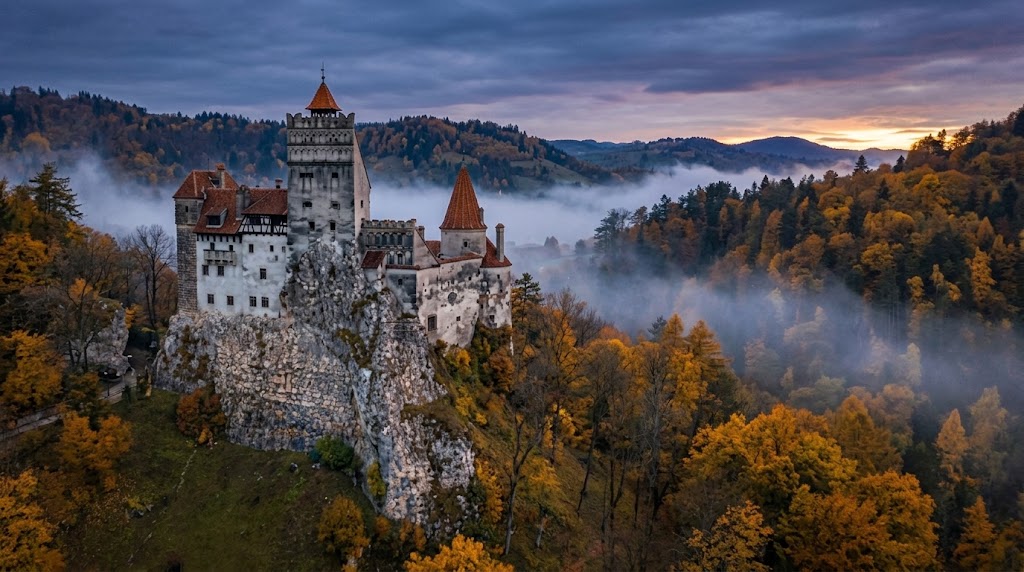 Bran Castle looming atop its 200-foot limestone precipice, guarding the historic mountain gorge of Transylvania.
The Saxon Citadel: Built Against Empires
Bran Castle’s origins were forged not in occult folklore, but in brutal frontier geopolitics:
- The Teutonic Knights (1211): The initial timber fortification was established by the Teutonic Order, Germanic crusading knights invited by King Andrew II of Hungary to secure the frontier against migrating pagan tribes.
- The Saxon Charter (1377): On November 19, 1377, King Louis I of Hungary granted the Saxon burghers of Kronstadt (modern-day Brașov) the royal privilege to construct a formidable stone citadel at their own expense. In exchange, the merchants received perpetual customs exemptions.
- The Customs Fortress: Completed in 1388, Bran was engineered as an unassailable border fortress and commercial toll gate. Sentry guards stationed in the octagonal Donjon tower commanded panoramic artillery sweeps over the valley floor, collecting a three-percent tax on all wool, wine, and weapons passing between Central Europe and the Ottoman Orient.
Separating Myth from Blood: Vlad the Impaler
The universal identification of Bran as “Dracula’s Castle” stems from Irish novelist Bram Stoker’s 1897 masterpiece Dracula. Stoker never set foot in Eastern Europe; he culled geographical sketches, folklore accounts, and an 1860s engraving of Bran Castle from British Library archives, adopting its dramatic cliffside silhouette as the fictitious lair of his vampiric count.
However, the real historical inspiration behind the myth—Prince Vlad III Dracula (widely remembered as Vlad the Impaler, or Vlad Țepeș)—carries a far darker historical reality:
- The Scourge of Wallachia: Ruler of the neighboring principality of Wallachia in the 15th century, Vlad earned his terrifying moniker through the calculated, industrialized use of impalement. He executed political rivals, corrupt boyars, and invading Ottoman soldiers by hoisting them atop greased wooden stakes inserted through the torso, leaving victims suspended in agonizing public exposure for days.
- The Bran Connection: While Vlad’s primary administrative capital was located at Târgoviște and his true mountain fortress was the now-ruined Poenari Castle in the Argeș valley, his fate crossed Bran repeatedly. In 1459, Vlad led retaliatory cavalry raids against the Brașov Saxon merchants, burning suburbs and slaughtering merchants who failed to pay tribute. Later, in the autumn of 1462, following his retreat from Ottoman forces, Hungarian King Matthias Corvinus captured Vlad and briefly imprisoned him within the stone chambers of Bran Castle before transferring him to Visegrád.
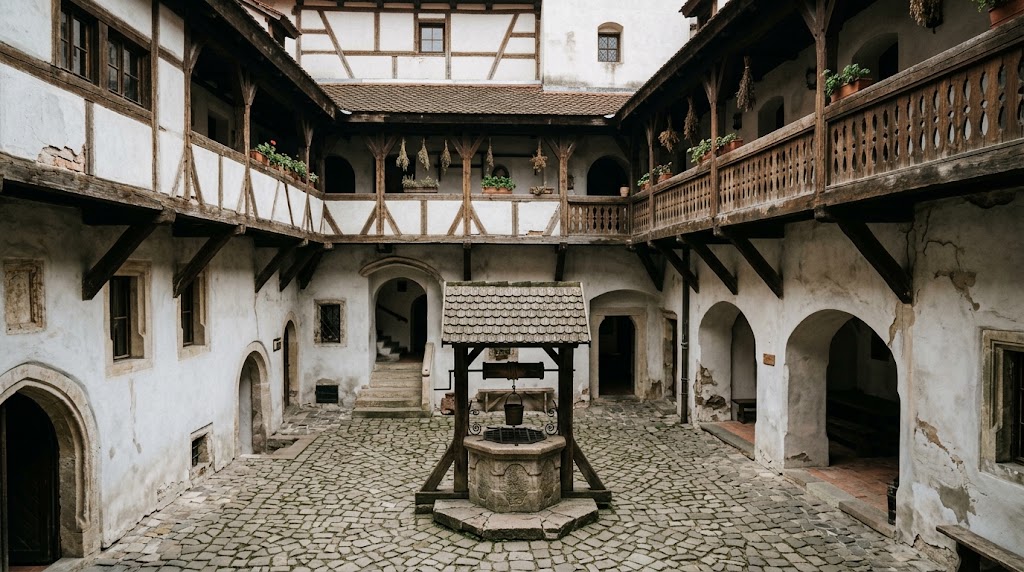 The interior courtyard: timber-framed balconies, stone arches, and the central cistern well that concealed an emergency escape shaft.
Architectural Anomalies: The Secret Staircase
Wandering through the labyrinthine interior of the castle reveals five centuries of defensive ingenuity:
- The Concealed Escape Hatch (1927): For hundreds of years, visitors and guards walked past a heavy brick fireplace connecting the first-floor grand room to the third-floor library, completely unaware of what lay within the stone masonry. During extensive restorations in 1927, architects tapped the chimney breast and discovered a completely hidden, narrow stone-vaulted stairway bored through solid rock. This secret passageway allowed the castle commander to slip between defensive floors undetected during sieges.
- The Central Well: Dominating the picturesque inner courtyard is an antique stone water cistern chiseled directly through seventy vertical feet of solid limestone bedrock. In wartime, a false wooden partition deep within the well shaft opened into an underground escape tunnel that emerged out of the southern cliff base into the river valley.
- The Medieval Torture Gallery: A specialized permanent exhibition housed within the castle cellars displays authentic medieval judicial instruments: the spiked iron Virgin of Nuremberg (Iron Maiden), the bone-stretching rack, Judas cradles, and pear-shaped iron chokes utilized by regional magistrates to extract confessions from accused heretics and bandits.
Queen Marie: The Royal Resurrection
Following the collapse of the Austro-Hungarian Empire and the Great Union of Romania in 1918, the citizens of Brașov made a historic gesture: on December 1, 1920, they unanimously gifted Bran Castle to Queen Marie of Romania (granddaughter of Britain’s Queen Victoria) in gratitude for her tireless humanitarian work during World War I.
Queen Marie fell deeply in love with the romantic, drafty ruin:
- The Transformation: Working with royal architect Karel Liman, she converted the fortress into a bright, tranquil summer residence, installing ceramic tiled heating stoves, antique Transylvanian oak furniture, open-air sun verandas, and cascading gardens of white English roses along the castle moat.
- The Queen’s Heart: Upon her death in 1938, in accordance with her handwritten will, Queen Marie’s heart was excised from her body, placed inside a jewel-encrusted silver casket, and interred in a stone chapel crypt across the valley from Bran Castle—a touching, immortal tribute to her devotion to the Romanian people.
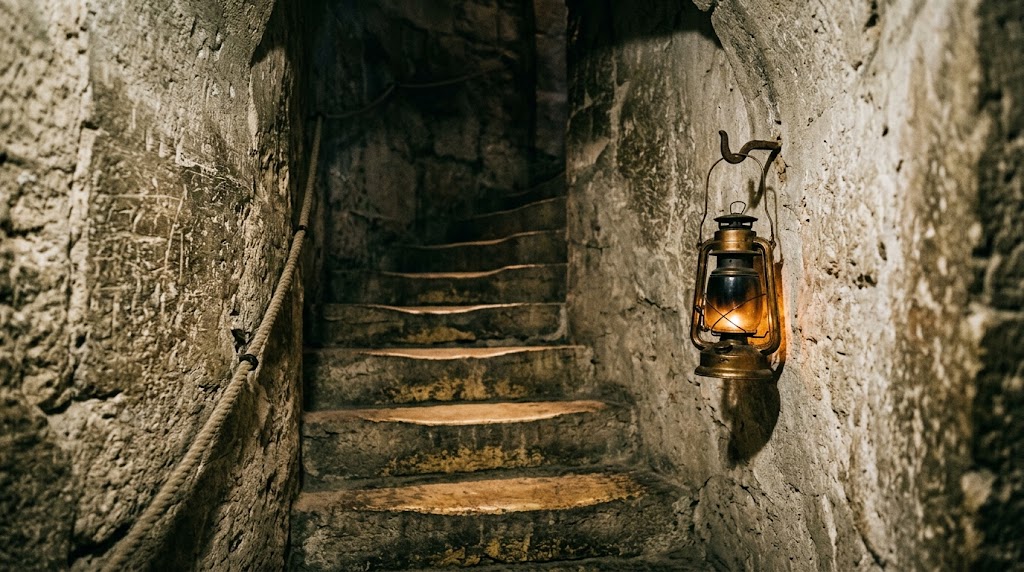 The secret stone stairway: a narrow corridor carved through solid limestone, once hidden behind a fireplace.
The Strigoi: The Folkloric Roots of Vampirism
While Count Dracula is a literary creation, the concept of the living dead was an authentic, deeply ingrained folk reality in the rural hamlets surrounding Bran:
- The Strigoi Belief: In traditional Romanian mythology, a strigoi is a troubled ancestral soul that refuses to enter the afterlife. Villagers believed that people born with a caul, those who died unnatural deaths, or those whose graves were desecrated could rise from their graves at midnight to siphon vital life essence from living livestock and sleeping kin.
- Mortuary Apotropaic Rites: Well into the late 19th and early 20th centuries, local villagers practiced defensive mortuary rituals: driving iron needles into the hearts or foreheads of deceased relatives, rubbing window sills with crushed garlic, and scattering poppy seeds over churchyards on the eve of Saint George’s Day and Saint Andrew’s Day to confuse returning spirits.
Expedition Field Guide: How to Journey to Bran Castle
Bran Castle is one of Romania’s premier cultural destinations, easily accessible from the historic Saxon city of Brașov.
Transit & Directions
- Base City: The historic medieval city of Brașov sits just 30 kilometers (18 miles) northeast of Bran. Frequent daily trains (CFR Călători) connect Bucharest’s Gara de Nord station to Brașov in roughly 2.5 hours.
- From Brașov to Bran: Public buses depart every thirty minutes on weekdays (every hour on weekends) from Autogara 2 (Bartolomeu Bus Terminal) in Brașov directly to the central village square of Bran (approx. 45-minute scenic ride).
- By Car: Drive along the scenic DN73 / E574 highway winding through the picturesque Râșnov mountain valley. Dedicated parking lots sit directly beneath the castle gardens.
Visitor Protocols & Best Exploration Tips
- Beat the Midday Crowds: As Romania’s most visited tourist site, mid-afternoon queues during peak summer and autumn can be overwhelming. Arrive right at opening (9:00 AM) or visit in the final two hours before gate closure to experience the empty, echoey stone rooms at their most atmospheric.
- Explore the Grounds Below: After touring the interior keep, walk down into the open-air Bran Village Museum (Muzeul Satului Brănean) at the base of the crag. Here, preserved 18th-century timber farmhouses, water-driven wool mills, and sheep barns demonstrate the authentic rustic lifestyle of the Carpathia mountaineers.
- Footwear & Temperature: The castle’s stone spiral staircases are narrow, steep, and polished smooth by millions of shoes; wear comfortable, non-slip footwear. Even on sweltering summer afternoons, the thick limestone masonry keeps interior halls cool and breezy.
- Halloween Festivities: Bran Castle hosts an internationally renowned annual Halloween Night Tour, granting late-night access to unlit corridors, atmospheric theatrical actors, and an open-air tent celebration in the royal park beneath the castle walls. Book tickets months in advance via the castle’s official portal.
The Verdict
Bran Castle is the ultimate intersection of myth, history, and Gothic imagination. Suspended high above the dark mountain forests of Transylvania, its weathered limestone walls remind travelers that the real history of human conflict, royal romance, and border warfare is often far more thrilling than the darkest fictions ever spun from its stones.