In the UNESCO-listed silver-mining city of Guanajuato, nestled deep within a steep arid ravine of central Mexico, lies one of the most unsettling anthropological exhibits on the planet: El Museo de las Momias de Guanajuato (The Guanajuato Mummy Museum).
Housed adjacent to the historic hilltop cemetery of Panteón Santa Paula, the museum displays over one hundred naturally preserved human mummies standing upright behind climate-controlled glass vitrines.
Unlike the regal pharaohs of Egypt or the embalmed Franciscan friars of Sicily, these individuals were never meant to be preserved. They were ordinary 19th- and early 20th-century miners, bakers, housewives, and infants. Their clothes remain partially intact—wool jackets, leather boots, and knitted baby dresses. Most hauntingly, their parchment-stretched faces are frozen in agape, grimacing expressions that resemble eternal screams of torment.
Yet the true horror of Guanajuato is not merely biological; it is administrative. These citizens were evicted from their resting places not by archaeological curiosity, but by an unbending municipal tax law.
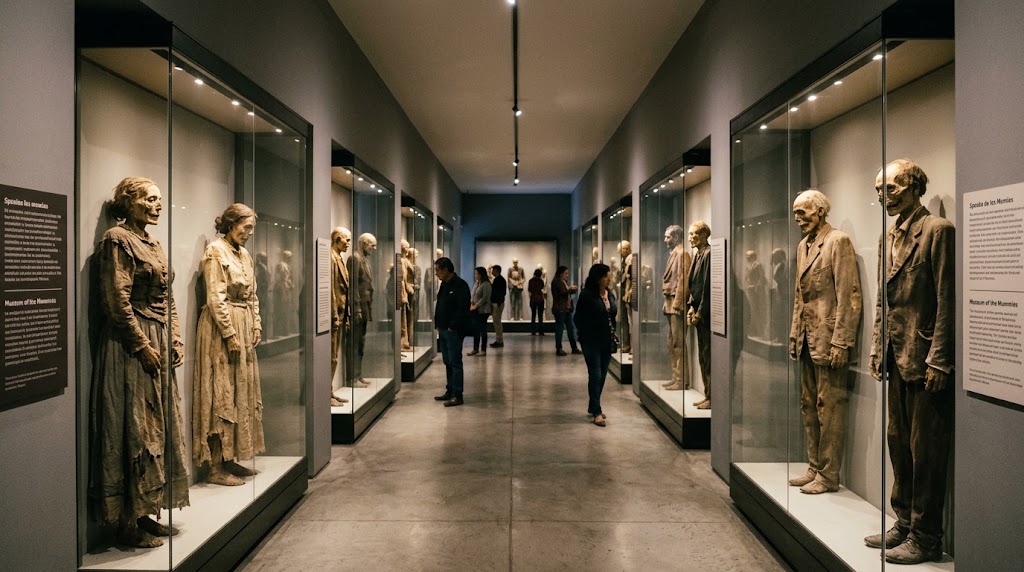 Inside El Museo de las Momias: naturally desiccated 19th-century mummies standing upright in glass displays.
The Eviction Notice: The 1865 Perpetual Grave Tax
The story of the mummies began in 1865, thirty-two years after a devastating cholera epidemic swept through central Mexico in 1833:
- The Overcrowded Crypts: The municipal cemetery of Santa Paula was overflowing. To create space for new burials and generate municipal revenue, city authorities passed a decree mandating a recurring perpetual grave tax on all cemetery plots and above-ground wall crypts (gavetas).
- The Three-Year Grace Period: Families were required to pay an annual fee. If the tax went unpaid for three consecutive years, the city issued an eviction warrant. Cemetery workers smashed through the plaster brick seals, exhumed the wooden caskets, and dumped the skeletal remains into a common ossuary pit.
- The First Discovery (June 9, 1865): When workers unsealed the tomb of Dr. Remigio Leroy—a 50-year-old French physician who died during a visit to Guanajuato with no local kin to pay his tax—they did not find bones. They found a perfectly preserved, petrified corpse, complete with skin, mustache, and 19th-century wool trousers.
As more delinquent tombs were opened, gravediggers uncovered dozens more naturally desiccated bodies. Rather than discarding them, the cemetery superintendent stored them in a subterranean vaulted cellar beneath the graveyard chapel.
The Natural Laboratory: Why Did They Mummify?
Unlike artificial Egyptian mummification, which involved evisceration, natron salts, and chemical balms, Guanajuato’s mummies are entirely natural phenomena:
- High Altitude & Zero Moisture: Situated at 2,050 meters (6,700 feet) above sea level in an arid mountainous plateau, Guanajuato experiences ultra-low relative humidity and dry alpine air currents.
- The Mineral Heat Chamber: Most bodies were interred in above-ground concrete-and-adobe wall niches (gavetas) rather than underground soil. The high desert sun baked these exterior stone vaults like ovens, rapidly evaporating bodily fluids before bacterial putrefaction could take hold.
- Mineralized Rock: The surrounding geological stratum is heavily saturated with sulfur, nitrates, and trace minerals from centuries of intensive silver mining, which seeped through the porous mortar and inhibited bacterial colonization.
The Screaming Faces and the Lore of Ignacia Aguilar
The most visceral aspect of the collection is the facial expressions: hollowed orbits, retracted lips exposing yellowed teeth, and jaws dropped open in what appears to be sheer terror.
While forensic pathologists confirm this is the natural result of tongue shrinkage and the post-mortem relaxation of the jaw muscles as tendons dry, one famous case remains shrouded in terrifying medical reality: Ignacia Aguilar.
- The Cholera Crisis: Aguilar suffered from a severe heart condition (or catalepsy) during a regional epidemic. In the 19th century, comas and cataleptic episodes were frequently misdiagnosed as biological death, and hygiene regulations demanded bodies be interred within hours to arrest contagion.
- The Horrific Exhumation: Decades later, when her family failed to pay the grave tax and her wooden coffin was chiseled open, gravediggers made a sickening discovery:
- Aguilar’s body was lying face-down inside the casket.
- Her hands were clawed over her face, with deep gouge marks scratched into the velvet casket lining and wooden lid.
- She had chewed her own arms and had fabric fibers clenched between her teeth.
Medical consensus strongly indicates she was buried alive in a state of suspended animation, awakening inside the pitch-black stone crypt to die of suffocating terror. Today, her preserved body stands as one of the museum’s most infamous centerpieces.
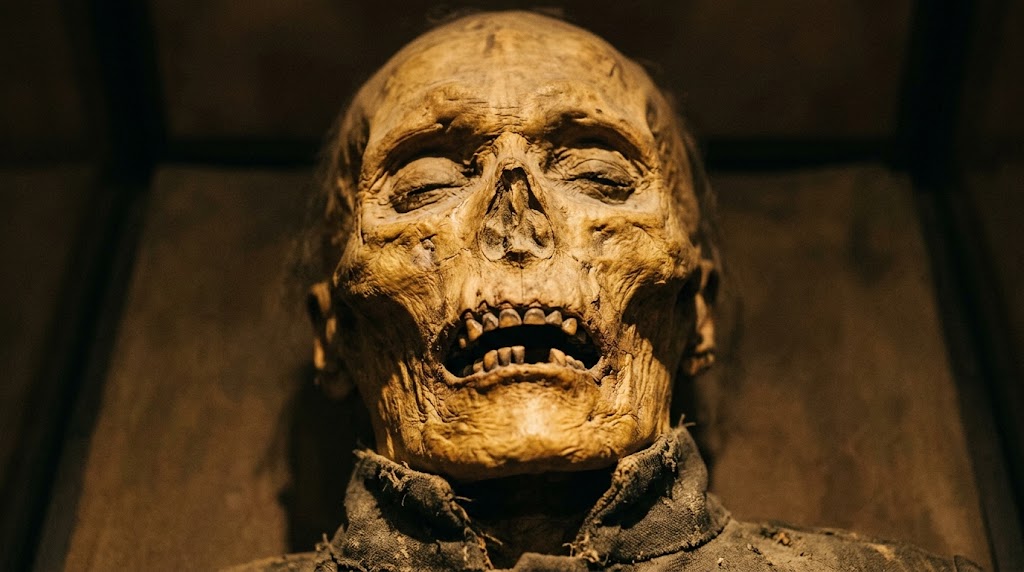 A close-up view showing the parchment-like desiccated skin and open jaw characteristic of Guanajuato’s natural mummies.
From Clandestine Spectacle to International Museum
By the late 19th and early 20th centuries, word of Guanajuato’s secret underground dead spread:
- The Candlelight Tours: Cemetery custodians began operating a clandestine side business. Travelers arriving on the newly constructed railway paid gravediggers a few centavos to be guided down into the unlit ossuary, holding tallow candles to illuminate dozens of naked mummies propped haphazardly against whitewashed walls.
- The Iconic Cinema of El Santo (1972): The site achieved cult pop-culture status with the release of the Mexican cinematic classic Santo vs. las Momias de Guanajuato (1972), in which the legendary masked luchador wrestler battled resurrected mummies across the city’s cobblestone streets.
- Modern Legal Protection: In 1958, the Mexican government outlawed the perpetual burial tax and banned the disinterment of any further bodies for exhibition. The existing collection of 111 mummies was stabilized inside modern museum galleries with dedicated lighting, UV-filtered glass, and professional curation.
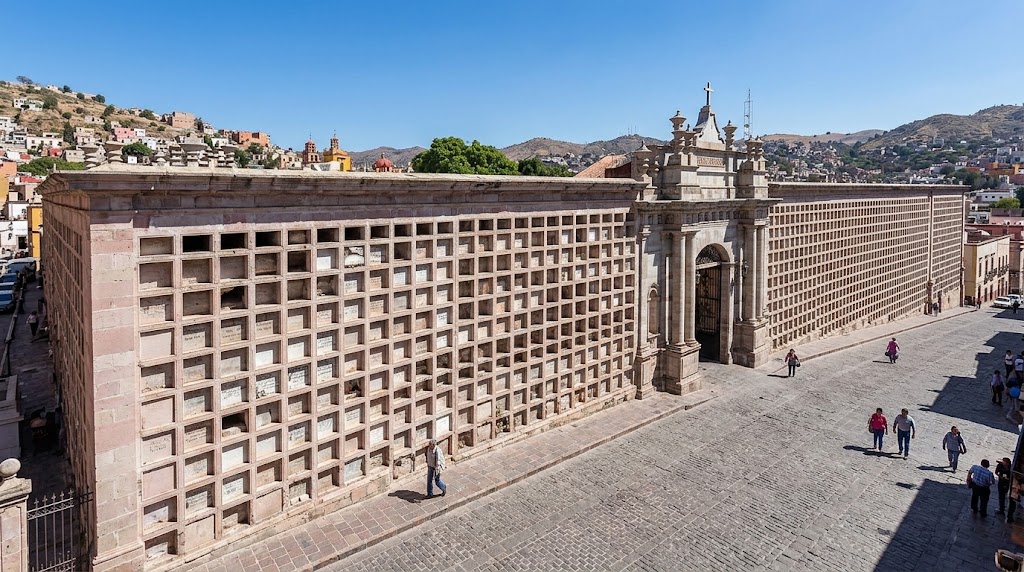 The historic Panteón Santa Paula cemetery: the neoclassical perimeter walls where the mummies were originally interred.
Expedition Field Guide: How to Visit Respectfully
The Mummy Museum is one of Guanajuato’s most visited cultural institutions, but it demands emotional resilience and ethical decorum.
Location & Transit
- Address: Explanada del Panteón Municipal s/n, Centro, 36000 Guanajuato, GTO, Mexico.
- Getting There: From the historic center (such as the Basilica or Jardín de la Unión), board a local municipal minibus marked “Momias” along Avenida Juárez, or take a direct 10-minute taxi ride uphill to the Santa Paula cemetery gates.
- Walking: You can hike up the steep cobblestone alleys (callejones) from the center (approx. 20–25 minutes), passing colorful colonial facades, though the ascent is strenuous at high altitude.
Visitor Protocols & Practical Tips
- Purchase Official Entry & Photo Permits: Operating daily from 9:00 AM to 6:00 PM. Admission is purchased at the front ticket counter. If you intend to take handheld non-flash photographs or video, you must purchase a nominal camera permit sticker at the register. Flash photography is strictly prohibited to prevent light deterioration of fragile skin and antique fabrics.
- Combine with Panteón Santa Paula: After touring the museum, walk directly into the active cemetery next door. Touring the towering neoclassical wall niches (gavetas) provides vital historical perspective on how the bodies were originally interred above ground.
- Ethical Sensitivity: Remember that these were real citizens whose direct descendants still live in Guanajuato today. The collection includes pregnant women and the “Smallest Mummy in the World” (a prematurely delivered fetus). Maintain reverent, quiet demeanor; avoid laughing or mimicking poses.
- Avoid Touts & Fake Guides: Near the bus stops and highway entrances to Guanajuato, motor scooter touts frequently attempt to flag down rental cars to direct tourists to private, low-grade “curiosity” displays. Insist on proceeding directly to the official municipal museum (Museo de las Momias Municipal).
The Verdict
The Mummies of Guanajuato present an uncompromising confrontation with our own mortality. Stripped of the romanticized veil of ancient myth, they remind travelers of the delicate border between life and death—and how the arbitrary stroke of a 19th-century bureaucrat’s pen can unexpectedly grant ordinary mortals a terrifying, immortal existence.