Rising starkly against the rolling green pastures and mist-veiled crags of the Slieve Bloom Mountains in County Offaly, Ireland, stands a four-story limestone tower house that commands international dark tourism folklore: Leap Castle (Léim Uí Bhrouin).
Constructed in the early 15th century (circa 1450) atop an ancient ceremonial rock outcrop utilized by Iron Age Celtic Druids, Leap Castle was the contested seat of the ferocious O’Carroll clan—feudal lords of Éile known throughout medieval Irish annals for their merciless brutality, political treachery, and internecine blood feuds.
Beyond its romantic ivy-draped masonry and restored arched mullioned windows, Leap Castle harbors a gruesome legacy of domestic slaughter. From the fratricidal murder that consecrated its Bloody Chapel to the harrowing 20th-century excavation of a secret spiked oubliette crammed with human skeletons, this fortress stands as the undisputed heart of Irish gothic history.
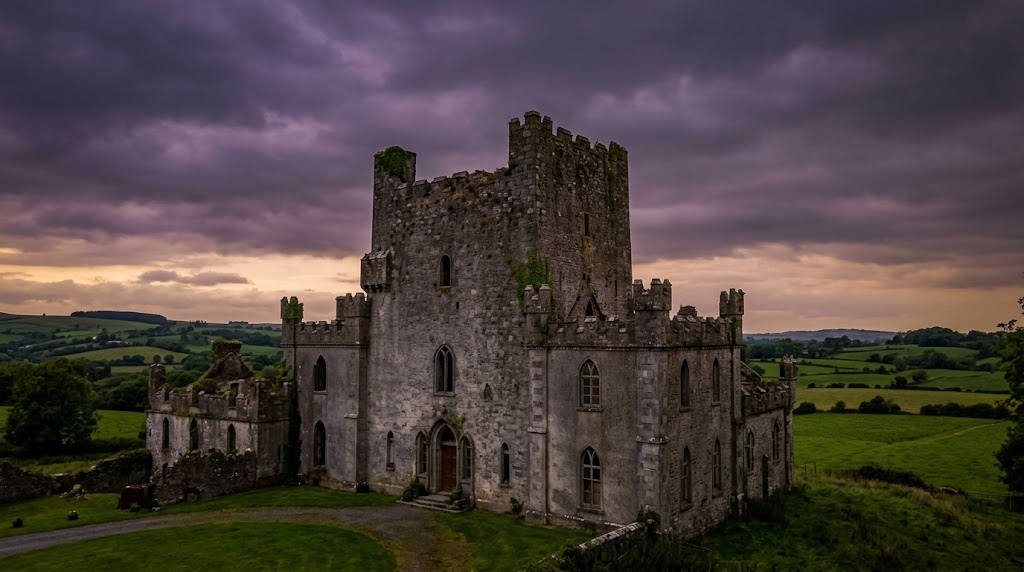 The central stone keep of Leap Castle standing sentinel over the fertile midlands of County Offaly, Ireland.
The Rule of the O’Carrolls: Feasts of Betrayal
In Gaelic Ireland, the O’Carrolls maintained their dominion through ruthless survival tactics:
- The Fatal Banquet: Clan chief Mulrooney O’Carroll frequently hired rival mercenary warriors—such as the McMahon and O’Neill clans—to fight frontier skirmishes against rival chieftains. Upon the victorious return of the mercenaries to Leap Castle, O’Carroll hosted grand celebratory victory feasts. As the mercenaries drank heavily and celebrated in the Great Hall, O’Carroll’s men slit their throats in their sleep to avoid paying their contracted gold bounties.
- The Contested Chieftaincy (1532): Following the death of Mulrooney O’Carroll in 1532, a fierce civil war erupted between his sons for leadership of the clan. One brother was a consecrated Catholic priest; the other, Teige O’Carroll, was a battle-hardened warlord.
The Sacrilege of the Bloody Chapel
The fratricidal rivalry reached its apocalyptic climax on the upper floor of the central keep, inside the family sanctuary now known worldwide as The Bloody Chapel:
- The Assassination: While the priest was celebrating holy mass before family members and attendants, Teige O’Carroll burst through the heavy oak doors armed with a broadsword. Enraged that his brother had begun the sacred liturgy without awaiting his arrival, Teige stormed the altar and ran his sword directly through the priest’s chest.
- The Dying Curse: The wounded priest collapsed over the altar stone, his blood defiling the holy sacrament and communion chalice before dying in agony in front of his horrified kin.
- The Spectral Legacy: Ever since that morning in 1532, travelers and castle residents have reported flashes of pale light illuminating the high Gothic arched windows of the ruined chapel late at night, accompanied by the muffled chanting of medieval Latin requiems.
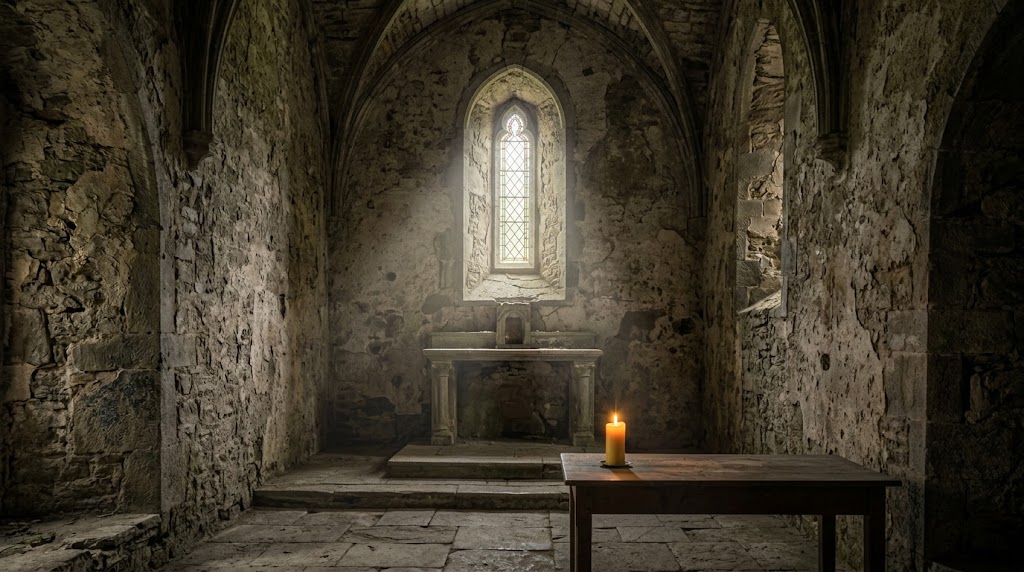 The interior of the Bloody Chapel: where a medieval priest was run through with a broadsword at the altar.
The Horror of the Oubliette: The Spiked Pit
While the chapel was infamous for murder, its darkest physical secret remained hidden behind masonry for centuries until structural renovations in the early 1920s.
While clearing debris behind the northeast corner of the chapel wall, workmen discovered a concealed trapdoor opening into a subterranean vertical void: The Oubliette (from the French oublier, meaning “to forget”):
- The Architecture of Agony: The chamber was an eight-foot-deep stone drop into pitch blackness. Embedded upright into the solid rock floor was a forest of razor-sharp wooden and iron spikes.
- The Victims: Feudal lords disposed of unwanted guests, captives, and rival clansmen by walking them blindfolded across the upper gallery and releasing the trapdoor. Victims plummeted into the darkness, impaled through chests and thighs on the spikes below, where they were left to starve in agony amid the putrefying corpses of previous captives.
- The Excavation: When laborers emptied the oubliette in the 1920s, it required three full horse-drawn cartloads to haul away the mountain of human skeletal remains. Among the fractured bones, workers recovered a silver pocket watch manufactured in the 1840s—chilling physical proof that the horrific pit had been used to dispose of unwanted souls well into the 19th-century Victorian era.
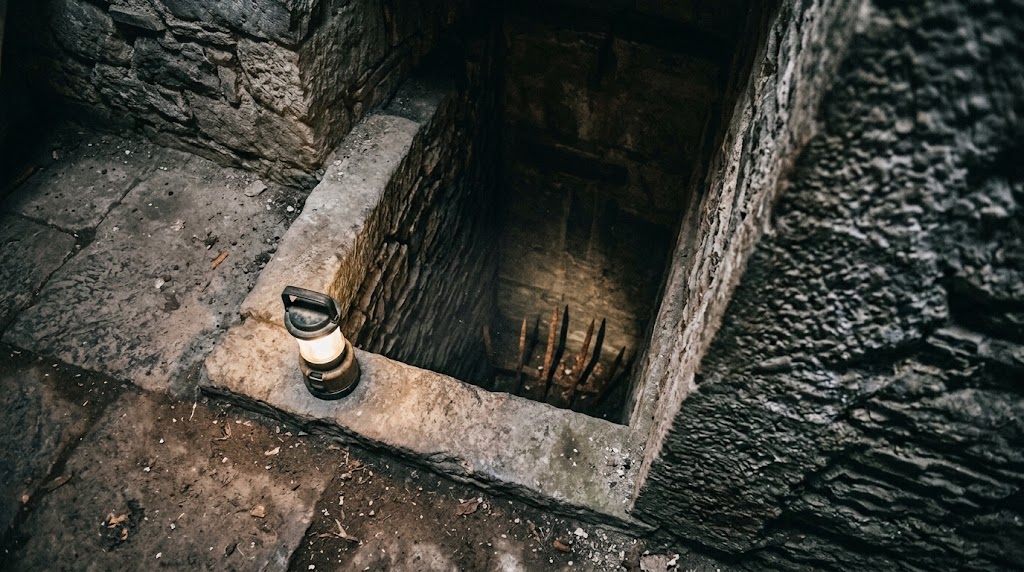 Looking down into the mouth of the Oubliette: an eight-foot sheer drop onto subterranean iron spikes.
The Mildred Darby Occult Chronicles and the Elemental
In the late 19th and early 20th centuries, the castle passed into the hands of the Anglo-Irish Darby family. The lady of the house, Mildred Darby, was an eccentric gothic novelist and spiritualist who began conducting séances, automatic writing, and occult rituals inside the ancient keep:
- The Awakening: Locals believe Darby’s esoteric dabbles inadvertently aggravated centuries of dormant historical trauma.
- The Elemental Entity: In a famous 1909 article published in The Occult Review, Mildred Darby documented an encounter with Leap’s most terrifying entity—the “Elemental”:
“It was about the size of a sheep, thin, gaunt, and shadowy. Its face was human, yet grey and decaying, with black hollow cavities for eyes. It emitted a sickening, overpowering stench of decomposing flesh and sulfur, filling the room with an icy dread that paralyzed the limbs.”
The 1922 Burning and the Modern Minstrel
During the Irish War of Independence and Civil War in July 1922, local anti-treaty IRA fighters raided Leap Castle, viewing it as a symbol of British landlord oppression. They torched the estate with kerosene, gutting the central keep down to its charred stone shell and destroying the grand Victorian wings.
For over fifty years, the blackened limestone ruins stood empty, overgrown with brambles and haunted by crows.
Seán Ryan’s Resurrection (1991–Present)
In 1991, world-renowned traditional Irish tin whistle musician Seán Ryan and his wife Anne purchased the ruined citadel. Undaunted by its blood-soaked folklore, Seán spent decades single-handedly hauling out tons of charred timber, restoring the oak rafters, reglazing the chapel windows, and making Leap a warm, lived-in family home.
Seán, who regularly plays his whistle in the Great Hall, speaks of the spirits not with terror, but with affectionate respect: “We live together in harmony. If you show the castle and its past inhabitants respect, they leave you in peace. They were here long before me, and they will be here long after I am gone.”
Expedition Field Guide: How to Journey to Leap Castle
Unlike commercial state-run museums, Leap Castle is a private residence that generously welcomes respectful dark tourists and history enthusiasts.
Transit & Directions
- Location: R421 Road, near Kinnitty and Roscrea, County Offaly, Ireland.
- By Car from Dublin: Drive southwest along the M7 motorway toward Limerick. Exit at Junction 22 for Roscrea, then take the R421 north toward Kinnitty (roughly a 1.5 to 2-hour scenic drive).
- By Car from Galway: Drive southeast via the M6 and N52 through Birr (approximately 1 hour and 20 minutes).
Essential Visitor Etiquette
- Advance Contact Mandatory: Because Leap Castle is the Ryan family’s private home, you cannot simply show up unannounced. Visitors should reach out via local tourist desks in Birr or Roscrea, or arrange tours through specialized Irish heritage operators to confirm Seán is home and receiving guests.
- Support the Restoration: Admission is typically a modest cash donation paid directly to Seán Ryan, which goes entirely toward the immense ongoing structural maintenance of the 600-year-old stone masonry.
- The Musical Experience: If you are fortunate, your historical tour of the Great Hall and Bloody Chapel will conclude with Seán sitting beside the peat turf fire, playing a haunting ancestral tune on his tin whistle—an acoustic experience unmatched anywhere in Europe.
- Footwear & Attire: The keep’s original spiral stone stairs (caracole) are worn smooth and steep from six centuries of boots. Wear flat, slip-resistant shoes and dress warmly in autumn, as stone keeps retain winter chills.
The Verdict
Leap Castle is not a manufactured tourist haunt; it is an authentic, pulsating vortex of Irish medieval history. Standing in the drafty silence of the Bloody Chapel, gazing down into the dark mouth of the spiked oubliette, travelers encounter the unvarnished reality of feudal Ireland: where power was bought with steel, sanctified with blood, and etched forever into the living rock.