Deep within the dense, jaguar-inhabited rainforest canopy of the Tapir Mountain Nature Reserve in western Belize lies the yawning, spring-fed mouth of an ancient subterranean portal: Actun Tunichil Muknal (the Cave of the Crystal Sepulchre, universally known as the ATM Cave).
To modern geologists, it is a magnificent five-kilometer limestone karst cave carved by a rushing subterranean river. But to the ancient Maya of the Classic Period (circa 250–900 AD), this flooded subterranean void was not geological terrain—it was a literal, physical entrance to Xibalba, the dreaded subterranean realm of death ruled by the Twelve Lords of the Underworld.
To enter ATM today is not a passive museum stroll; it is a raw, demanding expedition. Travelers must swim across deep turquoise pools into the twilight of the cave mouth, wade through waist-deep subterranean currents, squeeze through knife-edge limestone fissures, and climb towering boulder cascades in pitch darkness before ascending to the dry upper chambers.
Here, lying untouched exactly where priests left them over eleven centuries ago, are the calcified skeletal remains of fourteen human sacrifices and hundreds of ceremonial ceramic vessels frozen in time.
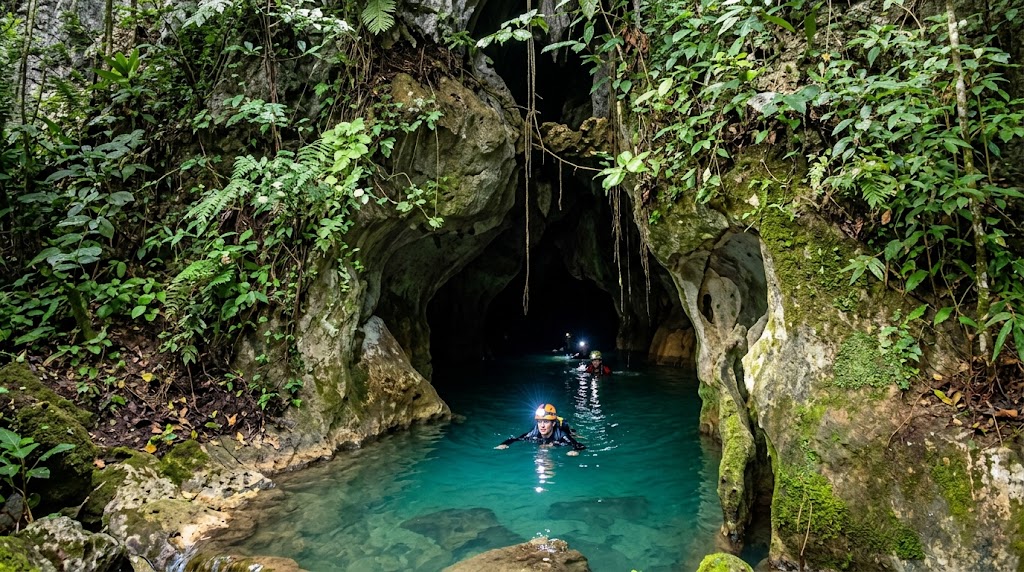 Entering the mouth of Actun Tunichil Muknal: swimmers navigating the spring-fed river portal into the limestone darkness of Xibalba.
The Descent into Xibalba: The Drought Apocalypse
Why did ancient Maya priests venture over a kilometer into total, lightless subterranean caverns carrying flaming pine torches and sacrificial victims?
The answer lies in environmental collapse:
- The Terminal Classic Megadroughts (750–900 AD): Climatological sediment cores from the Yucatan and Caribbean confirm that the Maya civilization was struck by historic, multi-decade megadroughts. Crops withered, royal reservoirs dried into cracked mud, and starvation destabilized powerful city-states.
- The Domain of Chaac: In Maya cosmology, rain was not born in the sky; it was manufactured inside deep, watery caves by Chaac, the rain and lightning deity.
- Escalating Blood Offerings: As years passed without monsoon rains, rituals outside temple pyramids failed. Desperate rulers and high priests retreated deeper into the subterranean underworld to plead directly with the subterranean lords. Initial offerings of corn, jade, and animal blood escalated into the ultimate currency: ritual human sacrifice.
The Ceramic “Kill Holes”: Liberating the Spirits
Ascending twenty feet up a slippery flowstone ledge into the vast dry upper cathedral chamber, the subterranean river falls silent below. The floor transforms into an extraordinary open-air archaeological matrix:
- Unmoved Offerings: Over 1,400 ancient ceramic pots, bowls, and storage vessels litter the calcium-crusted floor. Many have been cemented to the rock by continuous mineral dripwater over a millennium.
- The “Kill Holes”: Nearly every ceramic pot displays a deliberate puncture hole struck through its base or center. The Maya believed that crafted objects possessed their own sacred life force (k’uh); to deliver the vessel’s spirit into the hands of the gods of Xibalba, priests ritually “killed” the pot with an obsidian blade before depositing it on the cavern floor.
- The Bloodletting Altars: Deep within the dark recesses sit carved obsidian blades and stingray spines—implements used by Maya royals to pierce their tongues, earlobes, and genitals, dripping royal blood onto amate bark paper to be burned as fragrant smoke for the underworld entities.
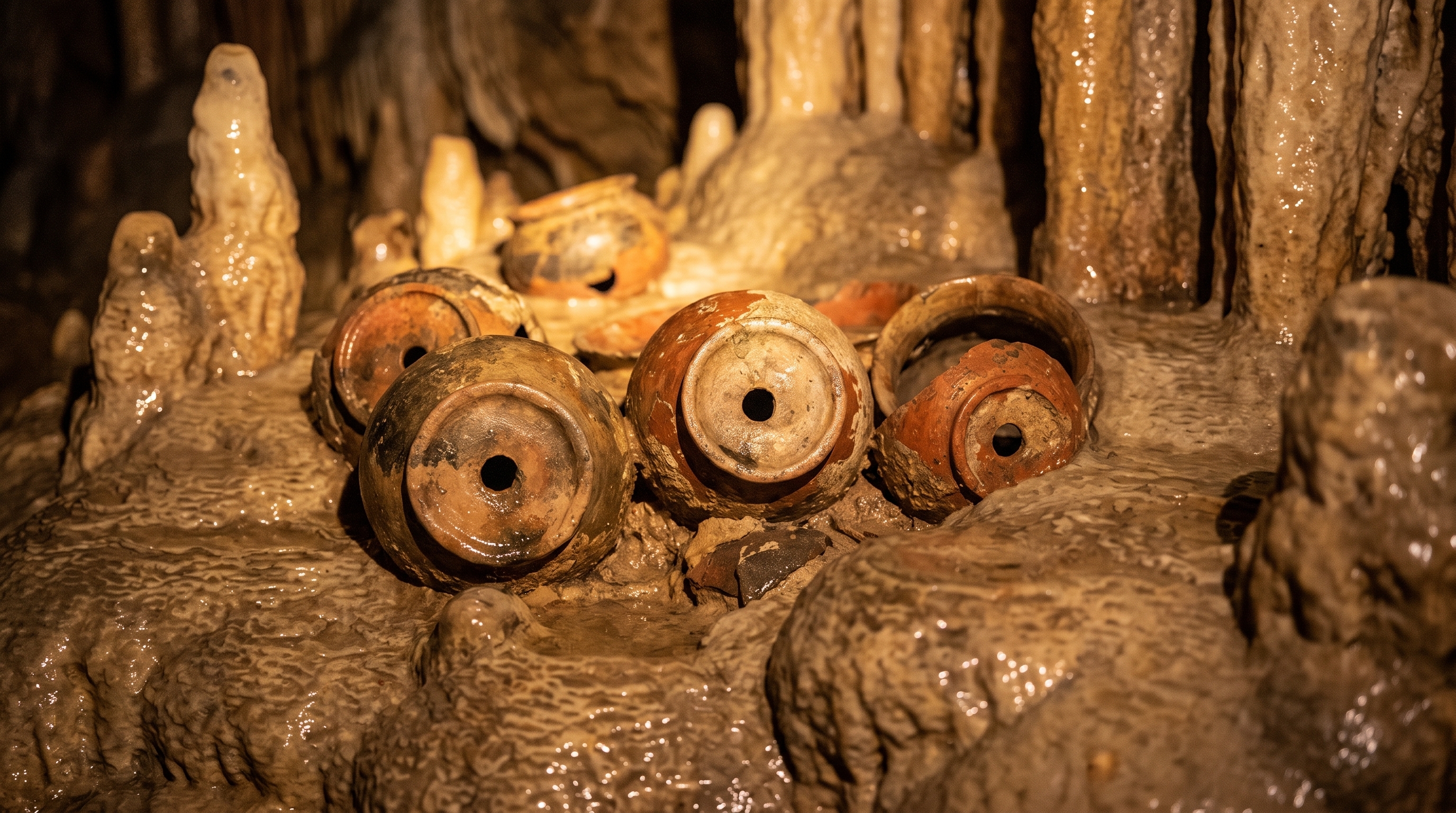 Ceremonial Maya pottery vessels featuring deliberate ritual “kill holes” encrusted in sparkling calcite.
The Human Sacrifices
Scattered across the cathedral chambers are the bones of fourteen documented human sacrifices:
- Demographics of Despair: Archaeologists have identified seven adults and seven children, including infants under one year old. In ancient Mesoamerica, infant tears were considered sacred sympathetic magic, spiritually linked to the falling of rain droplets.
- Signs of Trauma: Many of the adult remains exhibit blunt-force cranial trauma, fractured vertebrae, and crushed sternums—evidence of ritual skull-cleaving and heart extraction ceremonies carried out beneath flickering pine-sap torches.
The Crystal Maiden: The Sparkling Relic of Eternity
At the very furthest, deepest terminus of the upper chamber, reached only by navigating a narrow crevice between colossal limestone pillars, rests the cave’s most haunting and internationally celebrated resident: The Crystal Maiden.
Stretched out on her back in a natural limestone alcove, the skeleton belongs to a young woman (or teenage youth) aged approximately seventeen to twenty:
- The Death Posture: Her ribcage bears trauma consistent with violent sacrificial heart removal, after which her body was tossed or ceremonially laid into the limestone recess.
- The Calcite Metamorphosis: Over more than a thousand years, moisture dripping from the cavern ceiling saturated with calcium bicarbonate blanketed her entire skeleton. Molecule by molecule, the bones became completely entombed in a glittering, diamond-like crust of calcite crystals.
- The Ethereal Glow: When illumination from modern headlamps hits the skeleton, the crystalline bones shimmer and sparkle in the pitch-black void, giving her an unearthly, jewel-like permanence that earned her legendary moniker.
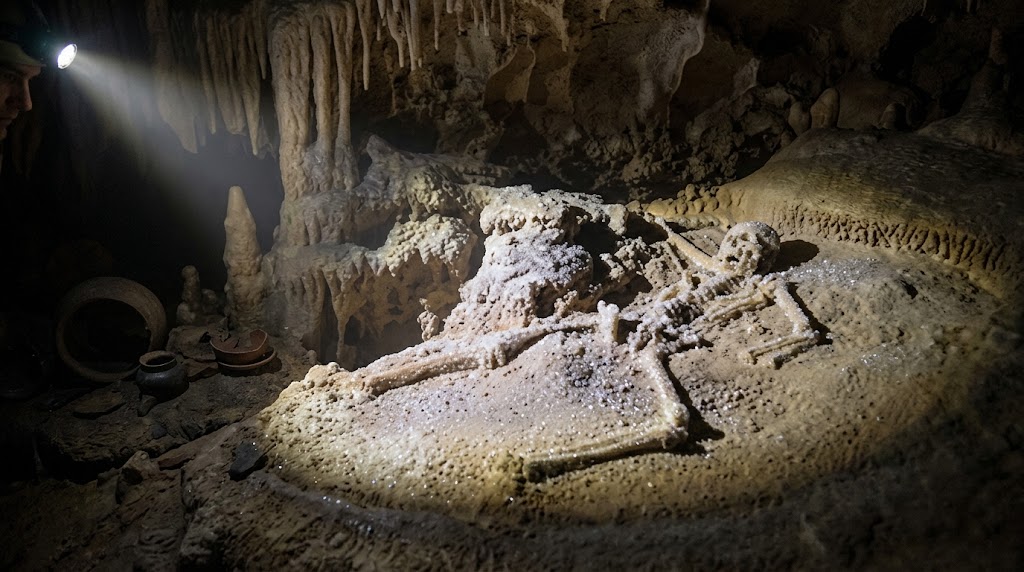 The Crystal Maiden: an eleven-hundred-year-old human sacrifice fully encased in a glittering crust of calcite crystals.
The 2012 Rupture and the Total Camera Ban
ATM Cave has no security glass cases, velvet stanchions, or elevated steel catwalks. Travelers walk inches away from ancient skeletons and thousand-year-old pottery.
This exceptional intimacy nearly destroyed the site in May 2012:
- The Accident: An international tourist attempting to take a photograph slipped on a damp rock. Their heavy handheld digital SLR camera slipped from their grasp and plummeted directly onto an ancient Maya skull, smashing the cranium and punching a gaping hole through the thousand-year-old bone.
- The Immediate Ban: Outraged by the irreversible loss of world heritage, the Belize National Institute of Culture and History (NICH) enacted an absolute, immediate decree: all cameras, go-pros, smartphones, and recording hardware are permanently banned inside the ATM Cave for visitors.
- The Footwear Protocol: To protect delicate limestone calcifications and ceramic shards, visitors are required to remove their muddy hiking shoes at the base of the upper chamber and navigate the sacrificial dry chambers wearing thick socks only.
Expedition Field Guide: How to Journey to ATM Cave
Visiting Actun Tunichil Muknal is one of the most physically rigorous and strictly managed eco-expeditions in Central America.
Logistics & Transit
- Base Camp: Most expeditions depart from the vibrant inland town of San Ignacio, situated in the Cayo District near the Guatemalan border.
- The Journey: A 45-minute four-wheel-drive van transfer reaches the Tapir Mountain Nature Reserve ranger station. From the parking outpost, visitors complete a 45-minute jungle hike involving three river crossings (wading through the Roaring River with guide ropes) before arriving at the cave mouth.
Mandatory Visitor Protocols
- Licensed Elite Guides Only: Independent access is illegal. Belize licenses fewer than thirty elite, specially trained naturalist guides permitted to lead travelers into the cave, limited to strict groups of eight people per guide. Book your tour weeks in advance.
- Physical Demands: You must be able to swim comfortably, tread water in deep pools, scale slippery flowstone boulders, and navigate cramped, unlit caverns for 3 to 4 hours underground. It is not suitable for those with severe claustrophobia or joint mobility issues.
- What to Wear:
- Synthetic quick-dry athletic apparel (leggings and rashguard shirts).
- Sturdy water shoes or lace-up hiking boots with aggressive wet-rock grip for the jungle trek and river portion.
- Mandatory clean spare socks in a dry bag (for walking through the sacrificial bone chambers).
- Leave all cameras, watches, bags, and jewelry behind at the ranger outpost; guides provide certified headlamps and helmets.
The Verdict
Actun Tunichil Muknal is not a preserved spectacle; it is a sacred time machine. Submerged in the cool subterranean waters where an empire pleaded for its life, travelers encounter the raw intersection of human desperation, natural calamity, and spiritual awe. To stand in socks in the dark, watching the Crystal Maiden sparkle beneath a solitary beam of light, is to witness the fragile beauty of our shared struggle against oblivion.