Hidden deep within the dense, mist-shrouded pine forests of northern Bohemia, roughly forty-seven kilometers north of Prague, looms a jagged early-Gothic stone citadel that defies every tenet of military architecture: Houska Castle (Hrad Houska).
Erected in the mid-13th century (circa 1253–1278) during the reign of King Ottokar II of Bohemia, Houska presents an insurmountable riddle to historians, architects, and military engineers alike.
Most European castles were constructed upon towering crags to control arterial river trades, defend territorial frontiers, or safeguard sovereign dynasties. Houska had none of these purposes. It sat in an isolated, swampy wilderness with no strategic value. It had no water well, no natural cistern, no defensive moat, and no active kitchen when first completed.
Even more disturbing is its defensive posture: the massive battlements, iron portcullises, and arrow slits were engineered facing inward, pointing down toward the castle’s central stone courtyard. Many of its exterior multi-paned windows were architectural illusions (trompe-l’œil)—mere wooden frames affixed to solid limestone blocks. Houska was not built to keep invaders out; it was built to keep something subterranean trapped inside.
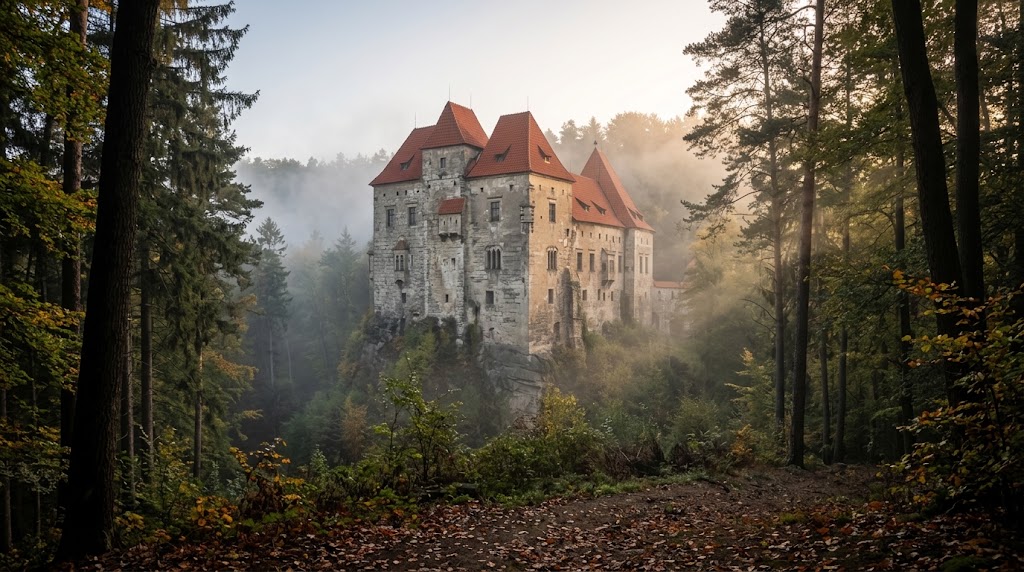 Houska Castle standing silent in the forested hills of northern Bohemia, framed by autumn mist.
The Legend of the Fissure: Brána do Pekel
The dark mythology of Houska predates its stone walls by centuries:
- The Bottomless Rift: According to local Slavic folklore, the site originally contained a bottomless, yawning limestone pit descending deep into the bowels of the earth. From this chasm, noxious sulfurous vapors rose, and local hunters reported terrifying winged creatures—half-human, half-reptilian aberrations—crawling out under cover of night to ravage nearby livestock.
- The Condemned Prisoner’s Descent: Legend holds that local dukes offered a full royal pardon to any condemned prisoner who agreed to be lowered into the abyss on a hemp rope and report what lay within. A young criminal accepted the wager. Within seconds of descending into the dark, he began shrieking uncontrollably. When guards hauled him back to the surface, the young man’s hair had turned entirely shock-white, his face was withered with terror, and he had visibly aged decades in mere moments. He babble-incoherently about monsters in the sulfurous gloom and died days later in a local asylum.
Terrified by the omen, Bohemian rulers ordered the fissure capped with thick blocks of consecrated limestone, sealing the abyss beneath the foundation stones of a dedicated mountain fortress.
The Gothic Chapel: Sealing the Portal
Directly over the purported site of the subterranean rift sits the spiritual epicenter of the compound: the Castle Chapel.
Architectural surveys confirm that the chapel’s stone floor sits directly above a hollow geological cavity. The chapel was deliberately designed with non-traditional sacred geometry:
- The Pagan Centaur Fresco: Dating back to approximately 1330, the fading lime-wash frescoes on the chapel walls depict standard biblical iconography—Saint Michael battling a dragon and Christ in majesty—interspersed with a shocking aberration. High on the stone wall is a painted female centaur archer, drawing her bow with her left hand (historically considered the hand of the Devil in medieval Catholic iconography) aimed directly at a human figure. A mythological, half-beast pagan motif inside a consecrated high-Gothic Christian sanctuary is practically unprecedented in European ecclesiastical art.
- The Heavy Stone Floor: The massive flagstones beneath the altar are unusually thick, bound with lime mortar, and have never been completely excavated due to structural collapse concerns.
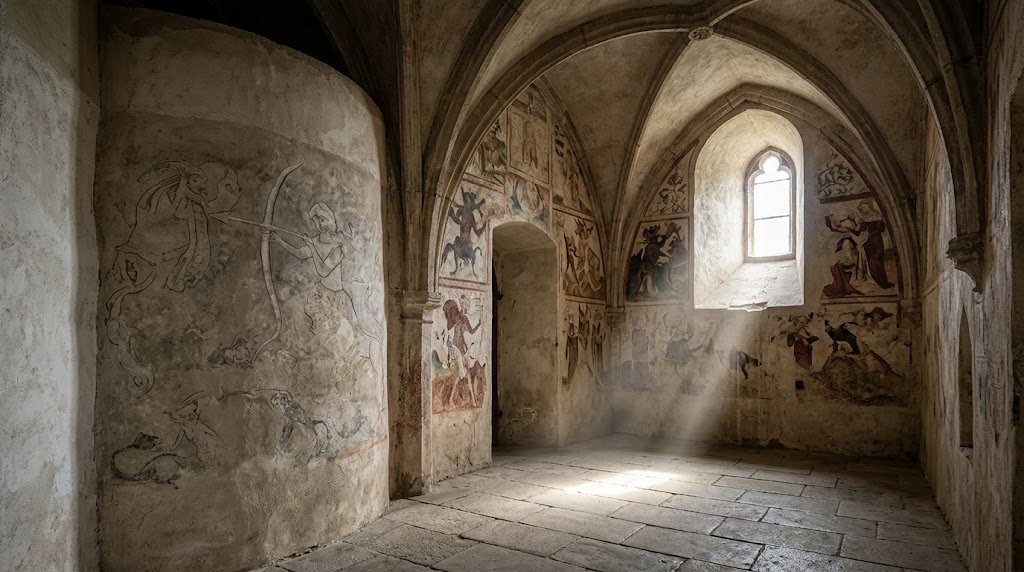 Inside the Gothic Chapel: the controversial 14th-century left-handed centaur fresco painted on ancient limestone mortar.
The Nazi SS Occupation: Himmler’s Ahnenerbe
Houska’s dark reputation drew the attention of the Nazi SS during the Second World War:
- The Occult Division (1939–1945): Following the annexation of the Sudetenland and the occupation of Bohemia and Moravia, the Ahnenerbe (Heinrich Himmler’s esoteric and occult research bureau) seized Houska Castle.
- Secrecy and Experiments: The local Czech populace was strictly expelled from the perimeter, and the castle was declared a classified military exclusion zone. SS personnel conducted covert occult archives, esoteric racial genealogical research, and reportedly investigated local dimensional folklore. Over 13,000 sensitive Freemasonic, occult, and Jewish esoteric manuscripts looted from across occupied Europe were secretly stored in Houska’s vaulted cellars to protect them from Allied carpet bombing.
- The Midnight Evacuation: When Soviet forces advanced through Czechoslovakia in early May 1945, the SS garrison destroyed the majority of their operational paperwork, packed specialized crated artifacts, and fled westbound into American lines, leaving lingering architectural scars across the castle’s timber paneling.
Modern Structural Restoration and Legends
Following decades of communist state neglect during the Cold War—during which the castle served as an agricultural library and vehicle storehouse—Houska was returned to the descendants of its pre-war owners, the Šimonek family, in the 1990s.
Through private funding, the family stabilized the roof, cleaned centuries of soot from the chapel frescoes, and opened the property to travelers, folklorists, and dark tourism researchers.
Visitors regularly report severe localized temperature drops, unexplainable nausea within the central courtyard, and sudden battery drains on cameras and mobile devices—anomalies attributed by modern geologists to deep subterranean radon gas vents, iron deposits, and complex subterranean acoustic echoes through limestone karst chambers.
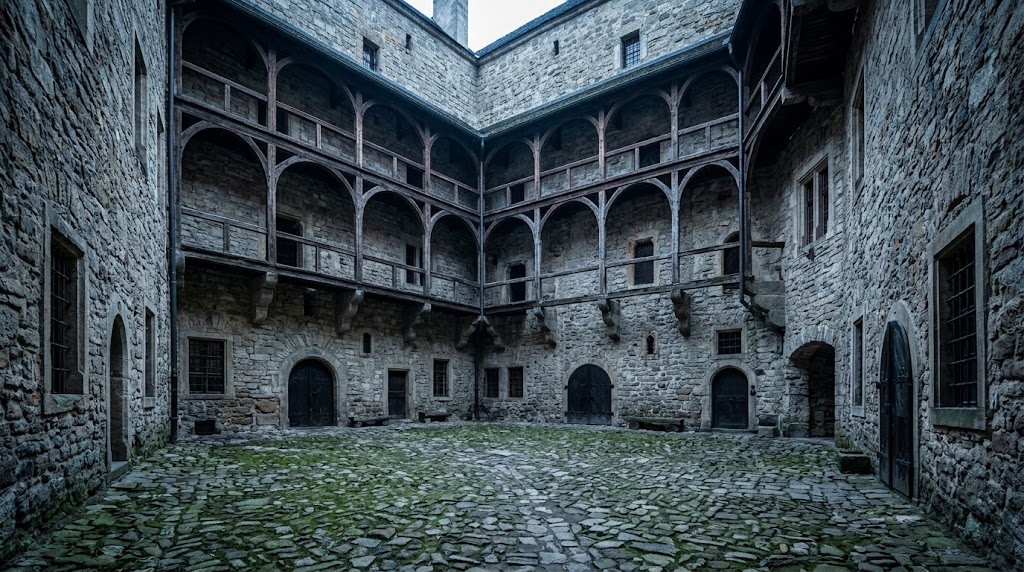 The interior courtyard: notice how high stone walls, inward-facing gallery balconies, and narrow doorways enclose the central ground.
Expedition Field Guide: How to Journey to Houska Castle
Houska Castle is accessible as a thrilling rural day trip from Prague, tucked within the scenic Kokořínsko Protected Landscape Area.
Transit & Directions
- Location: Houska 1, 472 01 Blatce, Liberec Region, Czech Republic.
- By Car from Prague (Fastest): Take Highway Route 9 northward toward Mělník and Česká Lípa. Turn onto Route 273 through Mšeno and follow local signs toward Blatce and Houska. The 65-kilometer (40-mile) drive takes roughly 1 hour and 15 minutes through scenic pine valleys. Ample paid visitor parking sits 500 meters below the castle gates.
- Public Transit: Take the morning train from Praha Hlavní Nádraží to Mšeno (roughly 1.5 to 2 hours with one transfer at Všetaty). From Mšeno, local rural buses run seasonally toward Doksy/Houska, or you can hike along the marked red tourist trail (approx. 7 kilometers) through lush sandstone rock formations.
Operating Schedule & Visitor Protocols
- Seasonal Availability: Houska Castle is open primarily from April through October (closed on Mondays; open Tuesday through Sunday from 10:00 AM to 5:00 PM). It remains closed during the harsh Bohemian winter months except for pre-booked Halloween and festival events.
- Guided Tours: Standard guided tours are conducted in Czech, but high-quality printed English translation guides and QR-code audio guides are available at the ticket pavilion. The tour explores the Gothic Chapel, the Knight’s Hall, the green hunting salon, and the underground cellar foundations.
- Footwear & Atmosphere: The approach path from the parking clearing is a steep gravel and dirt trail through the woods. Wear sturdy, comfortable walking shoes. The stone interior and subterranean chapel remain chilly (10°C to 14°C) even on warm summer afternoons; bring a light windbreaker or jacket.
- Combine with Kokořín Castle: Just 10 kilometers to the south stands Kokořín Castle, a dramatic 14th-century robber-baron fortress perched atop a sandstone cliff, making for a perfect full-day Bohemian castle expedition.
The Verdict
Houska Castle remains one of the world’s most compelling historical anomalies—a fortress whose every stone was laid with a singular, terrifying intention. Standing beneath the gaze of the left-handed centaur in the silent Gothic chapel, suspended over the sealed abyss, one realizes that the true terror of Houska is not merely folklore, but the chilling historical reality that its medieval builders believed every word of it.