Rising unexpectedly from the pancake-flat agricultural fields of northern Lithuania, twelve kilometers north of the industrial city of Šiauliai, sits one of the most visually staggering and spiritually defiant landscapes on Earth: Kryžių Kalnas (The Hill of Crosses).
Emerging through thick Baltic autumn mists, the low two-humped earthwork mound does not look like a traditional cemetery—because there are no graves beneath its soil. Instead, the entire slope is densely blanketed by an estimated 100,000 to 200,000 crucifixes of every conceivable size and material.
Massive four-meter-tall oak and birch crucifixes carved with traditional Lithuanian sun motifs tower overhead, while every available square inch of surface timber is hung with thousands of smaller brass, iron, amber, and plastic rosaries. When North European gale winds sweep across the plains, the hill produces an eerie, hypnotic acoustic symphony: the dry, wooden clatter and metallic clicking of millions of rosary beads vibrating in the gale.
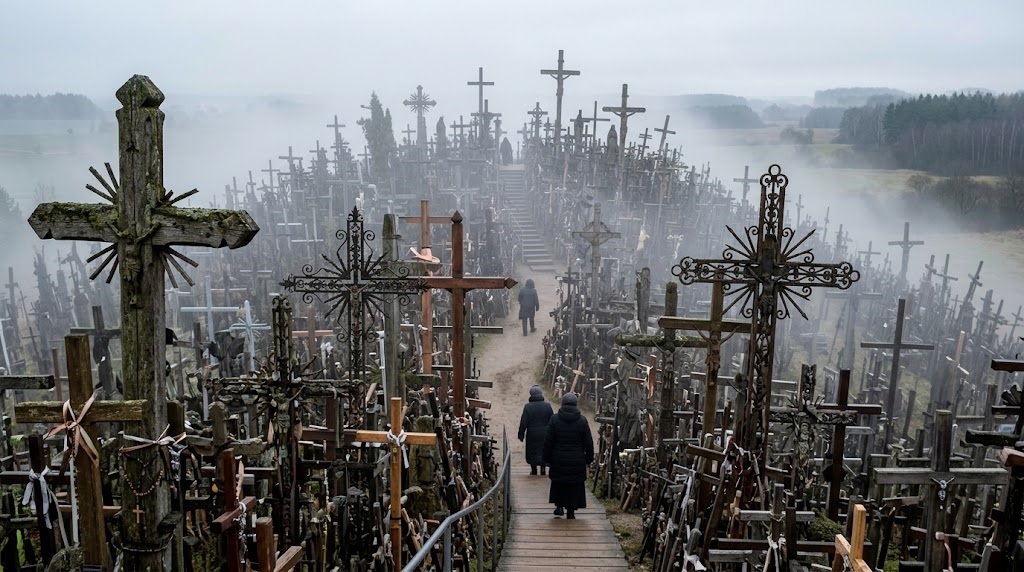 Kryžių Kalnas: an ocean of carved wooden crucifixes, iron totems, and rosaries covering the historic earthwork mound in northern Lithuania.
Born from Blood: The Anti-Tsarist Uprisings
The sacred origin of the mound is rooted in armed national insurrection against imperial subjugation:
- The November Uprising (1831): Following the brutal partition of the Polish-Lithuanian Commonwealth, Lithuanian patriots launched a fierce armed rebellion against the Russian Empire. Tsarist imperial troops mercilessly crushed the resistance, hanging rebel commanders and executing soldiers without formal burials.
- The Missing Dead: Grieving families, unable to retrieve or identify the corpses of their sons, brothers, and fathers, traveled to this ancient medieval hill fort (Jurgaičiai mound). They planted symbolic wooden crosses in the earth to give their fallen kin a consecrated marker under God.
- The January Uprising (1863): When another anti-Tsarist rebellion erupted thirty years later, the imperial regime banned the erection of Catholic crosses across private properties and roadsides. In open civil disobedience, Lithuanians snuck to the secluded mound at night, transforming the hill into a permanent shrine of non-violent resistance and ancestral mourning.
The Soviet War on Crosses: Operation Bulldozer
The hill transitioned from a Catholic sanctuary into an ideological battleground following World War II, when the Soviet Union occupied the Baltic States and enforced state atheism.
To Moscow, the Hill of Crosses was an intolerable symbol of Lithuanian national sovereignty, religious freedom, and anti-communist defiance. The KGB and local communist party officials resolved to obliterate it:
- The Bulldozers of 1961: In April 1961, military sappers and heavy bulldozers raided the hill. In a single afternoon, over 5,000 wooden crosses were chainsawed down and burned in giant bonfires. Iron crosses were carted off to scrap metal smelters, and stone carvings were pulverized into road gravel.
- The Midnight Resurrection: The very next morning, Soviet sentries arrived to find hundreds of fresh crosses planted in the still-warm ashes. Citizens had traveled under cover of darkness through surrounding swamps, carrying hand-whittled pine crosses on their backs.
- Escalating State Terror: The KGB repeated the destruction in 1973 and 1975, leveling the hill again. Authorities erected barbed-wire fences, posted armed snipers on surrounding watchtowers, declared the area a biological quarantine hazard, and drew up plans to flood the valley with sewage runoff.
Yet planting a cross became the ultimate act of silent rebellion. Ordinary factory workers, grandmothers, and university students risked summary arrest, blacklisting, and deportation to the Siberian Gulag to keep the mound standing.
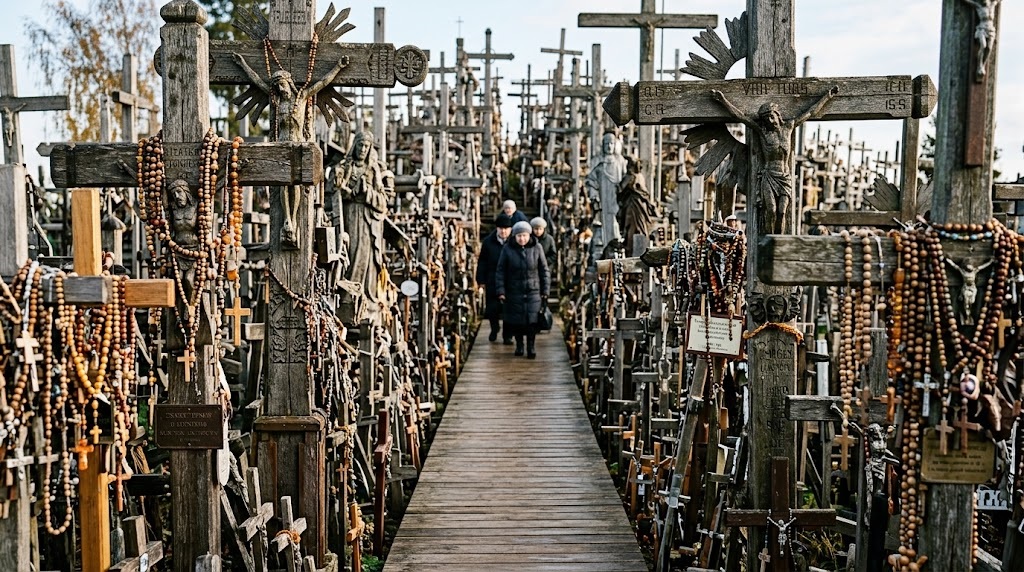 Walking the central spine of the mound: narrow wooden boardwalks flanked by dense tiers of carved crucifixes.
The Anatomy of the Mound: Cross-Crafting Heritage
The sheer physical density of the hill is an overwhelming architectural experience:
- Lithuanian Cross-Crafting (Kryždirbystė): In 2008, UNESCO inscribed traditional Lithuanian cross-crafting on the Representative List of the Intangible Cultural Heritage of Humanity. These are not simple Roman crosses; they are intricate syncretic masterworks carved from durable oak, crowned with forged iron sunbursts (saulutės), pagan geometric floral rosettes, and small roofed shrines sheltering wooden statues of the Rūpintojėlis (the Pensive Christ).
- The Strata of Memory: Beneath the upper timber crosses lies decades of natural decay. Older wooden crosses have collapsed and half-dissolved into rich forest humus, creating a multi-layered organic scaffolding upon which newer crosses are staked.
- The Amber Relics: Many crucifixes feature honey-colored Baltic amber gems embedded in the timber, glowing warmly when morning daylight cuts through low-lying mist.
The Modern Epoch: The Papal Blessing and Global Pilgrimage
The fall of the Soviet Union in 1990 finally liberated the Hill of Crosses from clandestine terror.
On September 7, 1993, Pope John Paul II made a historic pilgrimage to Kryžių Kalnas, holding an open-air mass before a crowd of 100,000 people. He presented a massive wooden crucifix with a stone base from the Vatican that now stands proudly at the foot of the hill, inscribed with his words: “Thank you, Lithuanians, for this Hill of Crosses which testifies to the nations of Europe and to the whole world the faith of the people of this land.”
Today, people from every continent—Catholic, Orthodox, Protestant, Jewish, and secular travelers alike—journey to the mound not only to pray, but to leave personal tokens of grief, survival, and hope.
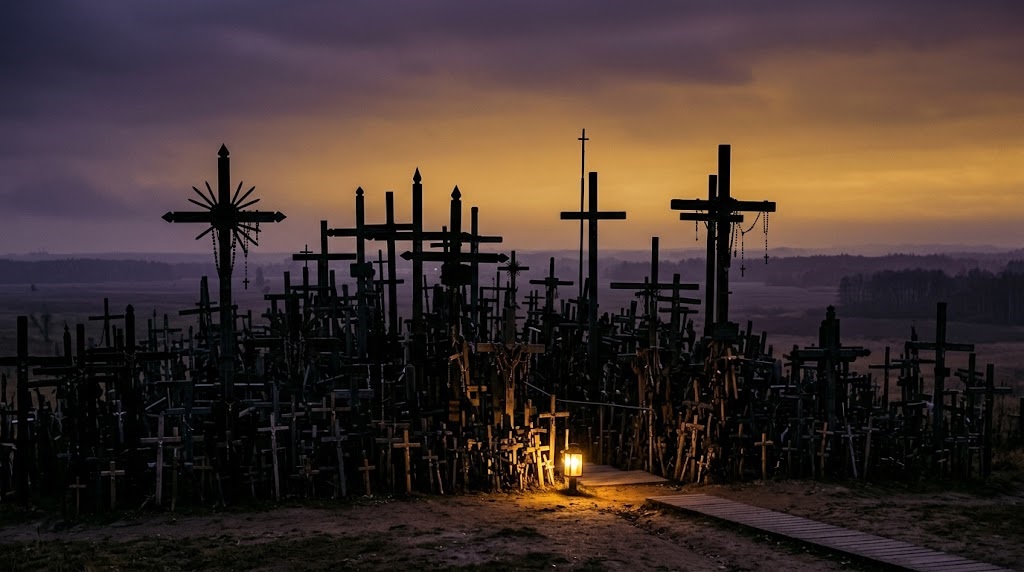 The silhouette of thousands of crucifixes against an evocative Baltic twilight, where silence and wind merge.
Expedition Field Guide: How to Journey to Kryžių Kalnas
Visiting the Hill of Crosses is a seamless day trip when traveling through the Baltic states, easily slotted between Vilnius (Lithuania) and Riga (Latvia).
Transit & Directions
- Gateway Town: The nearby transit hub is Šiauliai, connected by frequent express train lines from Vilnius (roughly 2 hours) and Klaipėda (1.5 hours).
- Local Bus from Šiauliai: From the Šiauliai Central Bus Station, catch the regional suburban bus heading toward Joniškis. Ask the driver for the Domantai stop (roughly a 15-minute ride).
- The Rural Walk: From the Domantai roadside bus shelter, follow the quiet, paved tree-lined country road for two kilometers (roughly a 20-minute flat walk) straight to the visitor center and the mound.
- International Driving: If driving the Via Baltica (E67/A12 highway) between Riga and Vilnius, the hill sits just two kilometers off the main highway, with ample pay-and-display parking.
Essential Visitor Protocols & Etiquette
- The Tradition of Leaving a Cross: You do not need to be religious to place a marker. Visitors can purchase hand-carved wooden crosses inscribed with traditional blessings at the visitor pavilion (or carve their own from fallen timber) and stake it anywhere along the peripheral paths.
- Strict Footwear & Path Etiquette: Always remain on the wooden boardwalks and gravel stairways. The soil is saturated with historic artifacts, fragile amber rosaries, and rotting wood; trampling off-trail damages delicate structural foundations.
- Photography Timing: The most atmospheric window for photography is dawn or late twilight, when low-hanging mist blankets the Baltic meadows, turning the forest of crosses into an ethereal silhouette against the cold sky. Pack a sturdy tripod to capture long exposures of swaying rosaries.
The Verdict
The Hill of Crosses is not an exhibition of morbidity; it is an unyielding monument to the supremacy of the human spirit over imperial violence. Standing atop the windswept mound, enveloped by the rhythmic clicking of thousands of wooden beads in the Baltic gale, travelers witness the ultimate triumph of memory: an empire of tanks and bulldozers dissolved into dust, while a hill of fragile wooden crosses still stands tall against the sky.