Rising out of the cracked, saline mudflats of the Buenos Aires pampas, 550 kilometers southwest of the Argentine capital, lies a landscape that evokes the end of the world: Villa Epecuén.
Bordering the hypersaline waters of Laguna Epecuén—a closed lake basin with mineral salt levels second only to the Dead Sea—this settlement was once one of South America’s most glamorous hydrotherapy and spa destinations. Today, it resembles an open-air graveyard of white petrified wood and fractured masonry.
Stripped down to bare brick and limestone by decades of corrosive brine, dead silver eucalyptus trees stand like skeletal fingers clawing at the sky. Collapsed spiral staircases lead to phantom rooftops, rusted iron bedframes poke through encrusted salt mud, and cracked mosaic bathtubs sit open to howling pampero winds. For a quarter of a century, Villa Epecuén lay submerged beneath thirty feet of saltwater—a modern Atlantis resurrected by drought.
 The petrified ghost forest and salt-crusted concrete ruins of Villa Epecuén, emerging after twenty-five years underwater.
The Golden Era: The Dead Sea of the Pampas
Founded in 1921, Villa Epecuén was built upon a geological anomaly:
- The Healing Saltwaters: Laguna Epecuén possessed mineral salinity ten times higher than the Atlantic Ocean, rich in sodium sulfate, magnesium, and chloride. Physicians throughout South America prescribed its waters to treat chronic skin conditions, arthritis, depression, and muscular trauma.
- The Aristocratic Boom (1950s–1970s): Wealthy urbanites traveled fourteen hours aboard the Ferrocarril del Oeste train from Buenos Aires. Over 280 hotels, thermal bath complexes, guesthouses, open-air casinos, and dance halls sprouted along the boulevard.
- The Thriving Metropolis: At its height, the year-round population of 1,500 residents welcomed over 25,000 tourists each season. Elegant Art Deco villas and grand neoclassical spas lined the water’s edge, framed by thriving groves of imported eucalyptus and weeping willows.
The Cataclysm of November 10, 1985
The town’s geography carried an intrinsic hydraulic flaw: it sat in a closed, endorheic depression with no natural drainage river outlet.
Beginning in 1980, unprecedented meteorological shifts linked to El Niño unleashed historic multi-year rainfall across the surrounding mountain ranges:
- The Breach: By early November 1985, the lake swelled past safe engineering thresholds. On the morning of November 10, 1985, a violent seiche storm wave fractured the municipal retaining levee.
- The Slow-Motion Evacuation: Unlike rapid coastal tsunamis, the flood was a relentless, agonizing creep. Brine rose roughly one centimeter per hour. Residents desperately hauled refrigerators, piano organs, and hotel linens into pickup trucks, wading through chest-deep saltwater as power lines shorted out.
- The Permanent Submersion: By November 1986, the entire resort was buried beneath four meters of water. By 1993, continuous rains submerged Villa Epecuén beneath ten meters (thirty-three feet) of corrosive mineral water. All 280 businesses, homes, and municipal facilities vanished completely below the surface.
 An automobile frame encrusted in sodium sulfate, resting where the receding floodwaters deposited it.
The Chemical Preservation: A Forest of Salt and Bone
In 2009, decades of prolonged southern hemisphere drought, coupled with agricultural drainage diversion canals, caused the waters of Laguna Epecuén to recede dramatically.
What emerged from the waves stunned geologists and urban explorers alike:
- The Bleaching Effect: The ultra-high concentration of sodium sulfate had acted as an industrial-grade stripping agent. Over twenty-five years, it dissolved all organic paint, drywall, wallpaper, and wooden window sills, leaving architectural skeletons bleached bone-white.
- The Petrified Forest: Thousands of mature eucalyptus and willow trees that once provided shaded canopy across the town suffered complete cellular dehydration from salt absorption. Their bark stripped away, the trees turned stark, metallic silver-white—standing petrified in rows along former avenues without rotting.
- The Floating Graveyard: The municipal cemetery was among the submerged infrastructure. When the waters receded, overturned concrete crypts and broken iron mausoleum gates emerged encrusted with glittering salt crystals, creating an unforgettable memento mori along the lake margin.
The Lone Sentinel: The Story of Pablo Novak
While all former residents established new lives in the nearby agricultural town of Carhué, one man famously returned: Pablo Novak.
Born in 1930, Novak lived in Villa Epecuén throughout its golden age. When the waters finally began receding in the late 2000s, he packed a gas stove, an iron cot, and a radio, moving into an abandoned, roofed stone cottage on the outskirts of the flooded perimeter:
- The Hermit of the Ruins: For over a decade, Novak was officially recognized as the sole resident of Villa Epecuén.
- Daily Solitude: Refusing modern electricity or running water, he spent his days cycling through the cracked, white avenues on a rusted bicycle, accompanied by his faithful stray dogs, boiling water for yerba mate, and greeting traveling documentary crews and dark tourists.
- Living Memory: Novak served as the living oral archive of the sunken city until his passing in January 2024 at the age of 93, recounting where dance halls once played tangos and which piles of rubble were once five-star hotel lobbies.
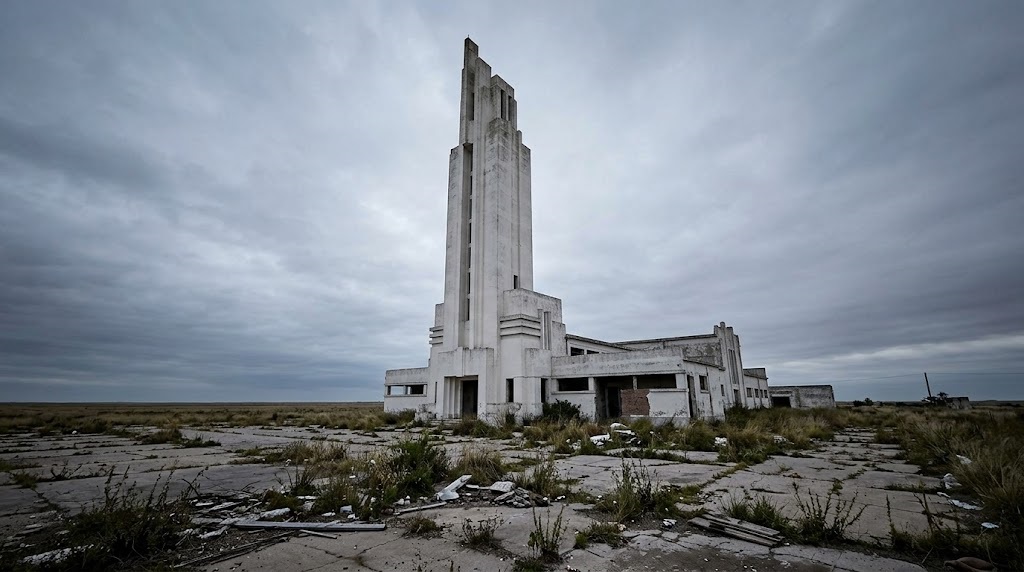 The monumental Art Deco slaughterhouse (Matadero de Carhué), designed by Francisco Salamone, rising from the salt flats.
The Monolith on the Horizon: Francisco Salamone’s Matadero
Just outside the flooded perimeter of Villa Epecuén stands one of South America’s most arresting architectural masterpieces: the Matadero de Carhué (Municipal Slaughterhouse).
Constructed in 1937 by legendary Italian-Argentine architect Francisco Salamone, this colossal structure fuses brutalist totalitarian proportions with radical Art Deco geometry. Salamone built sixty public monuments across the pampas under Governor Manuel Fresco, designed to project municipal power through sweeping towers and jagged concrete wings.
The Matadero’s 25-meter observation tower rises starkly against the flat horizon, its concrete facade scarred by salt spray and surrounded by fields of bleached bones and rusted meat hooks—an architectural exclamation point on the edge of the drowned district.
Expedition Field Guide: How to Journey to Villa Epecuén
Visiting Villa Epecuén requires crossing the vast interior plains of Buenos Aires Province.
Transit & Driving Route
- Base Camp: The staging point is the town of Carhué, situated 8 kilometers east of the ruins. Carhué features modern hotels, thermal spa baths, and regional restaurants.
- By Car from Buenos Aires: Drive southwest along Ruta Nacional 205 and Ruta Provincial 65 through Bolivar and Guaminí. The 550-kilometer (340-mile) drive takes roughly 6 to 7 hours across straight agricultural pampas.
- Long-Distance Bus: Overnight sleeper coaches (such as Chevallier or Plaza) depart daily from Retiro Bus Terminal in Buenos Aires directly to the terminal in Carhué.
Essential Visitor Protocols
- The Ruins Center & Guide Access: All visits must register at the official visitor center located at the historic railway station entrance (Ex Estación de Ferrocarril Epecuén), which now operates as an interpretive museum. Modest municipal entry fees support local conservation.
- Terrain & Salt Hazards: Wear sturdy hiking boots with thick rubber soles. The ground consists of broken concrete slabs, rusted reinforcement rebar, and sticky, deep saline mud that can ruin soft canvas sneakers.
- Corrosive Dust & Lens Care: High winds across the lake bed pick up fine sodium sulfate particulates. Keep camera lenses capped when not shooting, wipe gear with microfiber cloths immediately after visits, and never touch camera optics with salty fingers.
- Hydration & Sun Exposure: The Argentine pampas experience blistering summer heat (November to March) exceeding 36°C (97°F) with zero shade among the ruins. Pack at least two liters of drinking water, sunscreen, and broad-brimmed hats.
The Verdict
Villa Epecuén is a breathtaking modern Pompeii—a stark, poetic reminder of nature’s ability to reclaim what human ambition constructs. Standing among its petrified silver forests while the pink flamingos wade through the hypersaline lake waters beyond, travelers witness a monument not to catastrophe, but to the haunting, serene dignity of ruins washed clean by the sea.