Hidden within dense pine forests roughly 50 kilometers southwest of Berlin lies one of the most architecturally breathtaking, sprawling medical ruin complexes on Earth: Beelitz-Heilstätten.
Covering approximately 200 hectares across 60 separate brick buildings, this massive complex resembles a decaying imperial city rather than a sanatorium. Ornate brick facades, vaulted gothic ceilings, and rusted surgical operating amphitheaters stand slowly engulfed by creeping ivy and mature birch trees growing out of collapsed upper roofs.
Between 1898 and the end of the Cold War, Beelitz served as a mirror to Germany’s darkest century: a state-of-the-art tuberculosis sanctuary for imperial workers, a military trauma hospital that treated a wounded young Adolf Hitler in 1916, a heavily guarded Soviet Red Army enclave, and the final refuge of ousted East German dictator Erich Honecker.
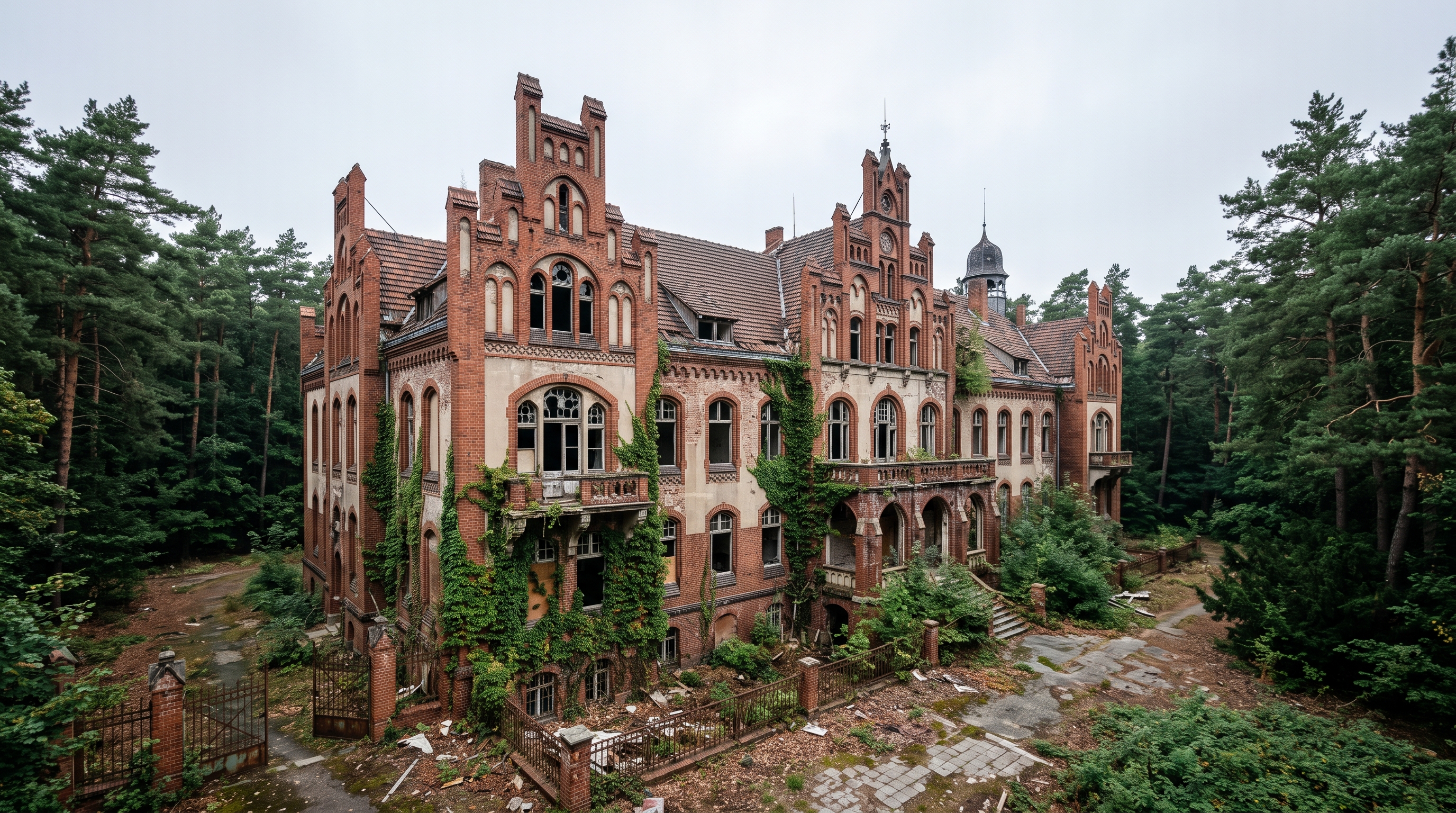 The ornate red-brick architecture of Beelitz-Heilstätten, slowly reclaimed by Brandenburg forest canopies.
The Imperial Crucible: An Utopian Cure for the White Plague
During the late 19th-century Industrial Revolution, Berlin was choked with coal smog, overcrowded tenement housing, and the rampant scourge of tuberculosis (the “White Plague”).
In response, the Berlin Workers’ Health Insurance Institute commissioned architects Heino Schmieden and Julius Boethke to construct an idyllic, self-contained sanatorium city:
- The Imperial Blueprint (1898–1930): The compound was segregated strictly into quadrants—men to the west of the railway line, women to the east, with separate zones for lung disease patients and convalescents.
- Self-Sufficient Infrastructure: Beelitz was light-years ahead of its era. It generated its own electricity via a dedicated coal thermal plant, maintained its own water pumping towers, ran a communal butchery, bakery, beer brewery, and post office, and pumped clean forest air through subterranean passive ventilation ducts.
Patients spent months lounging on sweeping south-facing balconies wrapped in heavy wool blankets, undergoing fresh-air rest cures (Liegekuren) amid manicured botanical gardens.
Blood, Shrapnel, and the Dictators
The utopian medical sanctuary vanished with the outbreak of the First World War (1914–1918), when the German Imperial Army requisitioned Beelitz as a field casualty evacuation hospital:
- Hitler’s Convalescence: In late 1916, a 27-year-old dispatch runner named Lance Corporal Adolf Hitler was transferred to Beelitz after suffering a shrapnel wound to his left thigh during the catastrophic Battle of the Somme. He recuperated in the men’s pavilion for nearly two months before returning to the trenches.
- The Soviet Cold War Enclave: After Berlin fell in May 1945, the Soviet military seized the entire complex. For the next 50 years, Beelitz was strictly classified as the largest Soviet military hospital outside the USSR. Russian Cyrillic signage, military murals, and hammer-and-sickle ironwork replaced German brass fixtures.
- Honecker’s Final Sanctuary: In December 1990, following the collapse of the Berlin Wall, former East German communist leader Erich Honecker took refuge inside the Soviet-controlled Beelitz hospital under the personal protection of Moscow, evading German arrest warrants for manslaughter before fleeing into exile to Russia and Chile.
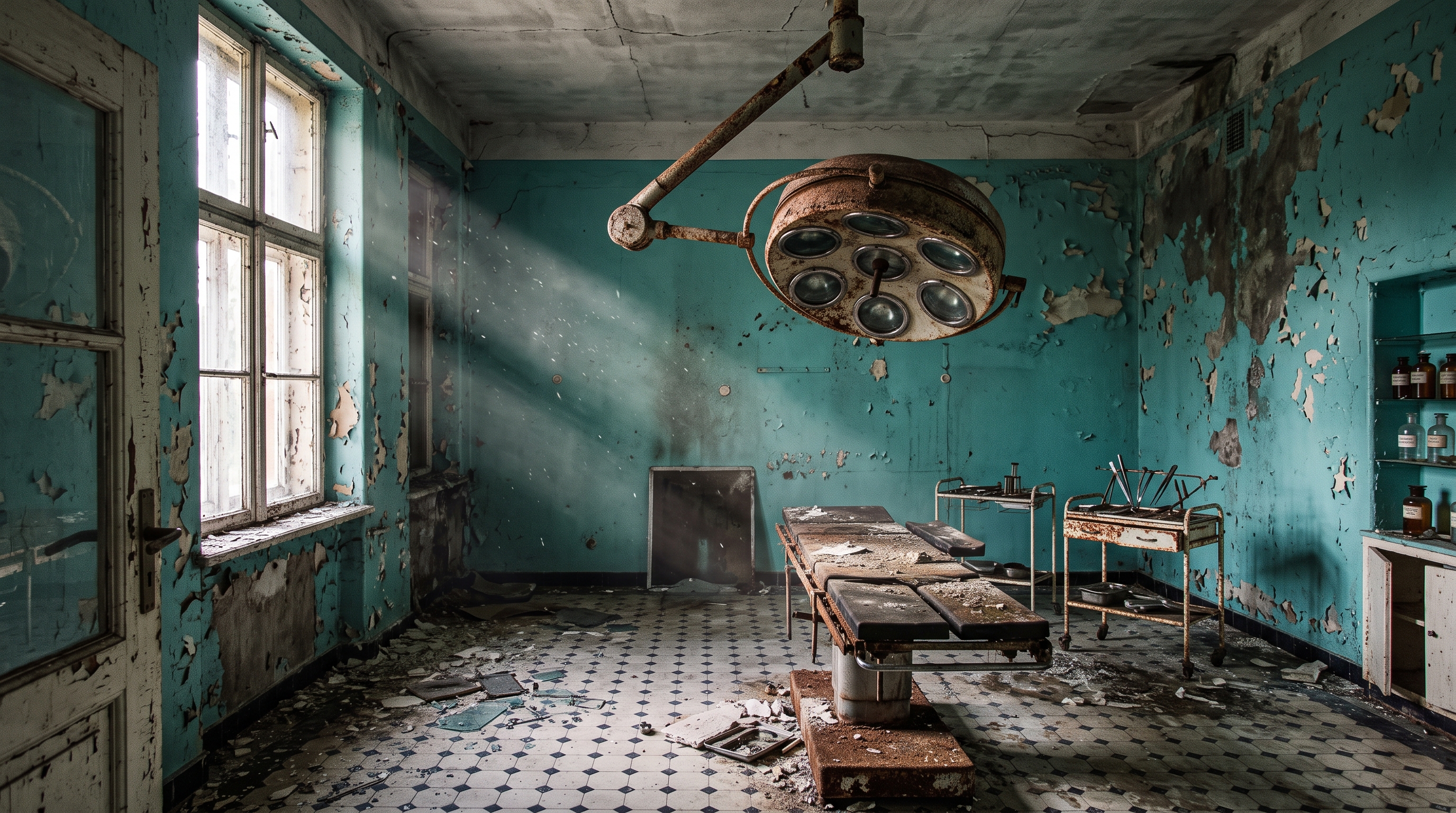 A skeletal operating suite inside the surgical pavilion, stripped down to raw tile, peeling paint, and iron beams.
The Decaying Labyrinth: From Desertion to Urban Lore
When the Red Army finally withdrew from reunified Germany in 1994, Beelitz-Heilstätten fell into administrative limbo.
Private developers went bankrupt, and the vast forest hospital was completely abandoned to the elements, scavengers, and urban explorers (urbex):
- The Natural Reclaim: Decades of roof water leaks transformed the grand Alpenhaus (Alpine Pavilion) into a living greenhouse. Seeds carried by wind took root inside floorboards, eventually growing into a literal forest blooming across the building’s fourth floor.
- The Dark Folklore: The isolated, unlit ruins became the backdrop for horrific local crimes—including murders by the serial killer known as the “Beast of Beelitz” (Wolfgang Schmidt) in the early 1990s—fueling international dark tourism legends of phantom medical whispers and paranormal sightings.
The Treetop Renaissance: The Baumkronenpfad
To halt destructive vandalism and preserve the fragile structures, authorities launched the Baumkronenpfad Beelitz-Heilstätten in 2015—an innovative 800-meter elevated steel canopy walkway suspended up to 23 meters in the air.
Visitors can now walk safely directly over the roof of the ruined Alpenhaus, peering down through collapsed ceilings at century-old bathtubs and hospital corridors overgrown with moss and towering mature trees.
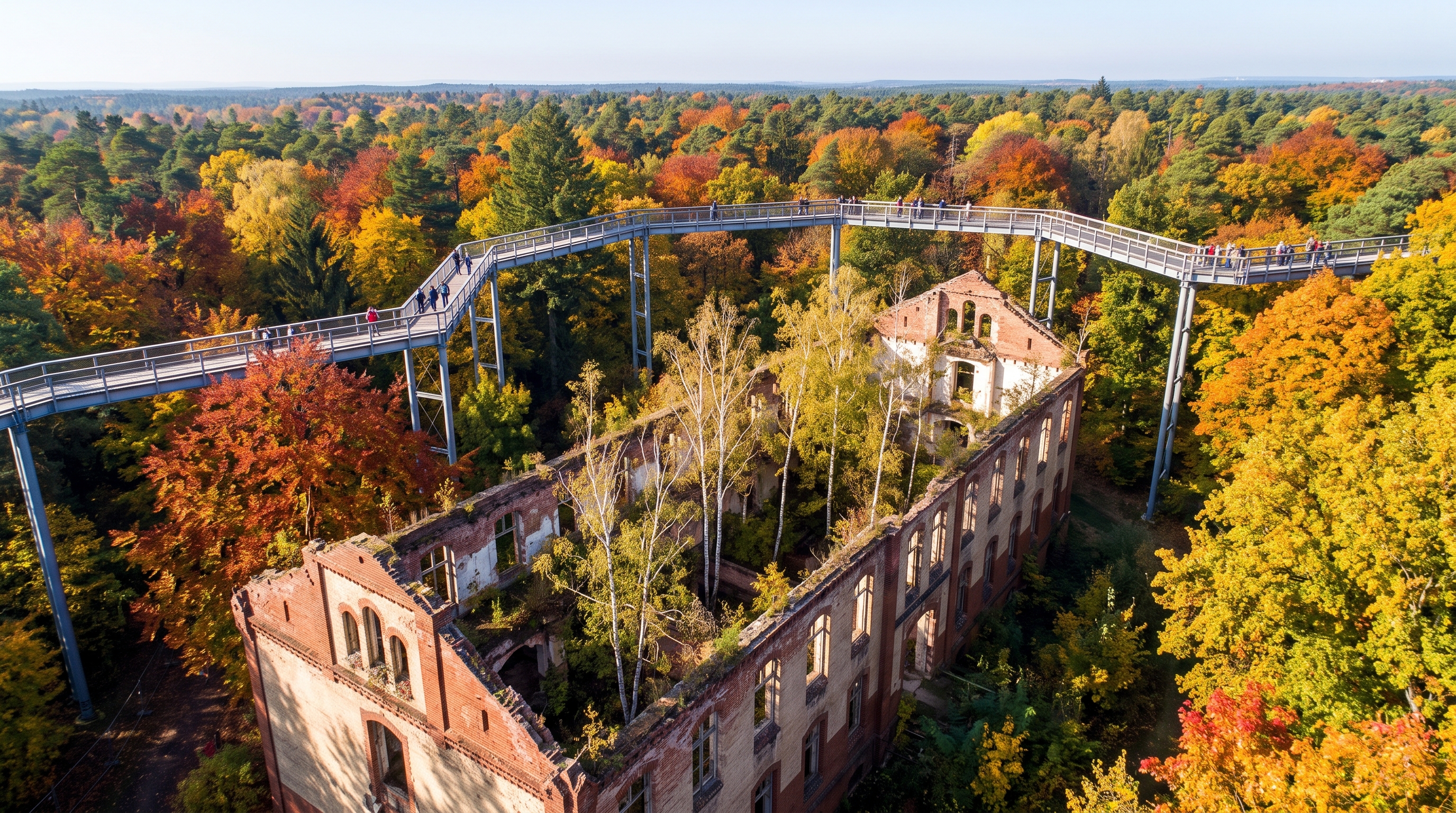 The Baumkronenpfad walkway offering a bird’s-eye view into the forested, collapsed interior of the Alpenhaus.
Expedition Field Guide: How to Visit Beelitz-Heilstätten Legally
Because trespassing inside unsecured buildings remains hazardous and strictly forbidden, visiting requires utilizing legal heritage channels.
Transit & Directions
- Regional Train from Berlin: Board the RE7 train from major Berlin stations (such as Alexanderplatz or Hauptbahnhof) bound for Dessau. Disembark directly at Beelitz-Heilstätten Station (approximately 45–50 minutes transit).
- Location: The entrance to the Baumkronenpfad park and tour meeting point is just a 5-minute walk from the train platform.
Visiting Protocols
- The Canopy Walkway: Self-guided access is permitted year-round on the elevated Baumkronenpfad boardwalk. Tickets can be purchased online or at the visitor center.
- Guided Interior Tours (Führungen): You cannot legally wander inside the locked buildings alone. Book an official guided historical tour through licensed preservation guides (such as go2know or the official visitor desk). Hard hats are provided, and tours grant access to preserved surgical rooms, the central boiler house, and gymnasium wards.
- Footwear & Photography: Wear durable closed-toe boots. Flash photography and tripods are allowed on specialized photo tours, but touching structural brickwork or picking up artifacts is prohibited.
The Verdict
Beelitz-Heilstätten is a monumental time capsule where imperial ambition, twentieth-century militarism, and the unstoppable reclamation of nature meet. Suspended between preservation and decay, these forested brick wards stand as a profound testament to the fragile transience of empires.