Stretching across the scorching northern rift valley of Tanzania, near the Kenyan border, lies a waterbody that appears plucked from an alien apocalypse: Lake Natron.
Viewed from satellite orbit, the shallow lake resembles an enormous, jagged gash of shimmering crimson and rust-orange across the cracked volcanic earth. On the ground, the air smells intensely of sulfur and salt, while heat waves distort the horizon beneath Ol Doinyo Lengai (The Mountain of God in the Maasai language)—the only active volcano on Earth that erupts carbonatite lava.
Lake Natron is renowned worldwide for a haunting biological phenomenon: its corrosive alkaline brine calcifies and mummifies animal carcasses that perish within its shallows, preserving them like calcified stone statues.
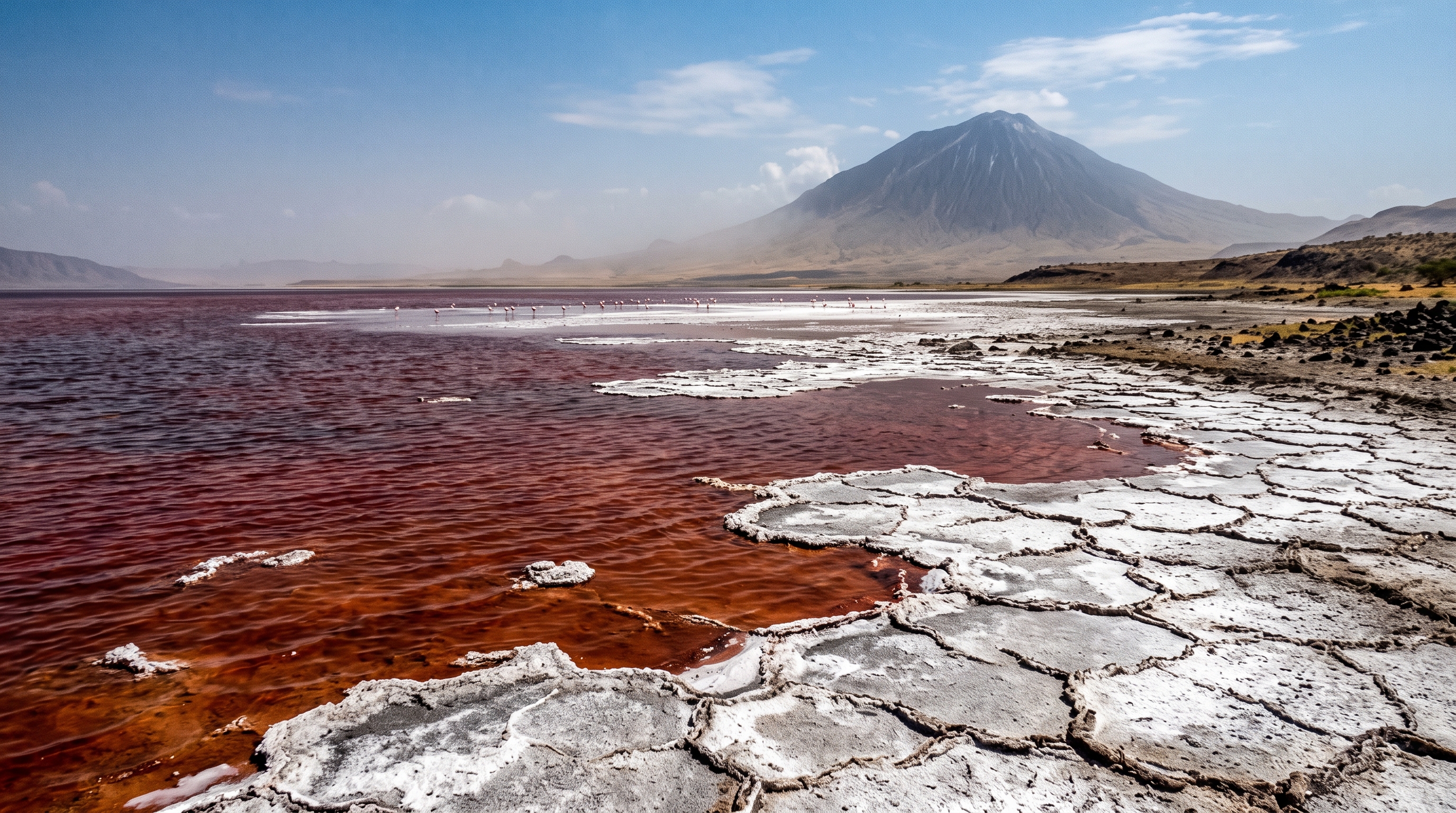 Cracked crystalline salt crusts framing the deep crimson brine of Lake Natron beneath the rift valley sun.
Lethal Chemistry: The Caustic Alchemy of Natron
The deadly nature of Lake Natron is driven by a unique convergence of hyper-arid climate and hyper-alkaline volcanic hydrology:
- The Volcanic Leaching: Surrounding volcanic hills channel mineral-rich runoff into the endorheic basin (a closed drainage lake with zero river outlets). Ol Doinyo Lengai deposits unique natrocarbonatite ash rich in sodium carbonate, potassium carbonate, and bicarbonate.
- Corrosive Alkalinity: Intense tropical evaporation concentrates these minerals into a thick chemical brine called natron—the exact naturally occurring chemical compound the ancient Egyptians harvested for mummifying pharaohs.
- The Ammonia Threshold: The water’s alkalinity routinely spikes to a pH between 10.5 and 12, caustic enough to strip ink from labels, dissolve organic mammal flesh, and cause severe chemical burns to human skin upon prolonged contact. Furthermore, subsurface thermal hot springs heat the brine shallows up to 60°C (140°F).
The eerie deep-red and orange coloration is not mineral sediment, but millions of bloom colonies of halophilic haloarchaea—salt-loving photosynthetic microorganisms that thrive in boiling, oxygen-deprived saline conditions where virtually no other cellular life can endure.
The Petrified Menagerie: How Animals Turn to Stone
The international fascination with Lake Natron ignited in 2013, when fine-art photographer Nick Brandt published his haunting documentary series Across the Ravaged Land.
Brandt encountered mummified bats, fish eagles, swallows, and flamingos washed up along the salt-encrusted shoreline. When migratory birds collide with the lake’s glassy, mirror-like surface—frequently disoriented by atmospheric thermal reflections—they drown in the hyper-saline soup:
- Instant Preservation: Because the caustic sodium carbonate brine inhibits decomposition by killing off microbial bacteria and fungi, flesh does not rot.
- Calcification: As the water level drops during the dry season, the carcasses dry out. The evaporite minerals coat feathers, claws, and skeletal tissue in a durable crust of rock-hard white sodium salts, turning the dead animals into eerie, chalk-like relics frozen in dynamic postures.
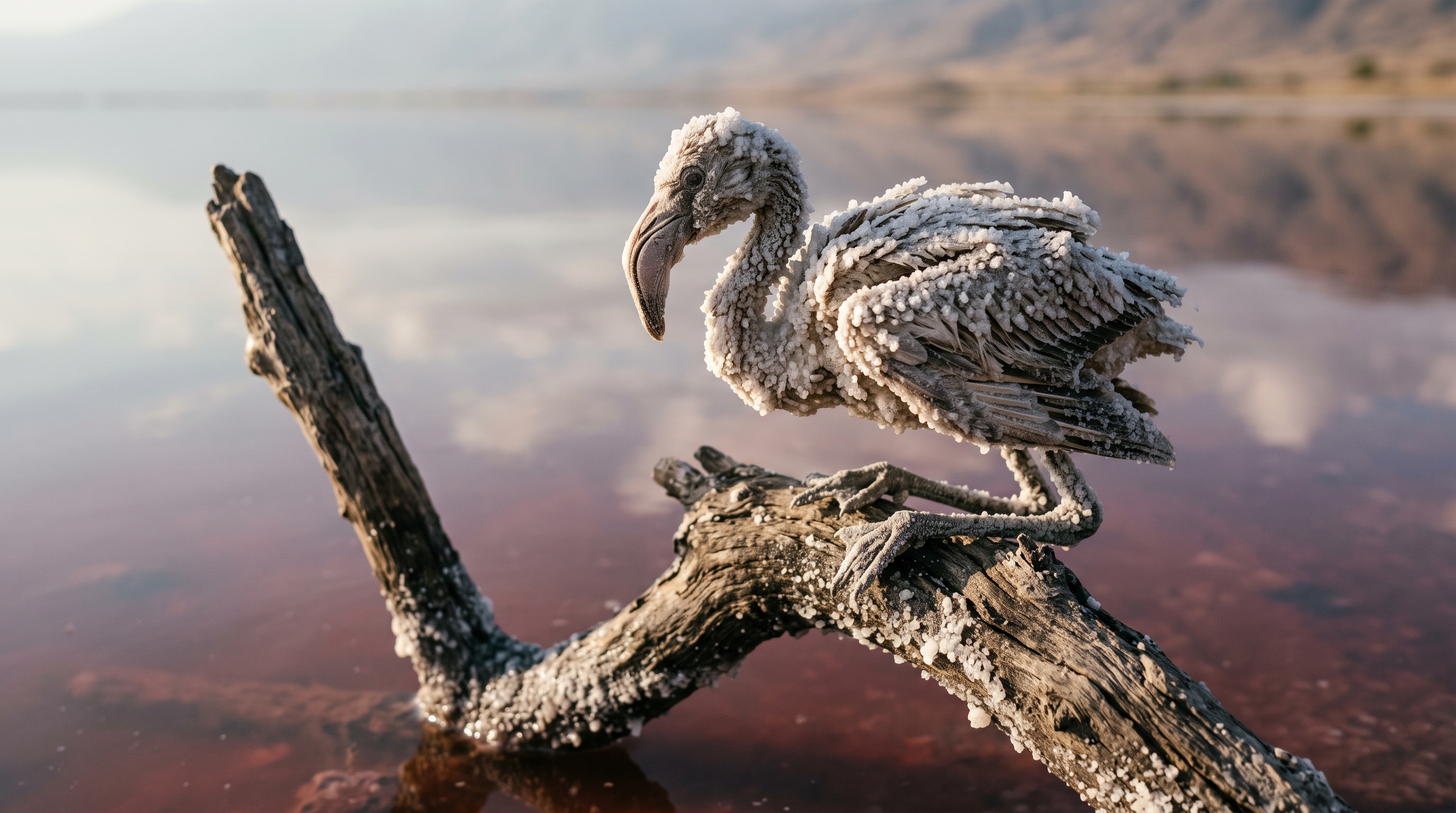 A swallow preserved by crystalline sodium carbonate minerals along the edge of the caustic basin.
The Flamingo Sanctuary: Life in the Cauldron
Paradoxically, this deadly caustic wasteland serves as the most critical biological nursery on Earth for an entire species: the Lesser Flamingo (Phoeniconaias minor).
More than 75% of the global population of lesser flamingos depends on Lake Natron as their solitary regular breeding ground in East Africa:
- The Impenetrable Moat: The lake’s lethal alkalinity acts as an impenetrable physical moat. Land predators such as jackals, hyenas, and baboons cannot wade into the corrosive caustic mudflats without burning their paws and drowning in the mire.
- Biological Armor: Flamingos have evolved tough, leathery skin on their stilt legs and specialized salt-excreting glands above their eyes, allowing them to wade and forage safely in brine that would blister human flesh.
- The Feeding Grounds: The flamingos feast peacefully on the dense blooms of spirulina cyanobacteria that blanket the mud shallows, nesting on conical mud mounds raised just inches above the hot alkaline surface.
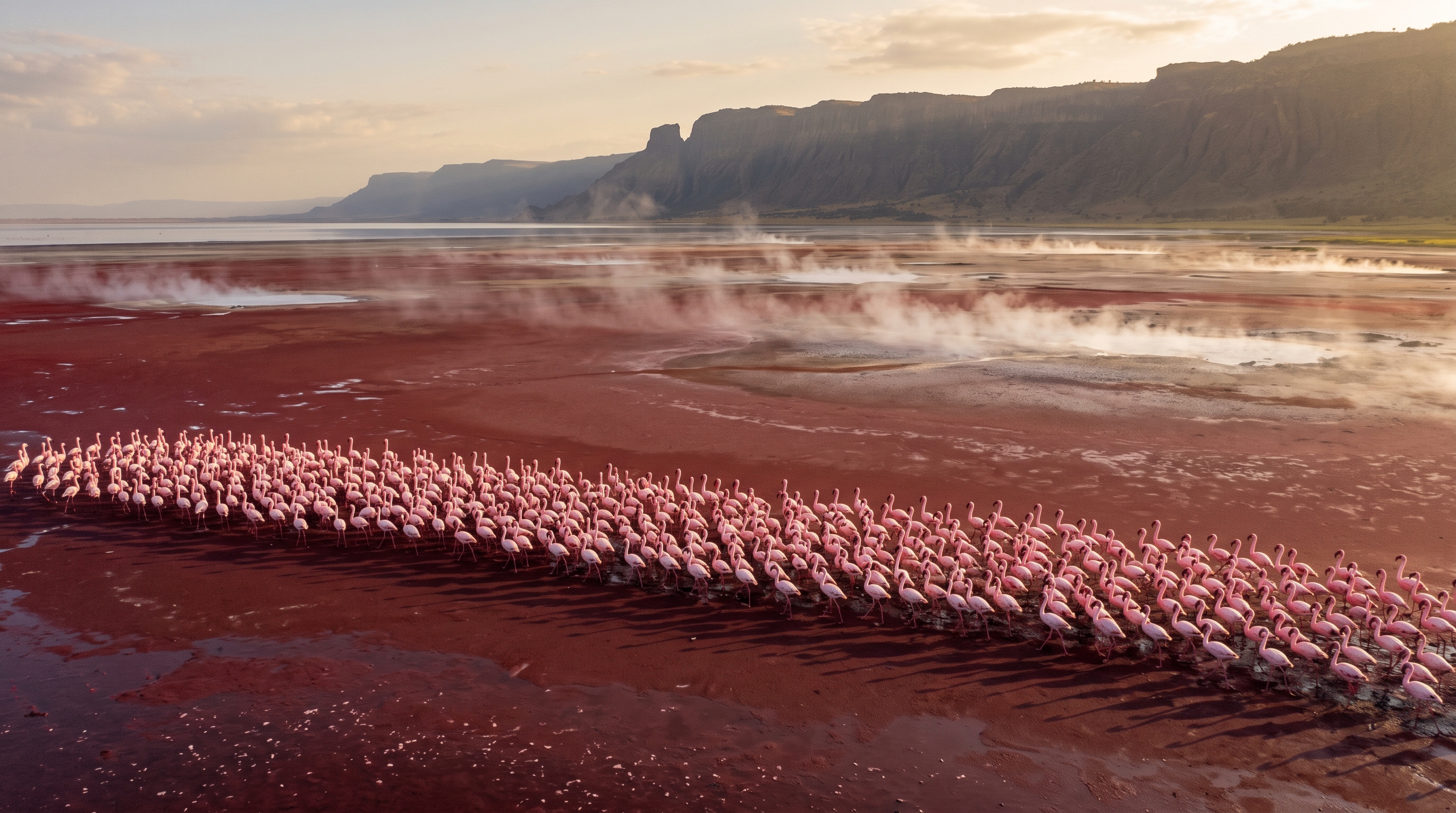 Thousands of lesser flamingos gather in the shallows of Lake Natron, safe from terrestrial predators.
Expedition Field Guide: Journey to the Caustic Basin
Lake Natron is one of the most remote, physically taxing frontiers in East Africa, requiring dedicated preparation and experienced Maasai guides.
Transit & Base Camp
- The Route: The journey begins from Arusha, traversing the rough, corrugated gravel tracks of the Great Rift Valley past the dusty trading settlement of Engaruka. The bone-jarring 4x4 drive takes 4 to 6 hours across barren volcanic plains.
- Accommodations: Eco-camps and tented safari lodges operate around the village of Engaresero, several kilometers back from the caustic mud line.
Essential Field Protocols
- Never Walk Barefoot: Crystalline salt crusts on the shoreline are razor-sharp and hide sink-traps of boiling caustic mud. Always wear heavy waterproof trekking boots with thick rubber soles.
- Skin & Eye Protection: The white salt flats reflect blinding sunlight and intense ultraviolet rays. Polarized sunglasses, wide-brim hats, and high-SPF mineral sunscreen are mandatory.
- Carry Copious Fresh Water: The dry thermal winds and 40°C (104°F) midday heat induce rapid dehydration. Carry at least 4 liters of clean drinking water per person for shoreline treks.
- Engaresero Waterfalls: After enduring the stifling alkaline heat of the lake flats, trekkers frequently hike up the narrow volcanic canyon of the Engaresero River to swim in freshwater plunge pools beneath natural mountain waterfalls.
The Verdict
Lake Natron is a masterwork of natural paradox—a primordial crucible where lethal volcanic chemistry and life’s incredible resilience meet. To stand on its cracked salt plains under the shadow of Ol Doinyo Lengai, surrounded by blood-red waters and silent calcified statues, is to witness nature operating at its most sublime, uncompromising extremes.