Roughly 70 kilometers east of Prague, in the historic silver-mining town of Kutná Hora, sits an unassuming medieval cemetery chapel known as the Church of All Saints. From the exterior, its slender 14th-century Gothic spires and quiet manicured grounds appear completely ordinary.
Walk down the damp stone steps into the subterranean crypt, however, and you are confronted by one of the most astonishing, macabre spectacles in human history: Sedlec Ossuary (Kostnice v Sedlci).
Decorating the vaulted ceilings, hanging from chandeliers, framing archways, and stacked in colossal pyramids are the bleached skeletal remains of an estimated 40,000 to 70,000 human beings. Far from a chaotic graveyard, these bones have been bleached, sorted, and meticulously sculpted into baroque ecclesiastical art.
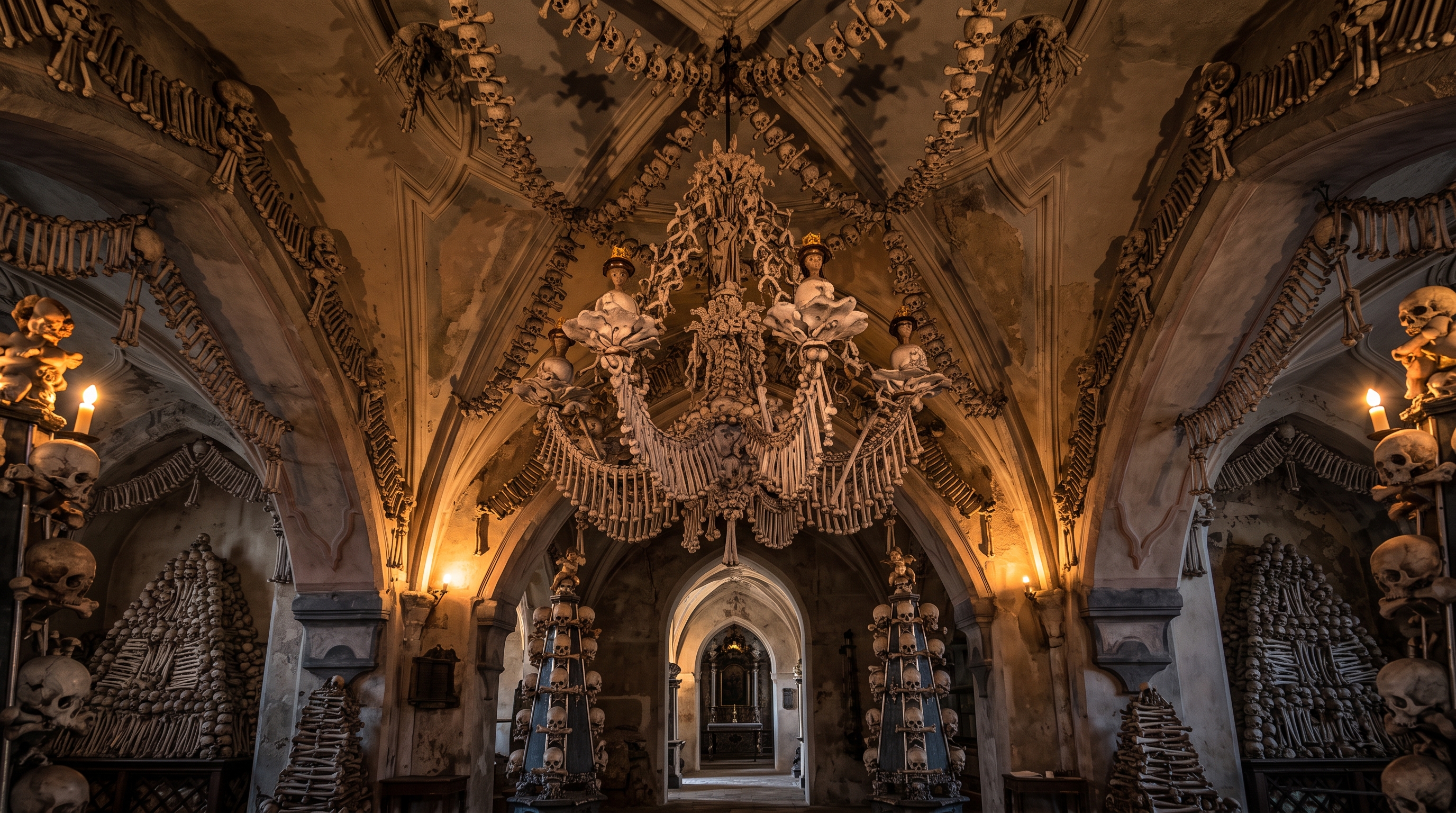 The centerpiece chandelier of Sedlec Ossuary: an intricate composition incorporating at least one specimen of every single bone in the human skeleton.
The Holy Soil: The Genesis of a Holy Graveyard
The story of how thousands of souls congregated beneath this small chapel began in 1278. King Otakar II of Bohemia dispatched Abbot Henry, head of the local Cistercian monastery at Sedlec, on a diplomatic mission to Jerusalem.
Upon his return, Abbot Henry brought back a handful of sacred earth gathered from Golgotha—the hill where Jesus Christ was crucified according to Christian theology—and scattered it across the Sedlec monastery cemetery:
- The Premier Holy Ground: Word of the consecrated soil spread rapidly throughout Bohemia, Poland, Bavaria, and Silesia. Sedlec instantly became the most coveted burial site in Central Europe; wealthy nobles and pious peasants alike paid fortunes to ensure their final resting place was blessed by Jerusalem’s earth.
- The Catastrophes: In 1348, the Black Death (Bubonic Plague) ravaged Europe, dumping over 30,000 corpses into mass trenches at Sedlec in a single season. Decades later, during the early 15th-century Hussite Wars, violent crusades resulted in thousands more casualties buried across the cemetery grounds.
By 1400, the graveyard was completely overwhelmed. To make room for new burials, thousands of older graves were exhumed, and their skeletal remains were unceremoniously stacked into the damp vaults beneath the newly constructed cemetery chapel.
The Blind Monk and the Woodcarver’s Genius
For nearly a century, the bones sat in disorganized heaps. Local tradition records that in 1511, a half-blind Cistercian monk was tasked with organizing the immense mounds. He dedicated the rest of his life to stacking the remains into six gigantic, orderly bell-shaped pyramids in the chapel corners.
The ossuary assumed its modern artistic form in 1870.
Following the secularization of church estates, the noble Schwarzenberg family purchased the monastery grounds. Baffled by the immense mass of disorganized bones in the chapel crypt, they hired a local master woodcarver named František Rint to bring order to the chamber.
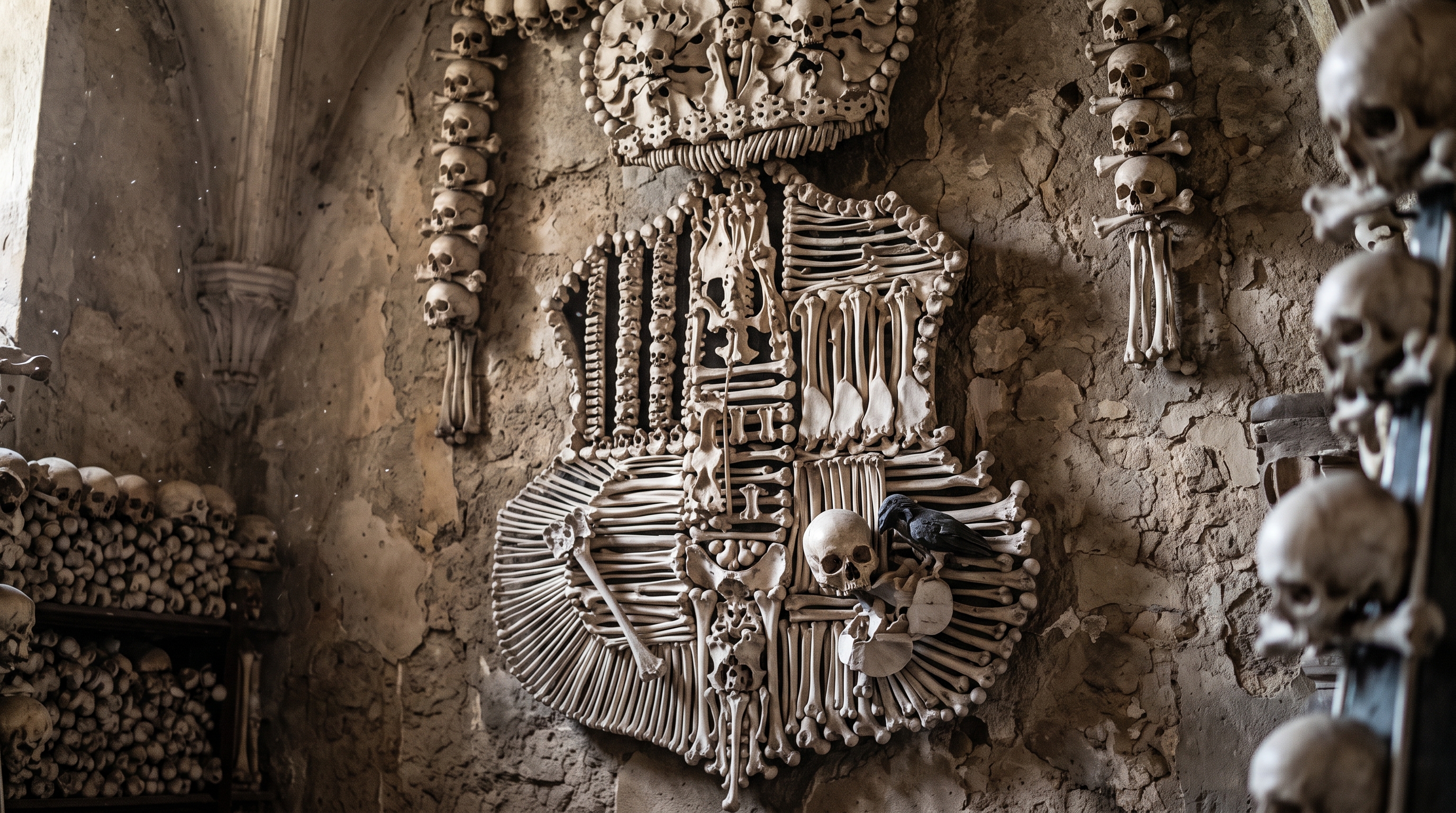 The Schwarzenberg family coat of arms, rendered in human femurs, ribs, and skulls—including a raven pecking at a severed head.
Given creative freedom, Rint saw the bleached remains not as trash, but as a medium for profound Christian devotion:
- The Bone Chandelier: Suspended from the center of the nave hangs a colossal chandelier. Supported by carved wooden frames, it contains at least one of every single bone in the human body, adorned with garlands of human skulls and pelvic bones holding candle sconces.
- The Aristocratic Heraldry: On the chapel’s left wall, Rint reproduced the elaborate heraldic coat of arms of the House of Schwarzenberg using human vertebrae, ribs, and arm bones. It faithfully includes the family’s historic emblem: a raven pecking at the eye of a severed Turkish soldier’s skull.
- The Signature: Near the entrance stairwell, Rint proudly immortalized his work by signing his name in bone: “1870 František Rint z České Skalice”, spelled out entirely in human finger and arm bones.
Memento Mori: Sacred Devotion, Not Horror
To modern sensibilities, Sedlec Ossuary can feel chilling or theatrical. Yet in medieval and baroque Christian theology, the crypt was deeply reverent.
The chapel represents the physical embodiment of Memento Mori (Remember that you must die) and Vanitas—philosophical concepts reminding human beings of the fleeting illusion of earthly vanity, wealth, and power.
Before the altar of Sedlec, social hierarchies dissolve completely. The bones of wealthy feudal lords, pious abbots, impoverished plague victims, and slaughtered infantrymen are indistinguishable, woven together into symmetrical tapestries under the gaze of eternity.
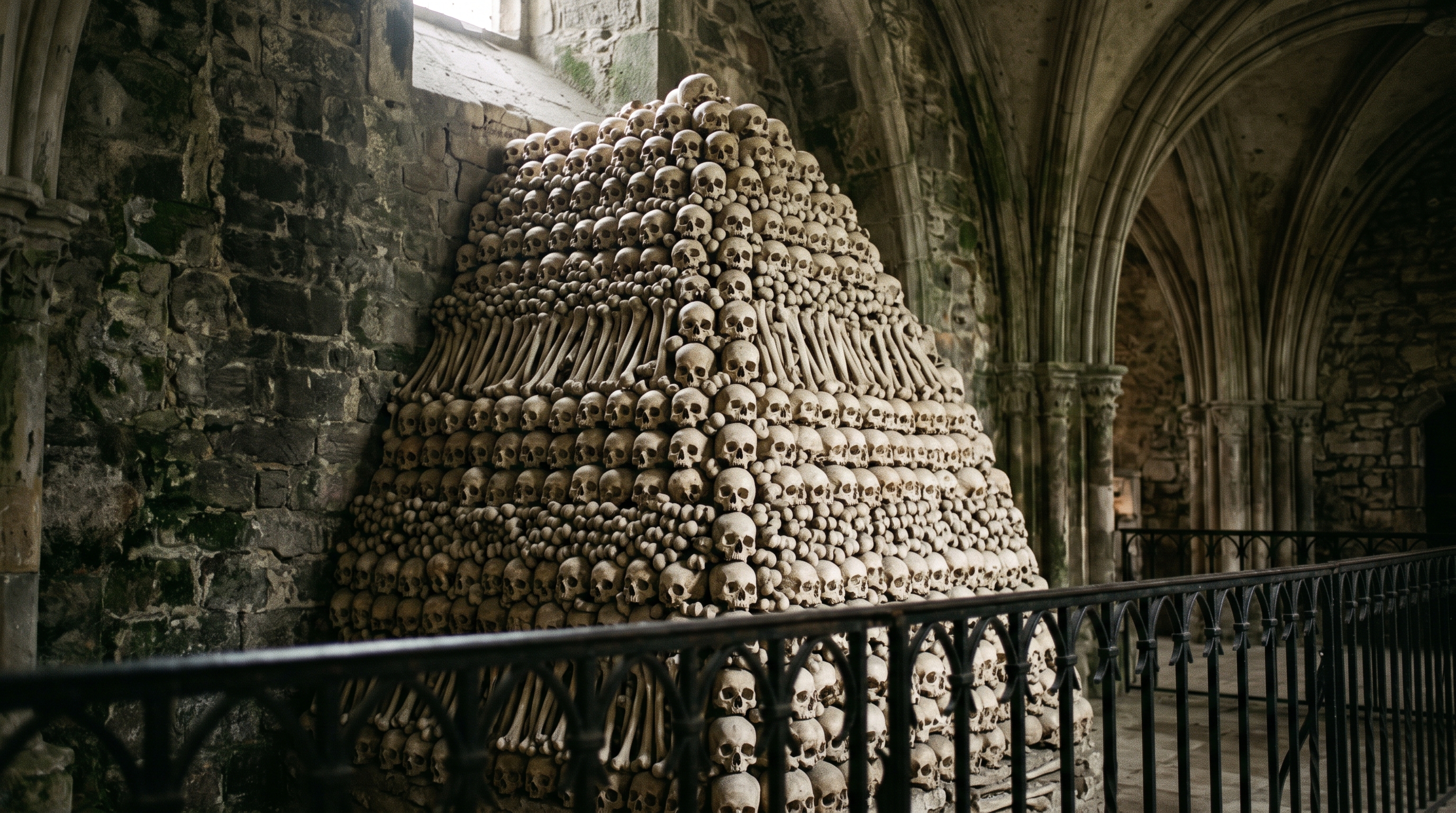 One of four colossal bell-shaped pyramids containing thousands of sorted human skulls and limb bones.
Expedition Field Guide: How to Visit Kutná Hora
Sedlec Ossuary is an easy, highly rewarding excursion from the Czech capital, but visitor regulations have tightened in recent years to preserve the site’s dignity.
Getting There
- Transit from Prague: Direct trains depart hourly from Praha Hlavní Nádraží (Prague Main Station) to Kutná Hora Hlavní Nádraží. The journey takes approximately 50 minutes.
- Walking to the Chapel: From the Kutná Hora station, the Sedlec Ossuary is a short, flat 10-minute walk through the Sedlec neighborhood.
Important Visitor Rules & Photography
- The Photography Ban: In response to viral “selfie culture” and disrespectful tourist behavior, photography and video recording inside the ossuary are strictly banned during public hours without an advance commercial media permit. Put phones away and experience the sanctuary through your own eyes.
- Combination Tickets: Tickets cannot be purchased at the door of the ossuary itself. You must buy tickets at the Sedlec Information Centre (located 200 meters up the road), which also grants admission to the nearby UNESCO-listed Cathedral of Our Lady at Sedlec and the breathtaking St. Barbara’s Church.
- Behavioral Code: Sedlec is an active consecrated place of Christian worship and a mass tomb. Dress respectfully (cover shoulders and knees), speak in whispers, and never touch the skeletal displays.
The Verdict
Sedlec Ossuary is a singular masterpiece of sacred architecture where death and beauty coexist in astonishing harmony. To stand beneath its bone chandelier in the quiet underground chill is to confront our shared human condition—a silent, humbling reminder that all earthly kingdoms eventually return to dust.