Nestled at the foot of the jagged Aravalli mountain range in Rajasthan’s Alwar district, roughly 85 kilometers from Jaipur, stands the sprawling 16th-century fortress of Bhangarh.
Encircled by three concentric ramparts, the citadel contains the skeletal ruins of grand royal palaces, elaborate Hindu stone temples, bazaars with roofless stone stalls, and fortified gates. While its classical medieval architecture is historically breathtaking, Bhangarh is renowned worldwide for a darker reputation: it is officially designated by local tradition and paranormal folklore as the most haunted location on the Asian continent.
It is also one of the few historical monuments on Earth where nocturnal entry is strictly prohibited by federal government decree.
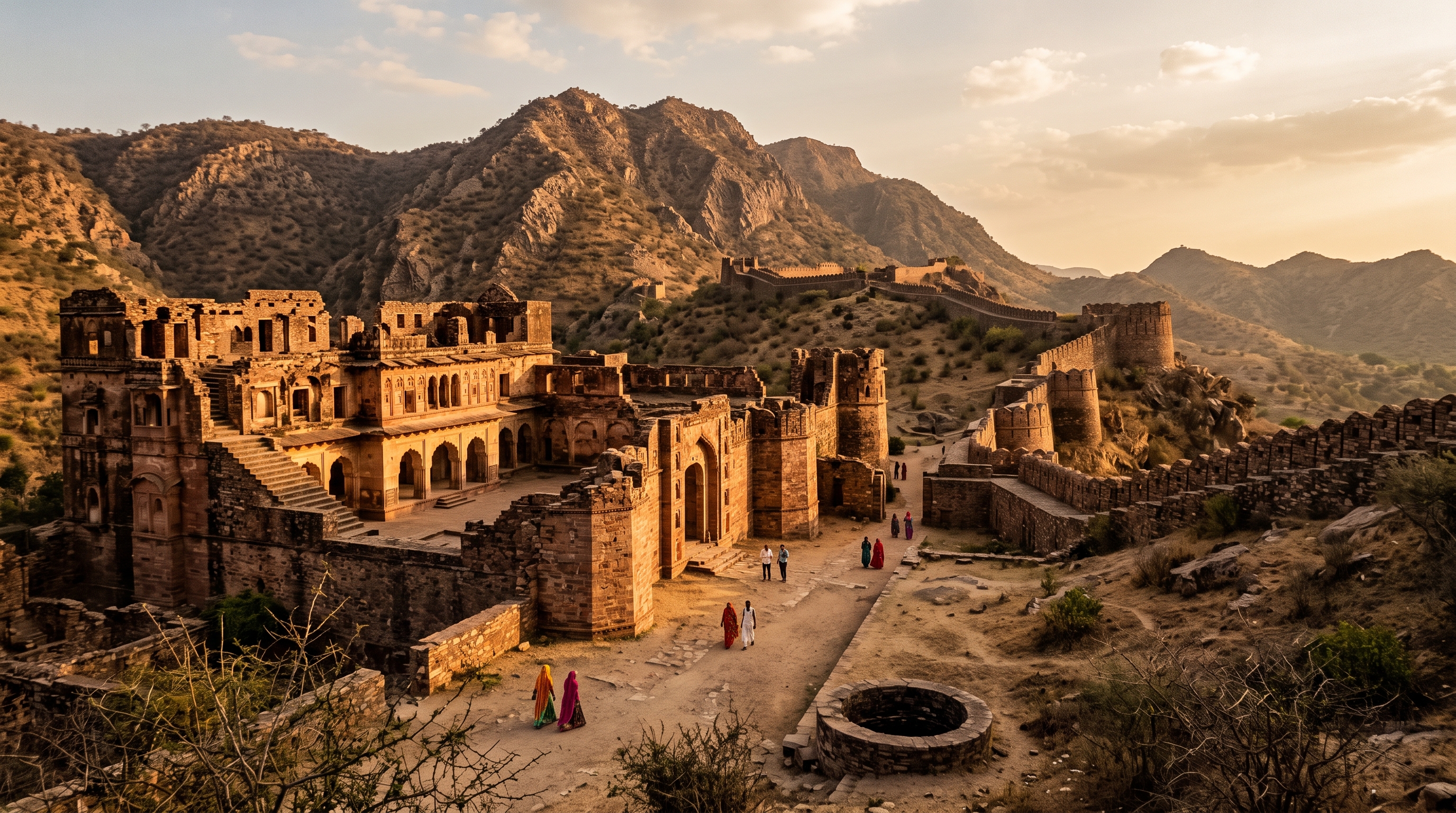 The sun-bleached stone ruins and stepwells of Bhangarh Fort framed against the desolate Aravalli range.
The Sunset Decree: The Government Warning Signboard
At the main entrance gate of the fortress stands a conspicuous yellow signboard erected by the Archaeological Survey of India (ASI)—the official federal body responsible for conserving cultural monuments.
Unlike standard heritage plaques, this signboard bears an explicit, legally binding legal restriction written in Hindi:
“Entering the borders of Bhangarh before sunrise and after sunset is strictly prohibited. Legal action will be taken against anyone who does not follow these instructions.”
Locals recount persistent tales of daredevil travelers who sneaked inside after dark to explore the empty stone pavilions, never to emerge, or who suffered severe psychological trauma and fatal accidents immediately following their visit. While modern authorities cite wildlife and safety hazards rather than ghosts, the aura of the dusk-to-dawn ban has turned Bhangarh into a pilgrimage site for international dark tourism.
The Dual Curses: History Meets Folklore
Established in 1573 by Raja Bhagwant Das for his son Madho Singh, Bhangarh was once a thriving imperial city of over 10,000 residents. Its sudden and total abandonment during the early 1700s gave rise to two powerful oral legends passed down across generations:
- The Shadow of the Ascetic: The first legend tells of Guru Balu Nath, a local holy hermit who meditated in the rocky hills where the fort was built. He granted permission for the citadel’s construction under one strict condition: the shadow of the royal palace must never touch his sacred meditation dwelling. Years later, an ambitious successor added vertical towers that cast a long shadow across Balu Nath’s sanctuary. The hermit supposedly cursed the fortress: “The moment the shadow touches my abode, the city shall be annihilated and rendered uninhabitable forever.”
- The Tantrik Sorcerer’s Obsession: The more prominent folklore centers on Princess Ratnavati, the jewel of Rajasthan renowned for her beauty. A local practitioner of black occult magic named Singhia became infatuated with her. He cast a spell over a vial of perfumed oil intended for the princess to hypnotize her into his arms. Ratnavati unmasked the deception and threw the vial onto a massive boulder. The enchanted stone leaped into motion, rolling down the hill and crushing Singhia. With his dying breath, the sorcerer cursed Bhangarh: every resident within the walls would meet sudden, violent death with souls bound within the stone, incapable of rebirth.
Soon after, a brutal military war broke out with the neighboring kingdom of Ajabgarh. The population was massacred, the palace sacked, and the city abandoned to the desert dust.
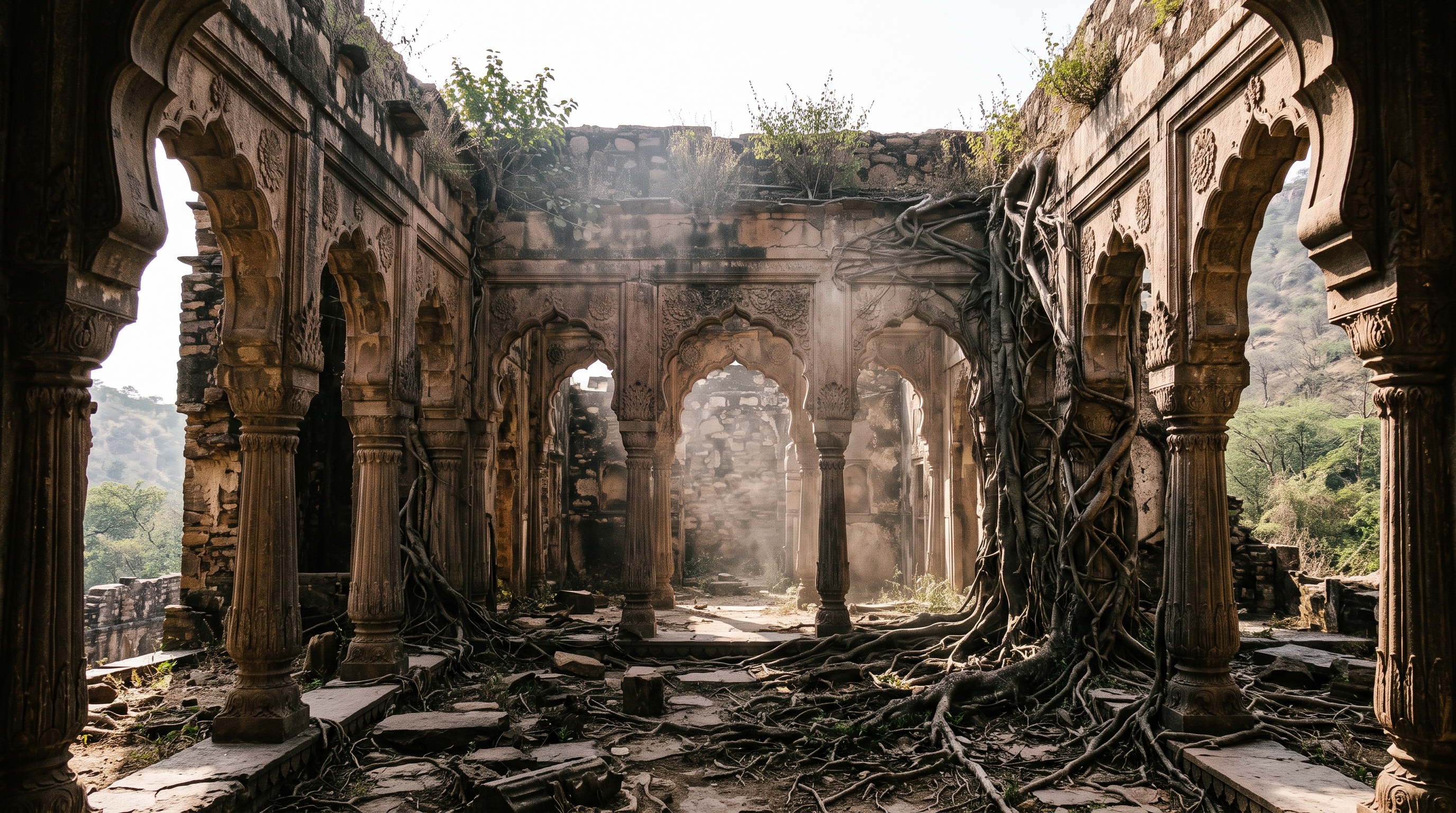 Crumbling arched corridors and roofless royal chambers reclaimed by wild banyan trees.
The Rational Reality: Leopards, Bats, and Falling Masonry
Beyond the paranormal lore, historians and park rangers point out very tangible physical reasons why Bhangarh Fort is both eerily quiet and legitimately dangerous after twilight:
- Apex Predators from Sariska: Bhangarh borders the dense jungle boundaries of Sariska Tiger Reserve. As soon as night falls, nocturnal predators—predominantly wild Indian leopards, striped hyenas, and Bengal tigers—regularly roam through the empty stone gates and ruins hunting wild boars and langur monkeys.
- Deadly Pitfalls & Absence of Electricity: The ancient fortress has zero artificial lighting. The ruined floors are riddled with unmarked open subterranean reservoirs, dry stepwells (baoris), and unstable stone lintels ready to collapse under minimal weight.
- Venomous Vipers: The sun-warmed rubble provides ideal nesting grounds for deadly venomous snakes, particularly the Indian saw-scaled viper (Echis carinatus) and the common krait (Bungarus caeruleus), whose nocturnal hunting habits make nighttime foot traversal hazardous.
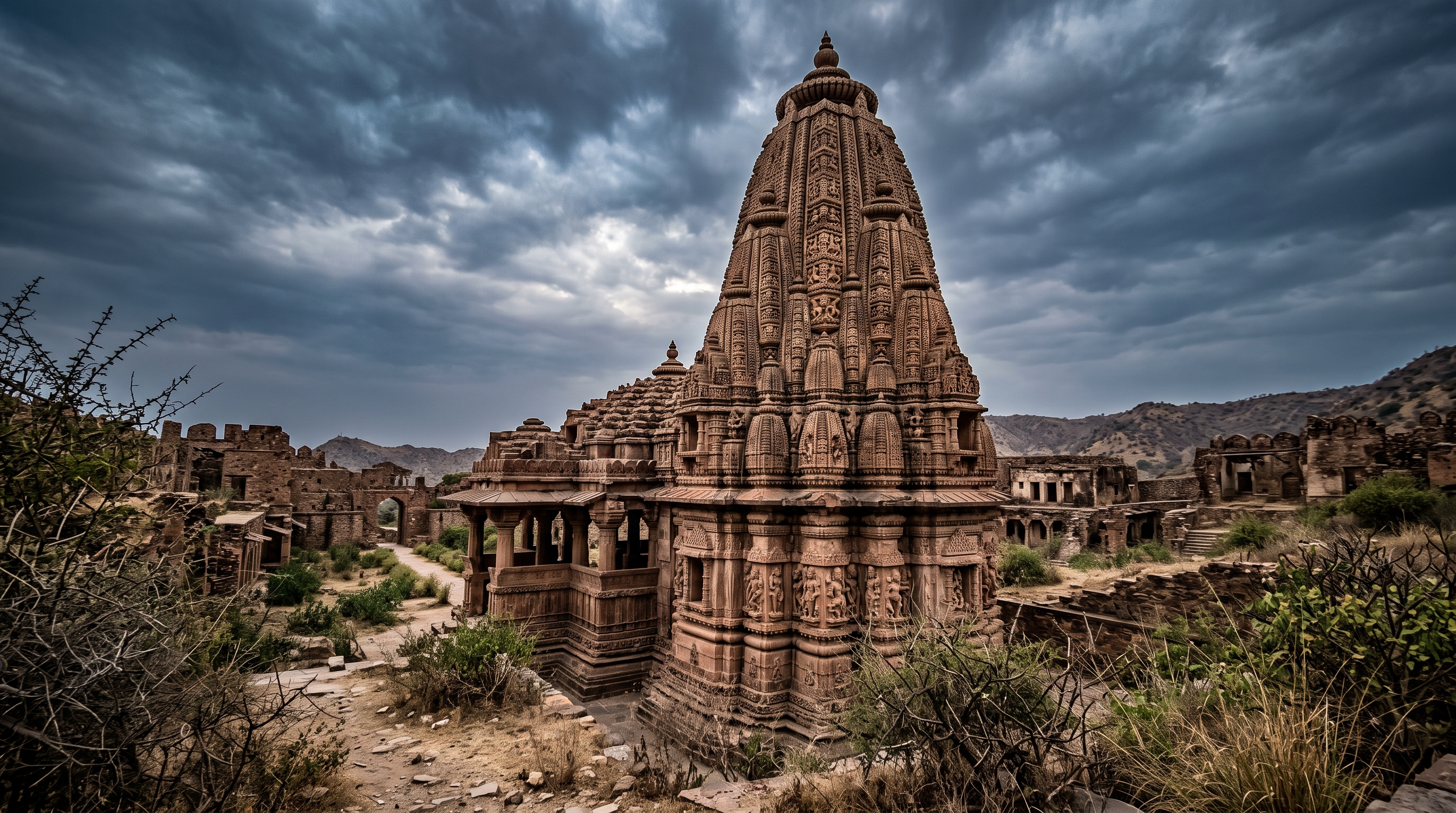 Intricate stone carvings of Gopinath Temple, one of several ancient shrines that survived the destruction of the fortress.
Expedition Field Guide: How to Visit Safely
Bhangarh is accessible as a day trip from the major tourist hubs of northern India, but requires strict adherence to operating hours.
Transit & Timing
- Base Camp: Stay in Jaipur (the Pink City) or Alwar. The most practical way to reach the site is by hiring a private taxi or rental vehicle for the 2.5-hour drive via NH21.
- Gate Hours: The complex is open daily strictly between 06:00 AM and 06:00 PM. Guards actively clear all visitors from the inner palace grounds by 05:00 PM to ensure the outer gate is bolted before darkness sets in.
Exploration Tips
- Explore the Ancient Temples: Interestingly, while the residential palaces and bazaars are completely ruined, several exquisite Hindu temples—including Gopinath Temple, Someshwar Temple, and Mangla Devi Temple—remain structurally intact and feature breathtaking Nagar-style stone carvings.
- Bring Water & Sun Protection: The Rajasthani heat inside the stone valley can soar well above 40°C (104°F) during summer months. Carry ample hydration, as on-site amenities are virtually nonexistent.
- Beware of Langur Monkeys: Large troops of rhesus macaques and gray langurs occupy the palace upper tiers. Keep food, sunglasses, and camera straps securely tucked away.
The Verdict
Bhangarh Fort is a rare crossroads where medieval architecture, royal tragedy, and primal nature meet. To wander through its roofless stone streets under the blazing afternoon sun is to step into a ghost kingdom frozen in time—a solemn reminder of how quickly the grandest imperial dreams can be swallowed by the silent desert hills.