Perched at an elevation of 1,441 meters (4,728 feet) atop Mount Hadzhi Dimitar in the windswept Central Balkan Mountains stands one of the most surreal architectural monuments on Earth: the Buzludzha Monument.
Emerging from thick mountain mists like a stranded extraterrestrial spacecraft, this colossal concrete saucer and adjacent 70-meter (230-foot) observation pylon officially served as the House-Monument of the Bulgarian Communist Party. Unveiled in 1981, the structure cost roughly 14 million Bulgarian leva (funded through mandatory worker contributions and commemorative stamp sales) and required seven years of grueling alpine engineering by over 6,000 workers and military conscripts.
Following the collapse of Bulgaria’s communist government in November 1989, Buzludzha was stripped of state security, abandoned to brutal mountain blizzards, and systematically looted. Today, it stands as a haunting, hollowed-out concrete shell—an astonishing temple of brutalist propaganda slowly conquered by mountain frost and decaying stone mosaics.
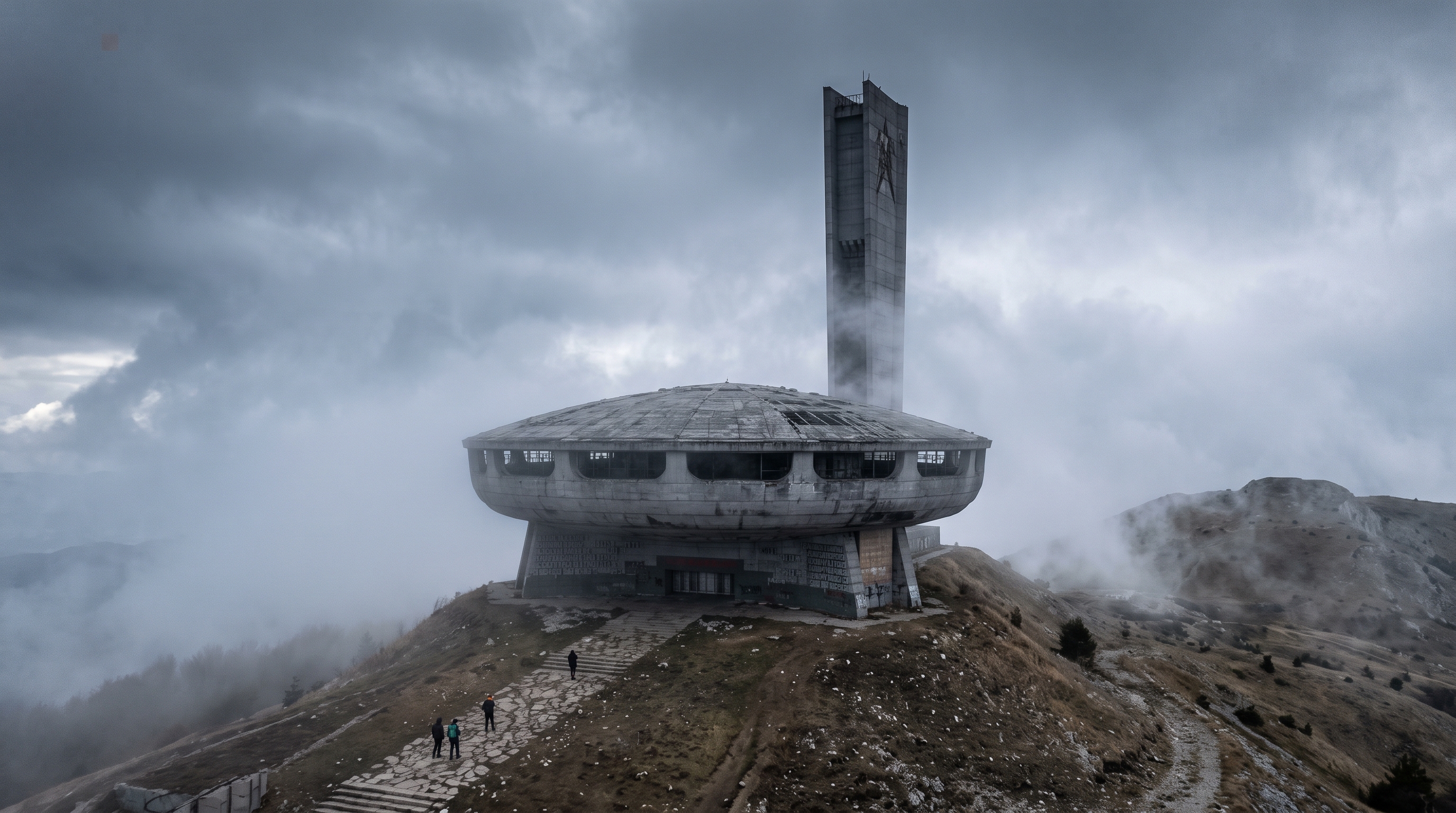 The concrete saucer and observation tower of the Buzludzha Monument rising through heavy Balkan fog.
The Ideological Mountaintop: Why Buzludzha?
The site was not chosen by accident; it was saturated in Bulgarian national mythology:
- The Hadzhi Dimitar Rebellion (1868): It was here that Bulgarian rebel commander Hadzhi Dimitar fought his desperate, bloody last stand against overwhelming Ottoman forces, securing his place as a martyr of national liberation.
- The Secret Socialist Congress (1891): In July 1891, Dimitar Blagoev and a small cell of revolutionaries met secretly on this remote peak to establish the Bulgarian Social Democratic Workers’ Party, the ideological forerunner of the communist regime.
To memorialize these twin foundations of armed rebellion and socialist doctrine, leading modernist architect Georgi Stoilov conceived an uncompromising brutalist amphitheater—a monument designed to look not back toward antiquity, but forward into a triumphant space-age future.
Architectural Triumph: Saucers, Mosaics, and Ruby Glass
Buzludzha was an unprecedented feat of mountain construction:
- The Saucer Sanctuary: The main circular dome spans 60 meters in diameter, hovering over an expansive ceremonial amphitheater lined with curved tiers of marble and red velvet seating. Overhead, a massive hammered copper relief of the hammer and sickle gleamed beneath the Cyrillic inscription: “Proletarians of all countries, unite!”
- The Master Mosaics: Encircling the inner circular promenade were over 500 square meters of intricate stone and smalt glass mosaics created by thirty renowned Bulgarian artists. The murals depict vivid socialist-realist tableaus: cosmic cosmonauts, peasant uprisings, factory furnaces, and stern portraits of Karl Marx, Friedrich Engels, and Vladimir Lenin.
- The Ruby Stars of the Pylon: Rising beside the saucer is a monolithic concrete tower featuring two 12-meter-tall faceted glass stars manufactured in Kyiv. Made of synthetic ruby glass and backlit by industrial spotlights, they were engineered to glow across the Thracian Valley by night and were three times larger than the red stars crowning the Moscow Kremlin.
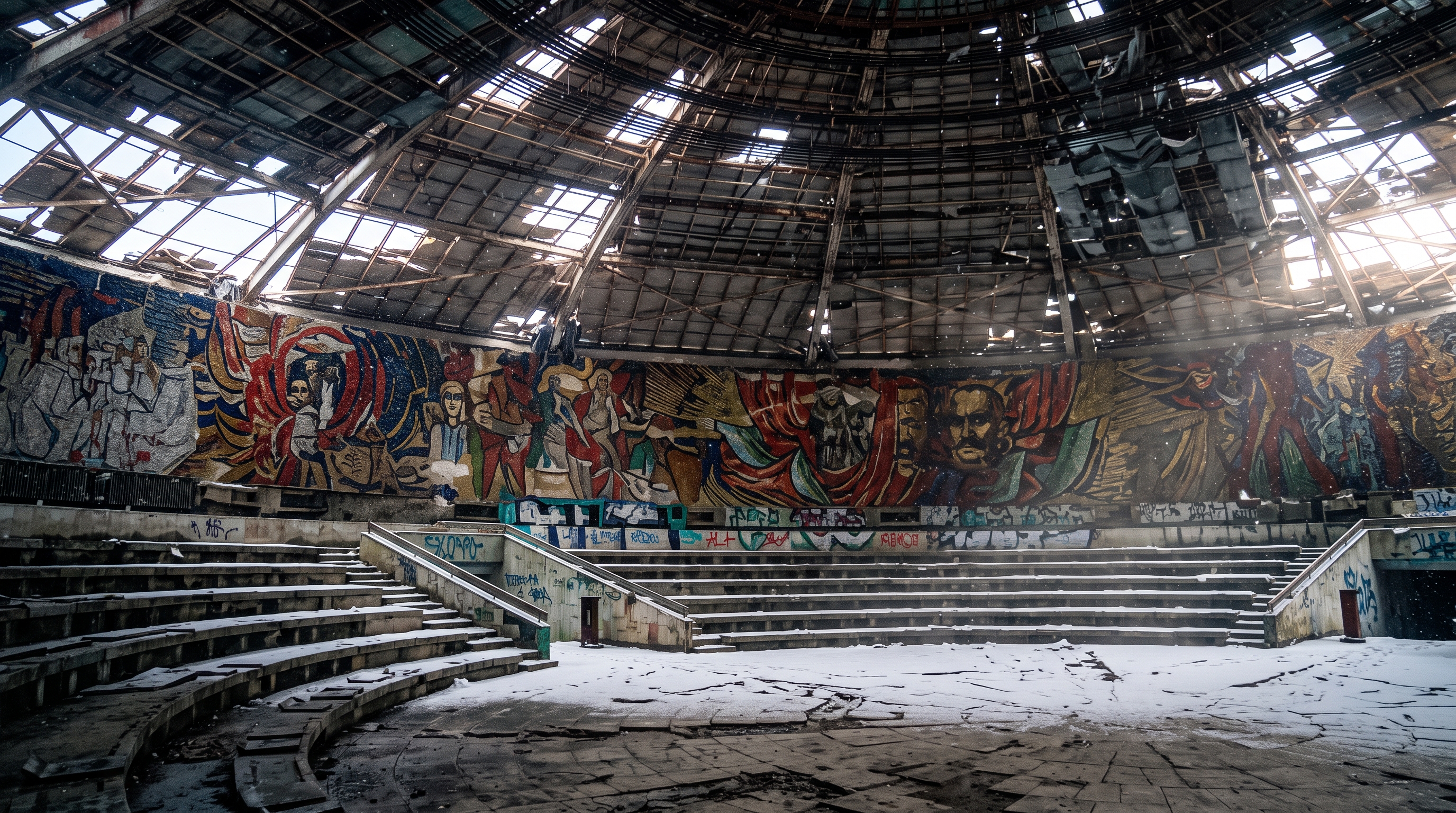 Inside the central amphitheater: decaying glass mosaic panels beneath exposed structural steel roof trusses.
The Fall and the Myth of the Real Rubies
When the Iron Curtain dissolved, Buzludzha’s fate was sealed:
- The Looting: Transferred from state ownership to municipal neglect, looters quickly invaded the unguarded sanctuary. Copper roof paneling was ripped away, exposing delicate interior plaster to sub-zero freeze-thaw cycles. Marble floor slabs and bronze fixtures were stripped for scrap.
- The Ruby Heist: A widespread local urban myth claimed that the massive red stars atop the pylon were made of genuine geological rubies. Treasure hunters fired rifle rounds into the glass and climbed the interior tower shafts, only to discover standard leaded industrial glass stained with copper and selenium.
- The Decay: Over three decades of exposure to alpine blizzards, icicles hanging from rusted steel rafters, and howling gale winds created an awe-inspiring ruin aesthetic that attracted international urban explorers, photographers, and documentary crews.
Preservation and Stabilization
Recognizing its irreplaceable architectural and historical significance, international heritage organizations intervened:
- Europa Nostra & The Getty Grant: In 2018, Europa Nostra listed Buzludzha among Europe’s 7 Most Endangered Heritage Sites. In 2019 and 2020, the Getty Foundation awarded substantial conservation grants to survey the structure and stabilize the surviving 80% of delicate wall mosaics.
- The Protective Canopy: Expert restorers constructed temporary wooden shelters and protective mesh over the mosaic walls to shield the smalt glass from rainwater and direct sun exposure while long-term stabilization plans proceed.
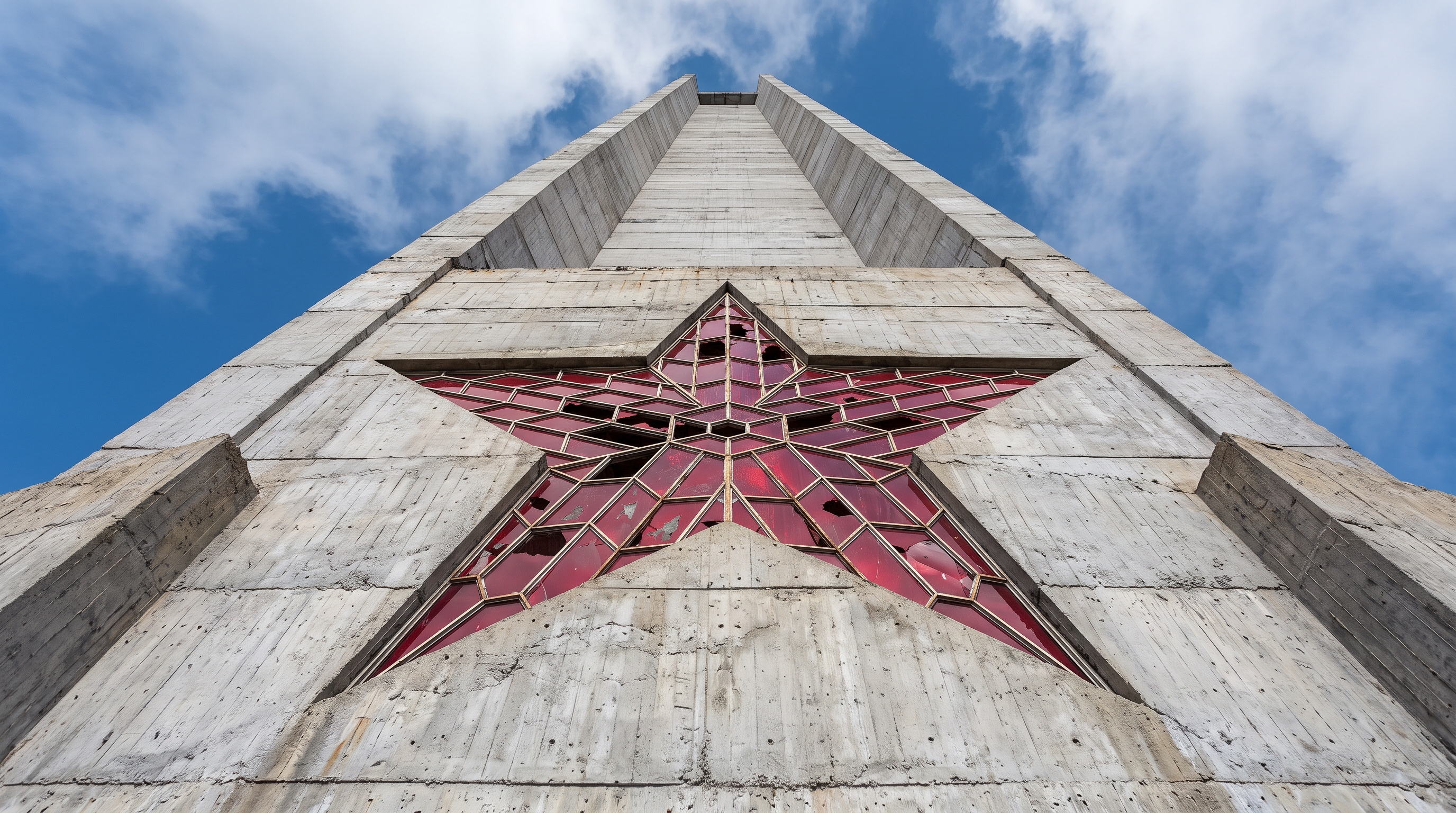 The soaring vertical concrete tower with its faceted red glass star standing tall against the alpine ridge.
Expedition Field Guide: How to Visit Buzludzha
While interior access is currently restricted for safety and restoration work, Buzludzha remains a bucket-list dark tourism and photography pilgrimage.
Logistics & Driving Directions
- Location: Stara Zagora Province, Central Bulgaria (near the town of Kazanlak).
- Transit: There is no public transportation directly to the monument. The easiest way is to rent a car from Sofia (a 3-hour scenic drive eastbound) or Plovdiv (roughly 2 hours north).
- Route: Drive via the scenic Shipka Pass along Route 55. Turn off onto Route 5005, which winds uphill for 12 kilometers through pine forests directly to the vast stone parking square below the monument.
Essential Visitor Protocols
- Strictly Exterior Viewing: Due to structural roof hazards and ongoing mosaic conservation, all subterranean entrances and ground-level doors have been welded shut and are monitored by continuous police security and video surveillance. Do not attempt to force entry or break through barriers.
- Alpine Climate Realities: The weather atop Mount Hadzhi Dimitar changes rapidly. Even in mid-summer, temperatures can plummet, and dense fog can reduce visibility to a few paces within minutes. Pack windproof thermal layers and sturdy hiking footwear.
- Combine with Shipka Memorial: Just a 15-minute drive westward along the ridge stands the Shipka Monument, an imposing 31-meter stone fortress tower commemorating the legendary 1877 battle against the Ottoman Empire. Visiting both offers an unforgettable cross-section of Bulgarian military and political history.
The Verdict
Buzludzha is neither a simple relic of tyranny nor an ordinary concrete shell; it is a monumental memorial suspended in ideological purgatory. Crowned in alpine frost, its defiant silhouette reminds travelers that political empires are fleeting, but the raw stone and steel they carve into the landscape endure.