Beneath the sun-drenched baroque piazzas and chaotic motor traffic of Palermo, Sicily, lies one of the most haunting anthropological archives in human history: the Catacombe dei Cappuccini (Capuchin Catacombs).
Descending down a narrow flight of stone steps beneath the Capuchin monastery (Convento dei Cappuccini), the humid Mediterranean warmth vanishes, replaced by cool, subterranean drafts and a distinct, dry mineral scent. Stretching across five interconnected subterranean limestone corridors are the preserved remains of approximately 8,000 individuals dating from 1599 to the 1920s.
Unlike the bone stacks of the Paris Catacombs or the Sedlec Ossuary, these dead are neither dismantled nor buried. They stand upright, pegged to walls by wire loops, or rest in glass-fronted walnut coffins, fully dressed in period tailcoats, lace gowns, military tunics, and Franciscan cowls—staring into the corridors with hollow eye sockets and skin stretched parchment-tight over bone.
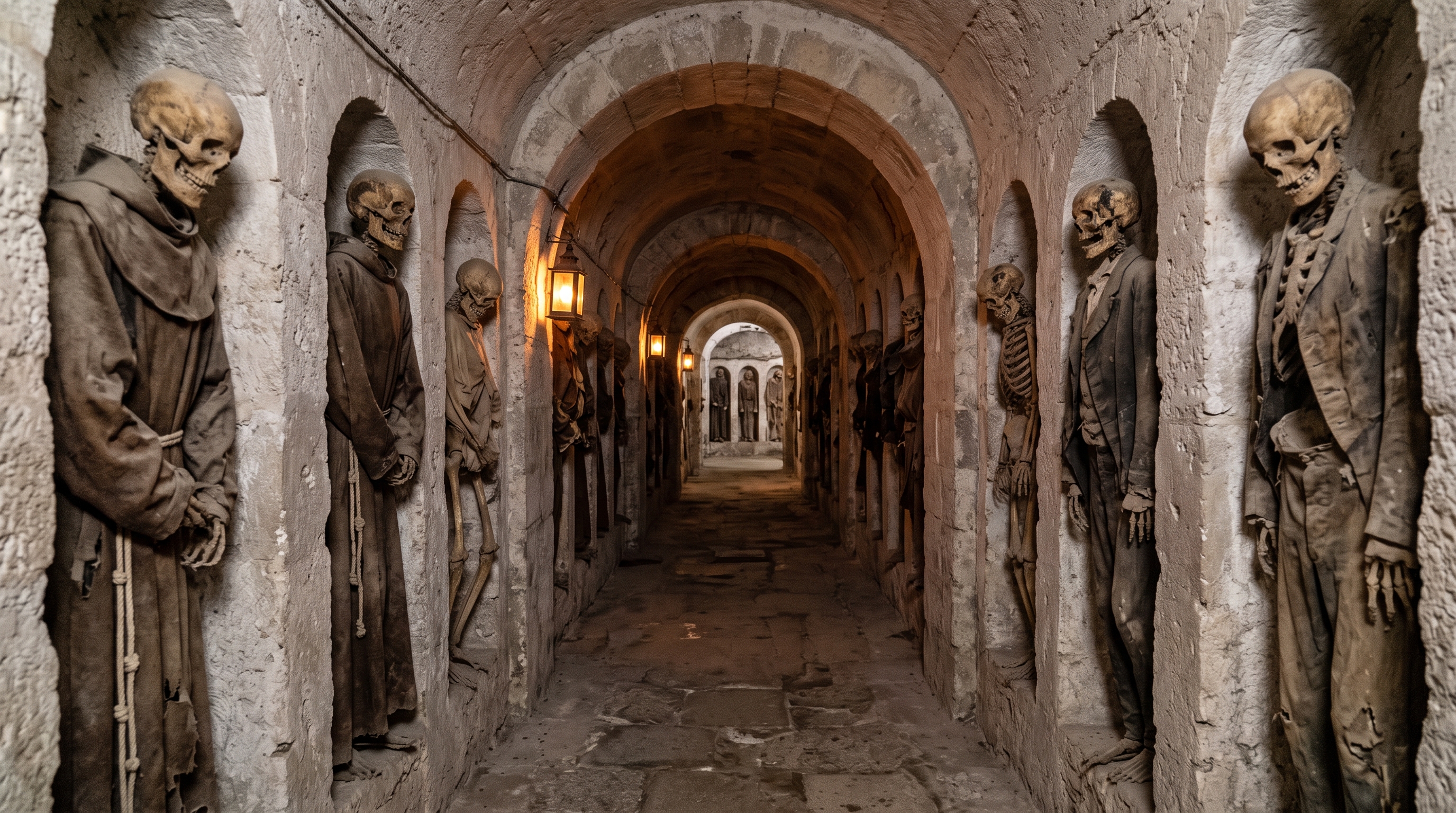 Corridor of the Monks: centuries-old mummies standing upright in niches along the vaulted subterranean corridors.
Origin of the Subterranean Pantheon
The catacombs began as a practical solution to a monastic dilemma:
- The Pioneer (1599): The Capuchin friars outgrew their original cemetery and excavated crypts beneath the church. When they began transferring remains from the old cemetery, they discovered that several corpses had naturally mummified due to the dry microclimate and porous volcanic limestone. The first monk interred was Brother Silvestro of Gubbio in 1599; his cowl-clad mummy still greets visitors at the entrance.
- The Status Symbol: Initially reserved solely for friars, wealthy Palermitan nobility and merchants soon petitioned to be mummified and displayed within the holy sanctuary. Maintaining a family member in the catacombs became the ultimate display of social prestige, religious piety, and ancestral remembrance. Families visited regularly on Sundays, paying recurring maintenance donations to ensure the clothes of the deceased were washed, pressed, and re-dressed in contemporary fashions.
The Chemistry of the Colatoio
The remarkable preservation of the bodies was achieved through an ingenious, rigorous process of natural desiccation rather than traditional Egyptian embalming:
- The Straining Chambers (Colatoi): Fresh corpses were laid across horizontal racks of terracotta pipe strainers inside sealed, well-ventilated chambers called colatoio rooms.
- Dehydration: For 8 to 12 months, bodily fluids drained through the pipes while constant dry drafts circulating through the volcanic rock desiccated the internal organs and musculature.
- Restoration & Stuffing: Once hardened, the carcasses were washed with vinegar, packed with straw or hay to restore anatomical volume, dressed in their finest Sunday attire, and suspended in their allocated niche.
During outbreaks of cholera and epidemic plagues, bodies were subjected to immersion baths of arsenic and mercuric chloride solutions to halt contagion, creating a durable chemical barrier against decay.
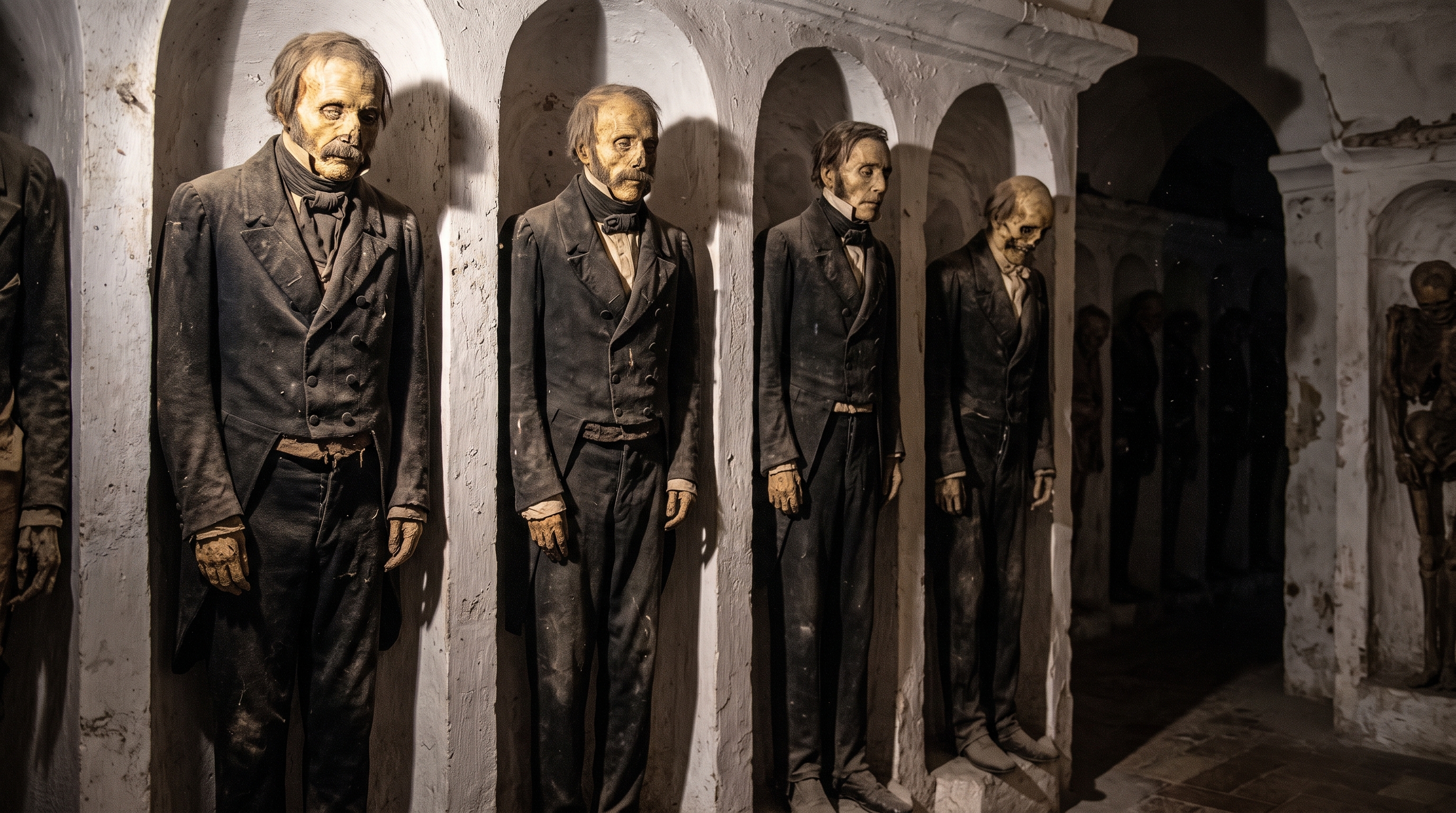 The Corridor of Professionals: doctors, lawyers, and civil dignitaries preserved in formal 19th-century garments.
The Architecture of Class: Subterranean Segregation
The catacombs were organized with rigid Victorian and feudal class structures:
- Corridor of the Friars: The oldest wing, lined with Capuchin brothers in coarse wool cowls, hands crossed over rosary beads.
- Corridor of the Professionals: Houses magistrates, jurists, army officers in gold-braided uniforms, and renowned physicians—identifiable by their formal tailcoats, neck stocks, and leather shoes.
- Hall of Women and Virgins: Women in lace bonnets, silk gowns, and ornate slippers, with unmarried maidens designated by iron crowns encircling their brows.
- The Children’s Chapel: The most heartbreaking sanctuary, where young children of affluent families stand or sit in miniature wooden chairs, wearing velvet coats and lace christening dresses.
The Sleeping Beauty: Rosalia Lombardo
In the Chapel of Santa Rosalia, at the deepest end of the complex, rests the catacombs’ most famous resident: Rosalia Lombardo.
Rosalia died of bronchial pneumonia resulting from the Spanish flu pandemic on December 2, 1920, just days shy of her second birthday. Overcome by grief, her wealthy father, Mario Lombardo, approached the celebrated Sicilian embalmer and taxidermist Alfredo Salafia to preserve her body for eternity.
Salafia’s secret chemical formulation—discovered in his personal handwritten notes decades later by paleopathologist Dario Piombino-Mascali—consisted of a revolutionary single-point arterial injection:
- Formalin: Saturated the tissues to kill all bacteria.
- Alcohol: Rapidly dehydrated the internal organs.
- Glycerin: Prevented over-drying to retain skin elasticity.
- Salicylic Acid: Acted as a powerful fungicide.
- Zinc Salts: Replaced blood with a rigid mineral lattice, turning tissues petrified and firm.
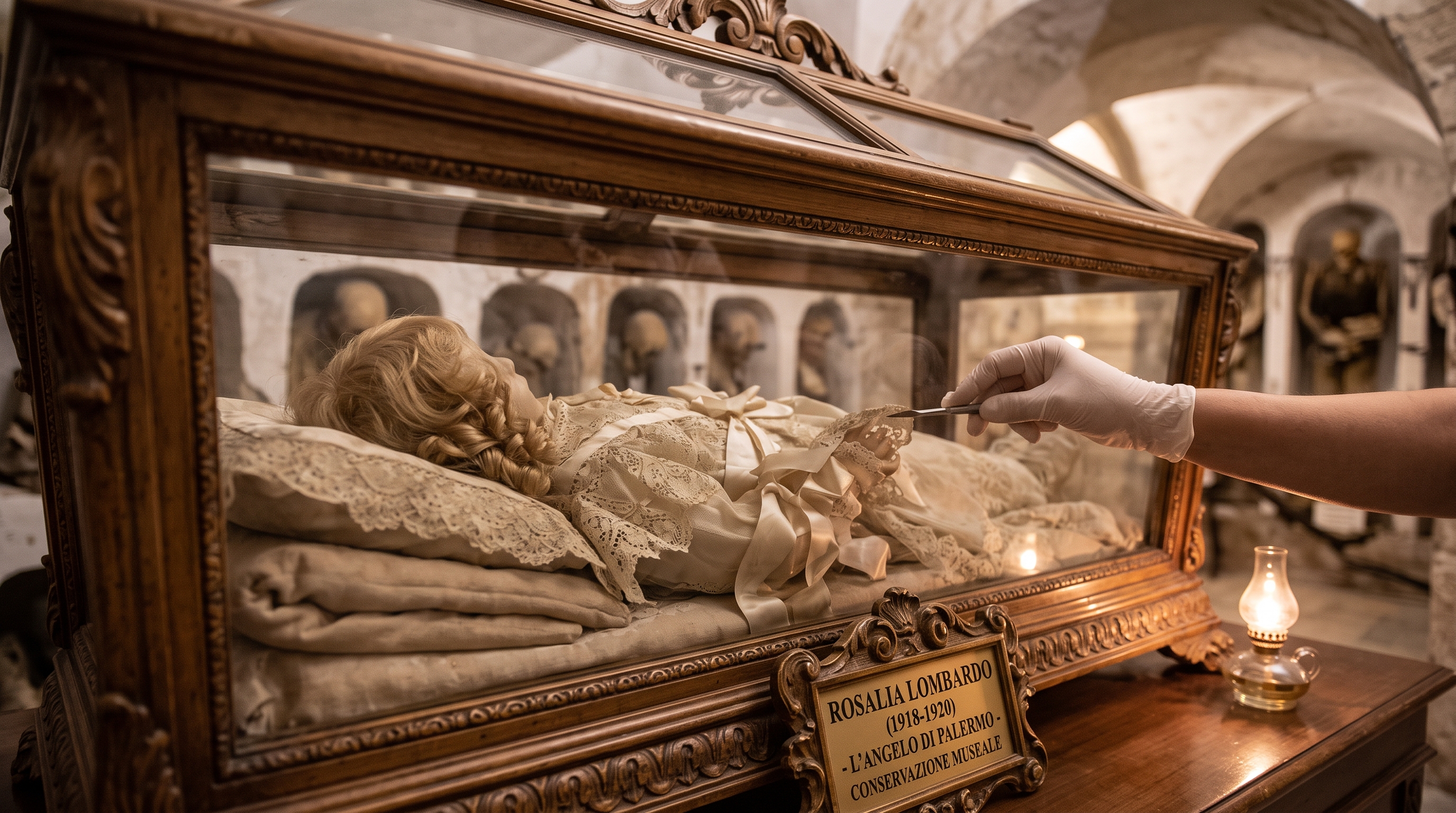 Rosalia Lombardo inside her hermetically sealed, nitrogen-filled glass enclosure, appearing as if peacefully asleep.
Rosalia’s golden curls, porcelain skin, long eyelashes, and delicate silk hair ribbon remain so immaculately preserved that she appears merely asleep in her glass casket, earning her the title “La Bella Addormentata” (The Sleeping Beauty). Modern micro-cameras have documented her eyelids opening and closing fractions of a millimeter over months—a natural optical illusion caused by subtle shifts in relative humidity.
Expedition Field Guide: How to Visit Respectfully
The Capuchin Catacombs are an active consecrated religious site and fragile archaeological archive. Strict regulations apply to all travelers.
Location & Transit
- Address: Piazza Cappuccini 1, 90129 Palermo, Sicily.
- Directions: Take AMAT Bus 109 from Palermo Centrale railway station to Piazza Indipendenza, then walk westward along Via Danisinni for roughly 15 minutes to reach the monastery gates.
- Hours & Tickets: Open daily (with midday closures from 12:30 PM to 2:00 PM). Tickets must be purchased at the door or via official municipal heritage desks.
Mandatory Protocols
- Strict Prohibition on Photography: Photography and filming are absolutely forbidden throughout the catacombs to protect preserved fabrics from light degradation and honor the dignity of the deceased. Flash sensors are monitored strictly by security staff.
- Atmospheric Climate: The catacombs remain at a brisk 15°C to 18°C (59°F to 64°F) year-round. Bring a light sweater or jacket even during scorching Sicilian summer months.
- Conservation Zone: Recent international conservation efforts have placed Rosalia Lombardo and fragile infant mummies inside temperature-controlled, nitrogen-sealed vitrines to arrest recent biological degradation. Never lean over railings or attempt to touch any fabric or bone.
The Verdict
The Capuchin Catacombs are not a chamber of horrors, but a profound cultural monument to humanity’s ancient struggle against mortality. Standing in these silent corridors, face-to-face with ancestors frozen mid-gesture in the garments of their lifetime, one encounters death not as an abstract ending, but as an enduring, tangible continuation of identity.