Rising unexpectedly from the tree-lined residential streets of Philadelphia’s Fairmount neighborhood stands an imposing medieval stone fortress spanning an entire city block: Eastern State Penitentiary.
Encircled by thirty-foot-high granite walls, heavy iron portcullises, and faux crenelated battlements, Eastern State was not designed merely to detain criminals. Opened in 1829, it was the world’s first true penitentiary—a revolutionary, terrifying social experiment designed to forge genuine penitence in the human soul through the medium of absolute, sensory-depriving solitude.
Today, after decades of abandonment followed by historic stabilization, Eastern State operates under a philosophy of “preserved ruin.” Its cavernous, barrel-vaulted cellblocks remain frozen in perpetual decay: peeling turquoise paint hangs like ribbons from limestone plaster, rusted iron cell wickets creak in drafts, and narrow skylights cast cold shafts of daylight down long, silent spokes.
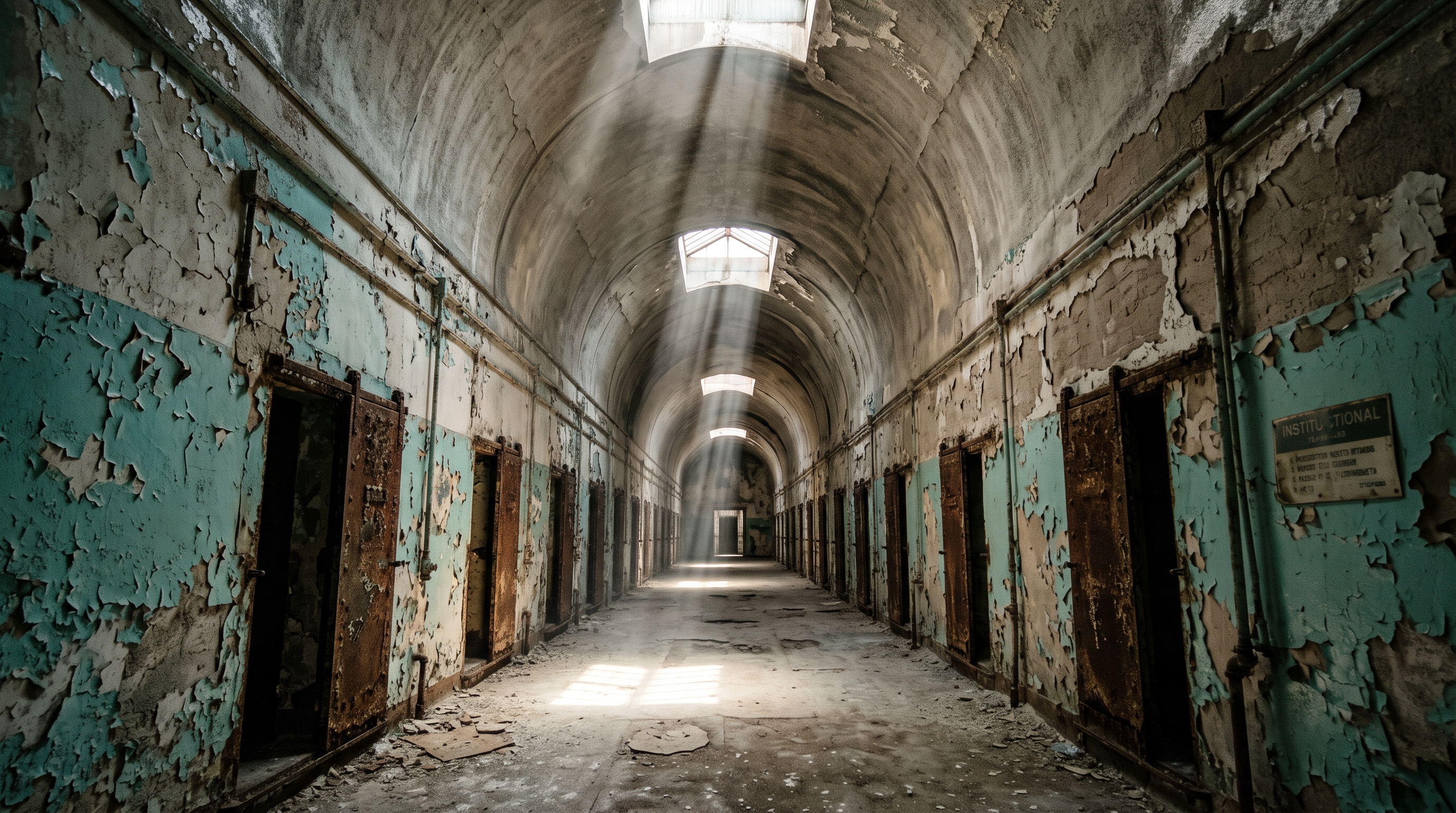 Cellblock 7: cavernous barrel-vaulted concrete halls where hundreds of individual solitary confinement cells open under shafts of natural sunlight.
The Quaker Crucible: The Birth of Solitary Confinement
In the late 18th century, Philadelphia’s overcrowded Walnut Street Jail was a violent den of disease, drunkenness, and lawlessness. A reformist civic group that included Benjamin Rush and Benjamin Franklin sought an enlightened, humane alternative rooted in Quaker ideals:
- The Pennsylvania System: Rather than brutal physical punishment or mass confinement, reformers believed that absolute isolation from corrupting societal influences would force criminals to look inward, converse with their conscience, and find spiritual redemption before God.
- The Hood of Anonymity: When inmates arrived, guards placed black hoods over their heads so they could never see the layout of the prison, learn the identity of fellow convicts, or be recognized by guards.
- The Absolute Silence: Inmates lived, ate, and worked in complete silence within their 8-by-12-foot solitary cells for years on end. Guards wore felt-soled slippers and wheeled food carts on leather-wrapped wheels to prevent any sound from echoing through the corridors.
The only illumination came from a single circular skylight in the ceiling, deliberately designed by architect John Haviland to represent the “Eye of God” looking down upon the prisoner’s soul.
Architectural Triumph: The Radial Hub-and-Spoke
Eastern State Penitentiary was the most expensive and architecturally influential public building in the young United States:
- The Radial Wheel: Haviland engineered a revolutionary hub-and-spoke layout: seven original cellblock wings radiated outward from a central octagonal surveillance rotunda. A single watchman standing in the central hub could observe all corridors simultaneously with minimal effort.
- Technological Luxury: Long before the White House enjoyed modern utilities, Eastern State featured indoor flushing toilets in every private cell, central radiator heating, and hot-water shower facilities, astounding 19th-century foreign dignitaries.
Over 300 prisons across Europe, South America, and Asia—including Kilmainham Gaol in Dublin and Pentonville in London—were modeled directly on Eastern State’s radial blueprint.
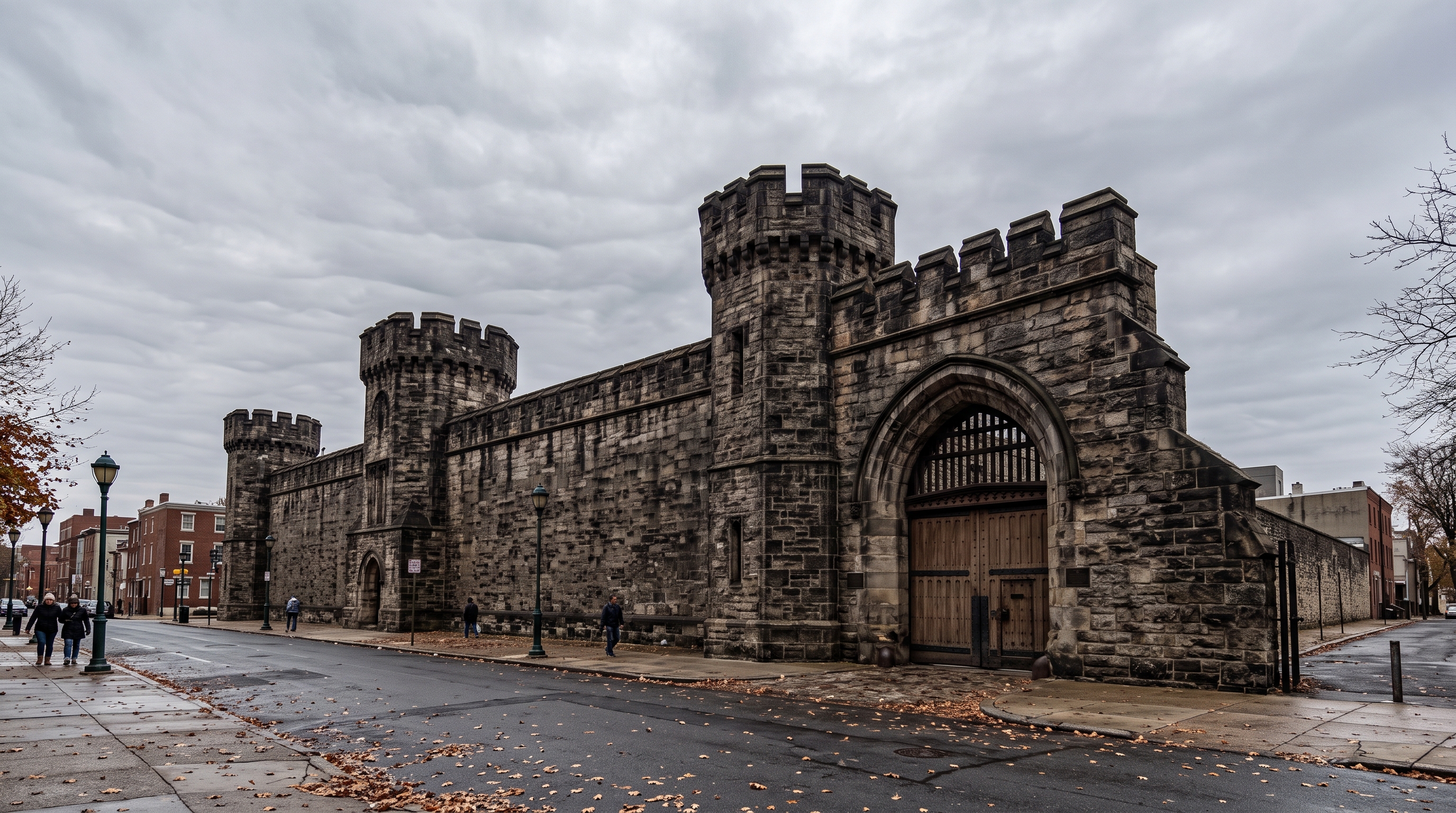 The massive granite perimeter wall and medieval gothic bastions, designed to strike psychological awe into passing 19th-century citizens.
The Psychological Breakdown and the Inmates
While visionary on paper, the relentless silence broke human minds.
When British author Charles Dickens toured Eastern State in 1842, he was horrified by the psychological toll of the Pennsylvania System, writing:
“I believe that very few men are capable of estimating the immense amount of torture and agony which this dreadful punishment, prolonged for years, inflicts upon the sufferers… I hold this slow and daily tampering with the mysteries of the brain to be immeasurably worse than any torture of the body.”
By 1913, sensory isolation was officially abandoned due to widespread prisoner insanity, and Eastern State transitioned into a standard congregate maximum-security facility.
The Kingpin and the Bank Robber
- Al Capone’s Luxurious Stay (1929–1930): Following an arrest in Philadelphia for carrying a concealed weapon, Chicago gangster Al Capone served eight months in Cellblock 6. Unlike standard convicts, Capone paid for lavish comforts: oriental rugs, polished mahogany armchairs, oil paintings, a cabinet radio playing waltzes, and uncensored phone privileges.
- “Slick Willie” Sutton’s 1945 Escape: On the rainy morning of April 3, 1945, master bank robber Willie Sutton and eleven fellow inmates slipped through a hand-dug, shored-timber tunnel extending 97 feet beneath the prison walls and emerged on Fairmount Avenue before police sirens sounded.
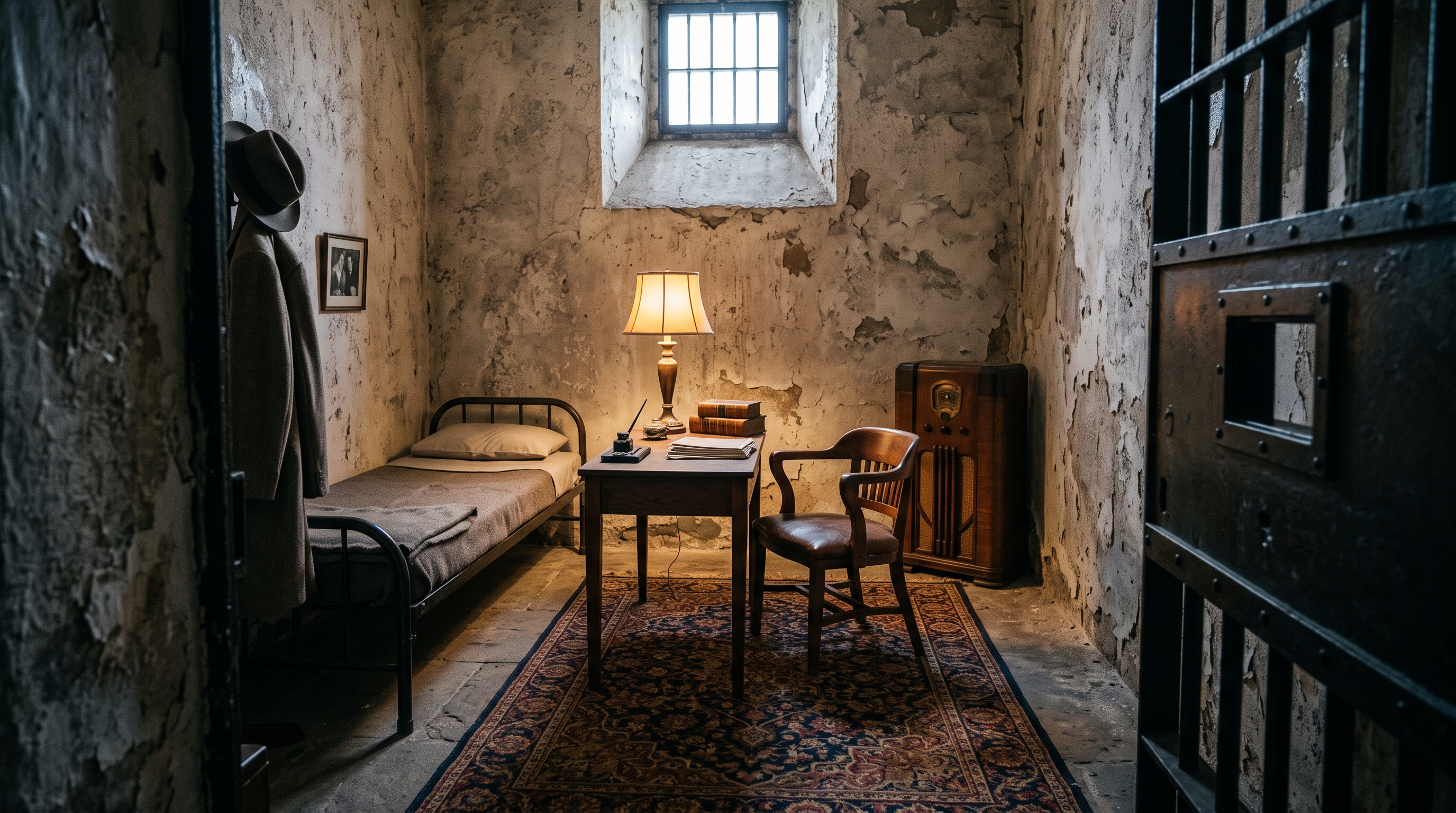 Al Capone’s restored cell inside Cellblock 6, equipped with 1920s antique furniture, floral rugs, and home luxuries.
The Preserved Ruin Philosophy
Eastern State ceased operations in 1971, and its remaining inmates were transferred to Graterford State Prison. For nearly a quarter-century, the abandoned compound stood vacant.
Birch trees took root through stone foundations, wild cats made colonies inside execution chambers, and weather collapsed skylights. When the site was saved from demolition and designated a National Historic Landmark, preservationists made a deliberate choice: instead of restoring the complex to a pristine artificial condition, they would halt active decay while preserving the raw, haunting patina of peeling paint, rusted steel, and crumbling mortar.
Expedition Field Guide: How to Visit Eastern State
Eastern State Penitentiary operates as one of the world’s most acclaimed museum ruins, offering immersive self-guided and guided historical tours year-round.
Location & Transit
- Address: 2027 Fairmount Avenue, Philadelphia, PA 19130.
- Transit from Center City: Catch the Philly PHLASH Downtown Loop bus or SEPTA Bus Route 32, 48, or 49 directly to the front entrance gates.
- Operating Hours: Open daily from 10:00 AM to 5:00 PM (night hours operate seasonally during Halloween and evening history events).
Essential Visitor Protocols
- The Iconic Audio Tour: Admission includes the renowned “The Voices of Eastern State” audio tour narrated by actor Steve Buscemi, featuring interviews with former guards, wardens, and incarcerated people. Bring wired headphones (or borrow a sanitized headset at entry).
- Dress for the Elements: Eastern State has zero central heating or air conditioning. Cellblocks are uninsulated stone corridors that remain chilly in spring and humid in summer. Wear layers and sturdy, flat walking shoes for uneven concrete flagstones.
- Photography Rules: Tripods and monopods are not permitted on general admission tickets (specialized early-morning photographer passes are available through advance online booking). Handheld DSLRs and phones are welcome.
The Verdict
Eastern State Penitentiary is more than an atmospheric ruin; it is a profound physical memorial to human ambition, architectural genius, and the tragic consequences of well-intentioned reform. To walk down its decaying, sunlit corridors is to experience the heavy silence where modern criminal justice was born.