Just twenty kilometers northwest of Limoges, nestled within the rolling green pastures of central France, lies a perimeter wall where time stopped with violent finality on the afternoon of June 10, 1944: the martyred ruins of Oradour-sur-Glane.
Passing through the subterranean portal of the modern memorial center (Centre de la Mémoire), visitors emerge onto sunlit cobbled streets devoid of engines, footsteps, or commerce. Spanning over forty hectares, this entire pastoral village remains frozen in the exact state it was left after a single catastrophic afternoon: roofless limestone townhouses, overhead tramway power lines suspended over rusted rails, cast-iron bed frames twisted by intense heat, and enamel street plaques that still read Rue Émile Desourteaux.
Following the liberation of France, French Resistance leader and future President Charles de Gaulle decreed that Oradour-sur-Glane must never be rebuilt, cleared, or altered. Instead, it was designated a permanent national monument—a physical testament to civilian innocence and the catastrophic savagery of total war.
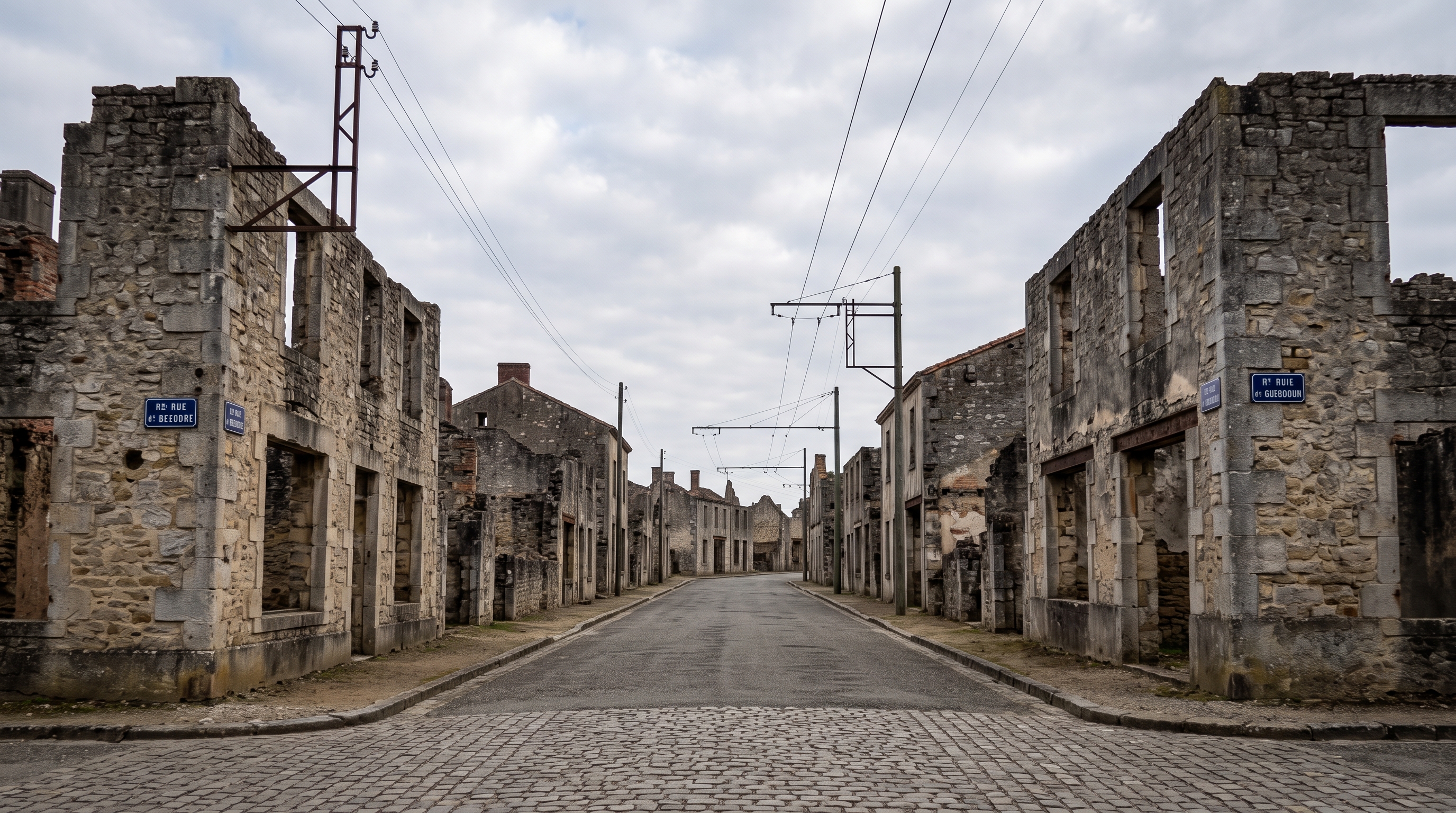 Rue Émile Desourteaux: the silent main artery of Oradour-sur-Glane, flanked by roofless limestone buildings and intact vintage streetcar tracks.
The Fatal Afternoon: June 10, 1944
Four days after the Allied forces landed on the beaches of Normandy, the 2nd SS Panzer Division Das Reich was redeployed from southern France to counter the Allied advance.
Hounded along their route by French Resistance fighters (Maquis), the 1st Battalion of the SS Regiment Der Führer, commanded by Adolf Diekmann, received disputed intelligence claiming an SS officer was being held captive nearby. For reasons never fully justified even at postwar military tribunals, the regiment completely encircled the non-resistant, tranquil market village of Oradour-sur-Glane:
- The Summons: At 2:00 PM, soldiers ordered all residents and visiting refugees to assemble at the central marketplace (Champ de Foire) under the pretext of an identity card inspection.
- The Separation: Women and children—including infants in carriages—were marched into the parish church of Saint-Martin. The men were divided into six groups and escorted into designated barns, garages, and wine cellars across town.
The Systematic Massacre
Within hours, coordinated slaughter commenced across the village:
- The Barns: Machine guns concealed beneath tarpaulins opened fire on the men, aiming deliberately at their legs to immobilize them. Once the victims fell, German troops covered the men with kindling and straw, setting the structures ablaze. Only five or six men managed to crawl out from beneath dead bodies through rear plaster gaps and escape into the woods.
- The Church of Saint-Martin: Inside the stone church, soldiers placed a heavy asphyxiation crate containing smoke bombs and incendiary chemicals. As smoke choked the 450 terrified women and children, SS troops fired rifles through the windows and hurled fragmentation hand grenades into the pews before lighting the wooden rafters on fire.
Only one person survived the church: Marguerite Rouffanche, a 47-year-old local woman who climbed behind the high altar, hauled herself through a narrow stained-glass window three meters up, and leaped out into the garden below, concealing herself in pea bushes while suffering multiple bullet wounds.
By nightfall, 643 men, women, and children had been murdered. The soldiers methodically ransacked the homes for valuables, set dynamite charges against stone masonry, and ignited fires until the settlement was reduced to an incinerated shell.
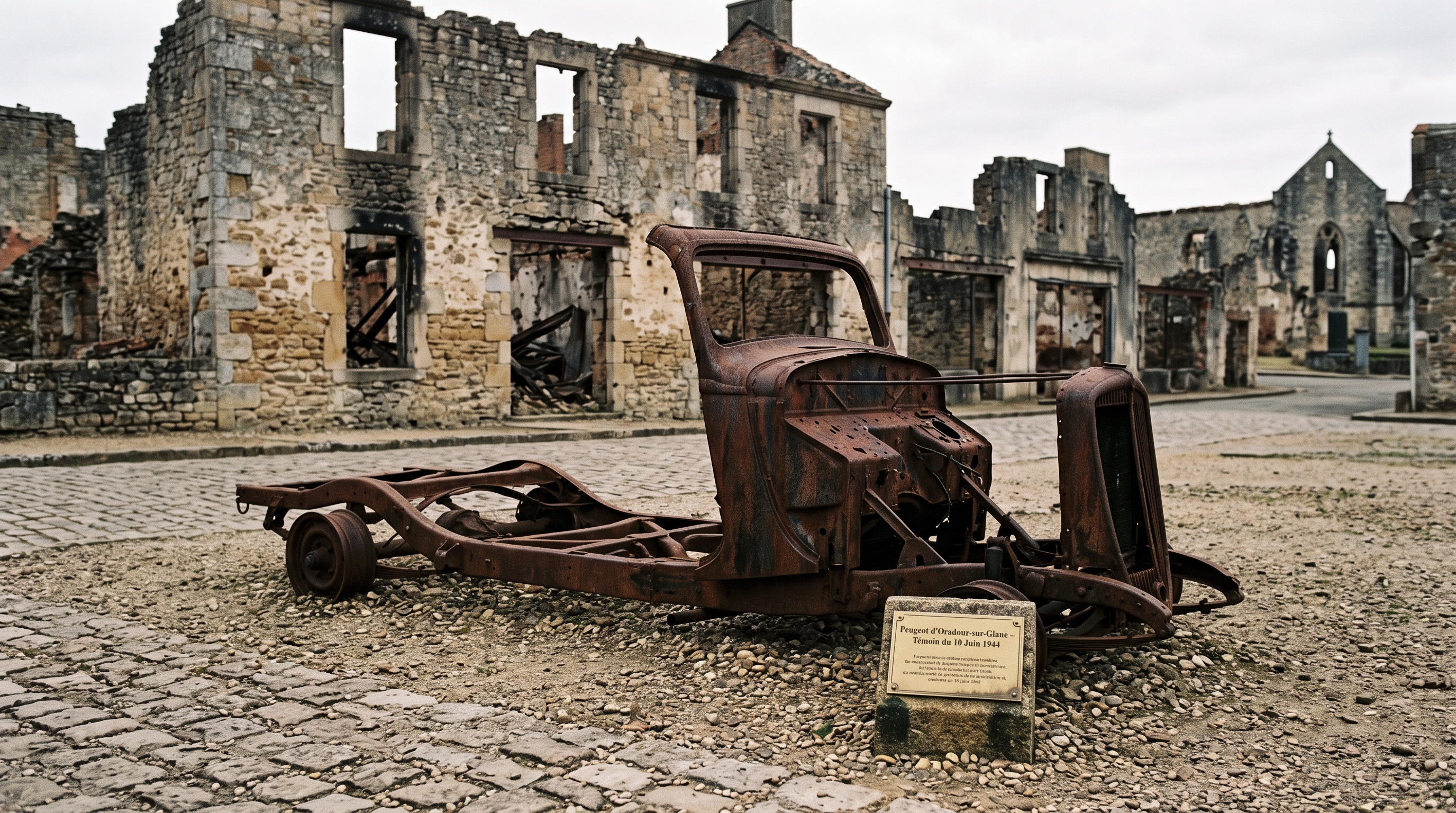 The skeletal iron frame of Mayor Desourteaux’s 1930s Peugeot 202, resting permanently where it burned in the town square.
The Anatomy of Preserved Domesticity
What makes Oradour-sur-Glane uniquely haunting compared to modern museums is the sheer intimacy of its preserved everyday artifacts:
- The Doctor’s Automobile: Resting in the center of the fairground is the rusted iron chassis of the black Peugeot 202 belonging to the village physician, Dr. Jacques Desourteaux, who returned to town mid-afternoon only to be captured and killed alongside his neighbors.
- The Hearth Artifacts: Look through the open doorways of ruined kitchens to spot cast-iron sewing machines fused to stone mantelpieces, enameled pots hanging from brick chimney corners, and rusted bicycle rims warped by thousand-degree blazes.
- The Commemorative Tablets: Fixed to exterior stone facades are modest enamel plaques reading “Ici Crime Hitlérien” (Here occurred a Hitlerian crime), designating execution sites and the specific tradesmen who lived there—bakers, tailors, coopers, and shoemakers.
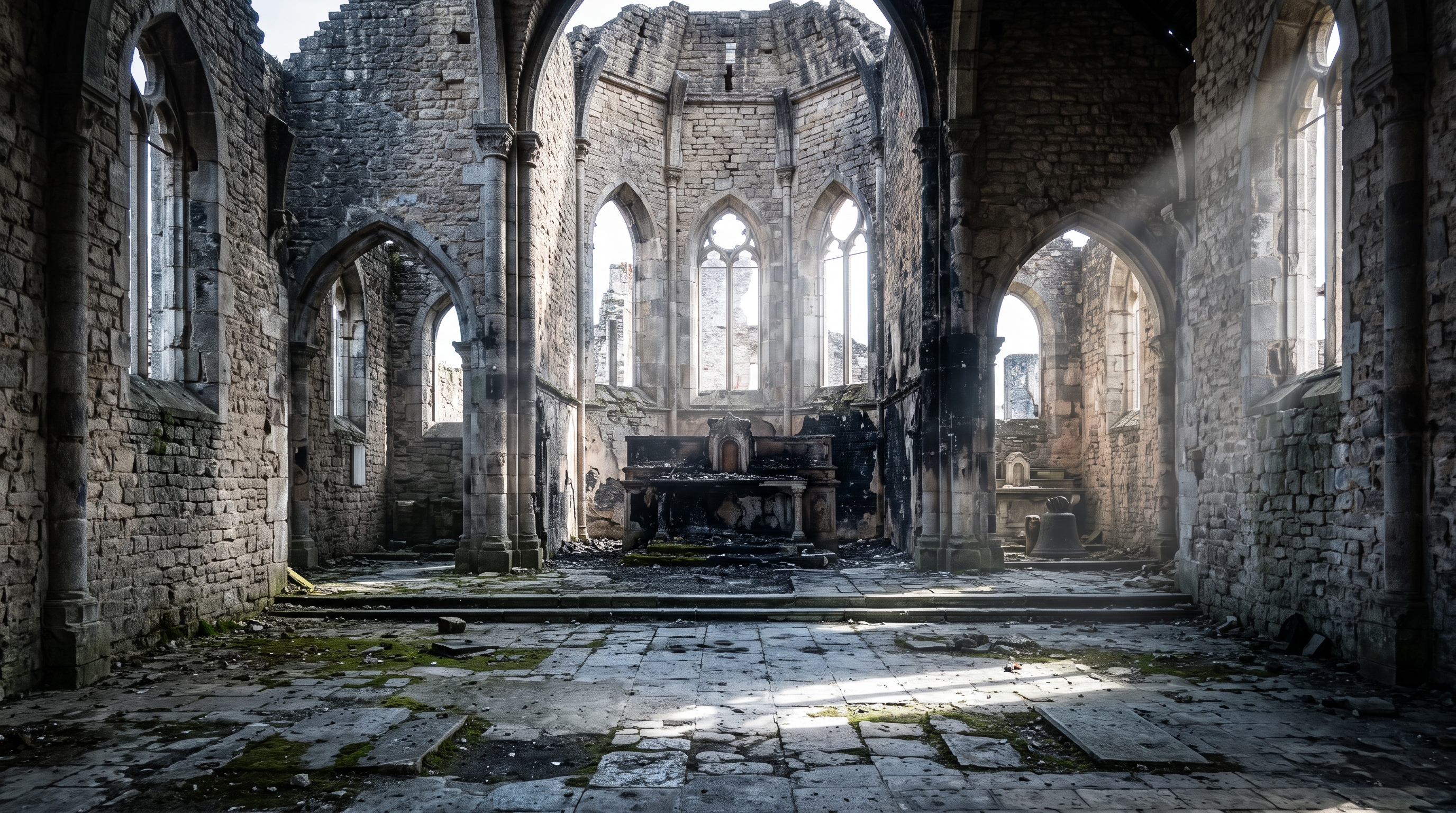 Inside the parish church of Saint-Martin: the altar where Marguerite Rouffanche made her desperate escape, flanked by charred limestone walls.
Expedition Field Guide: How to Visit Oradour-sur-Glane
Oradour-sur-Glane is maintained by the French Ministry of Culture and serves as both a memorial cemetery and educational archive.
Location & Transit
- Coordinates & Address: L’Esplanade du 10 Juin 1944, 87520 Oradour-sur-Glane, France.
- Transit from Paris/Limoges: Take the high-speed TGV train from Paris Gare d’Austerlitz or Montparnasse to Limoges-Bénédictins Station (roughly 3 hours). From Limoges bus terminal, board Regional Bus Line 12 directly to the visitor center entrance.
- Automobile: A direct 25-minute drive northwest from Limoges via the D9/D101 highway. Ample free parking is provided outside the village gates.
Mandatory Protocols & Etiquette
- Silence and Decorum: Oradour-sur-Glane is legally a war grave. Speaking loudly, running, smoking, consuming food, or playing music anywhere within the ruined perimeter is strictly forbidden. A somber, reverent atmosphere is maintained at all times.
- Strict Non-Interference: Do not touch or cross threshold chains into ruined interiors. Do not pick up rusted nails, broken glass, or pottery shards; removing any material from the village is treated as a severe criminal violation under French heritage protection laws.
- The Centre de la Mémoire: Allow at least 60 to 90 minutes to tour the modern underground interpretive center before stepping into the ruins. Its exhibits contextualize the rise of Nazism, the deployment of the Das Reich division, and post-war international trials.
The Verdict
Oradour-sur-Glane is not merely an open-air cemetery; it is an unyielding monument to the resilience of human memory against political amnesia. Walking down its silent, sunlit cobblestones, surrounded by the physical remains of ordinary lives shattered in an instant, visitors confront the true, unfiltered price of hatred—and the eternal obligation to remember.