In the heart of Silicon Valley, standing in stark, surreal contrast against modern corporate glass campuses, sits one of the most eccentric architectural riddles on the American continent: the Winchester Mystery House.
Spanning 24,000 square feet across four sprawling stories in San Jose, California, this colossal Queen Anne-style Victorian mansion defies every rule of civil engineering. Behind its redwood shingles and ornate turrets lies an intentional maze of 160 rooms, 2,000 doors, 10,000 window panes, and 47 fireplaces.
Yet its global notoriety does not stem from its grandeur, but from its madness: staircases with switchback turns that terminate abruptly into solid plaster ceilings, trapdoors cut into second-floor corridors, secret chimneys ending beneath floorboards, and doors that open directly onto sheer drops into empty garden space below. For thirty-eight consecutive years—twenty-four hours a day, seven days a week—the hammers never fell silent.
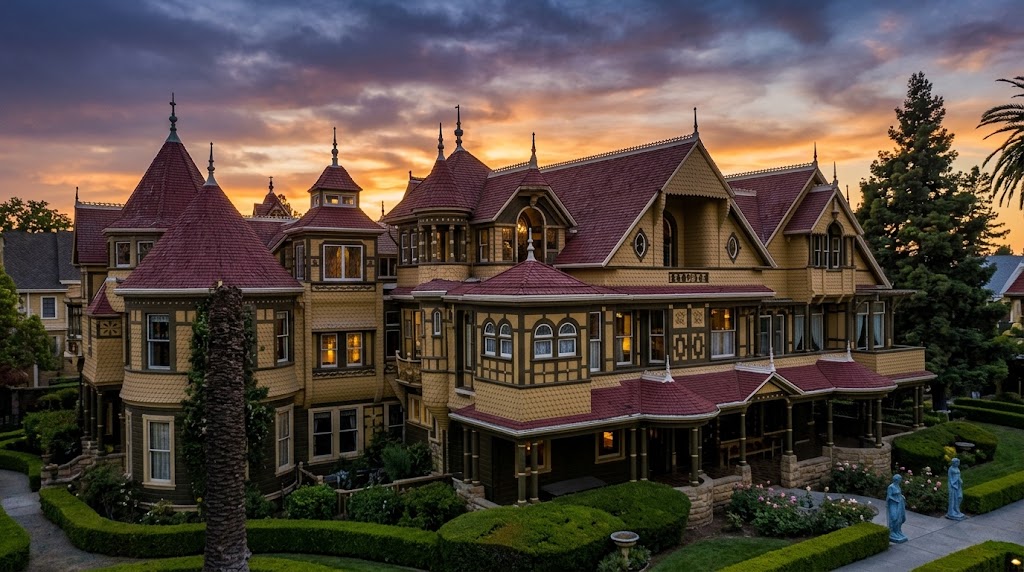 The sprawling facade of the Winchester Mystery House in San Jose, showing the asymmetrical gables, cupolas, and turrets added over nearly four decades.
The Legacy of the Repeating Rifle
The haunting origin of the estate is inseparable from the industrial conquest of the American frontier:
- The Winchester Fortune: In 1881, Sarah Lockwood Pardee Winchester suffered two devastating personal losses in rapid succession: the death of her infant daughter Annie, followed by the tuberculosis death of her husband, William Wirt Winchester—treasurer and heir to the Winchester Repeating Arms Company.
- The Blood Inheritance: Sarah inherited roughly twenty million dollars (equivalent to over half a billion dollars today) along with a fifty-percent stake in the arms manufacturer, providing her an astronomical daily royalty of approximately $1,000—tax-free in the late 19th century.
- The Medium’s Prophecy: Plagued by grief, Sarah consulted a renowned Boston spiritualist medium named Adam Coons. The medium delivered an ominous warning: the Winchester bloodline was cursed by the restless, vengeful spirits of soldiers, Native Americans, and pioneers slain by the Winchester repeating rifle—“The Gun that Won the West”. To placate and elude these phantoms, she was instructed to leave New Haven, travel toward the setting sun, buy a home, and never cease construction: “If you continue building, you will live; stop, and you will die.”
Thirty-Eight Years of Round-the-Clock Construction
In 1884, Sarah arrived in the Santa Clara Valley and purchased an unfinished eight-room farmhouse on 161 acres.
Instantly, she mobilized a permanent crew of twenty-two carpenters, glassmakers, plumbers, and gardeners who worked in round-the-clock rotating shifts:
- No Blueprints, No Architects: Sarah served as her own sole architect. Each morning, she convened with her head foreman over rough sketches scribbled on brown butcher paper or scrap napkins, directing walls to be erected, torn down, remodeled, and sealed behind fresh timber.
- The Blue Room (The Séance Chamber): Every midnight, the estate’s bell tower tolled to summon spirits. Sarah would retire alone to the secluded Blue Room—the occult nerve center of the compound. Accessible only through a secret passage, this chamber possessed one entrance door but three exits, including one disguised door opening into a narrow sink pipe down which Sarah could slip undetected to confuse lurking malevolent entities.
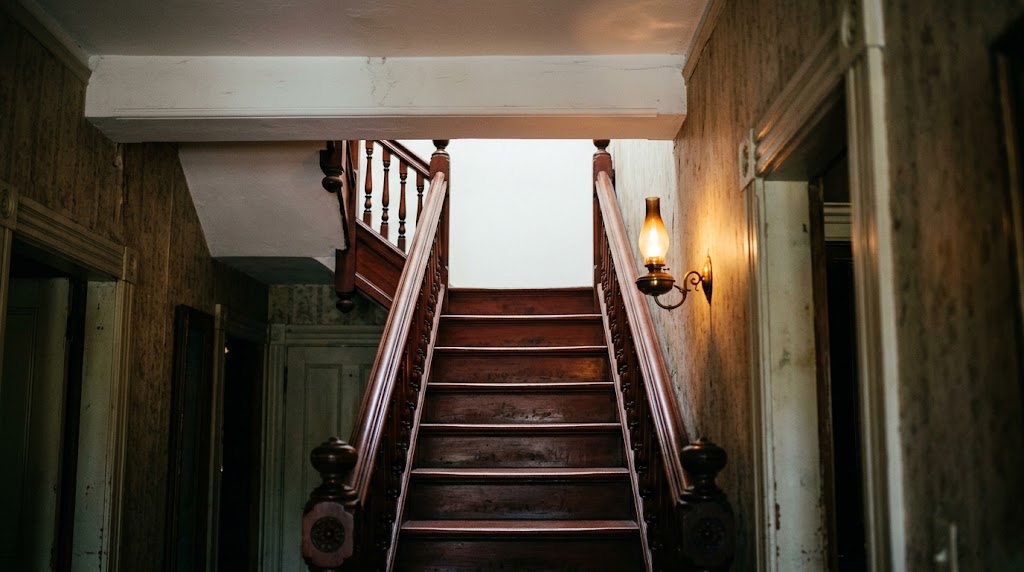 A famous “Staircase to Nowhere”: seven steps ascending directly into a ceiling beam with zero outlet.
Architectural Anomalies: Trapping the Phantoms
Wandering through the mansion reveals Sarah’s structural obsession with misdirection, defensive evasion, and esoteric symbolism:
- The Door to Nowhere: On the second floor of the outer facade sits an ordinary wooden door. Turning the latch reveals no balcony or landing—only a twenty-foot sheer vertical drop down onto exterior courtyard flagstones.
- The Switchback Stairs: To navigate between floors while suffering from crippling arthritis, Sarah engineered staircases featuring forty-four steps with two-inch risers, looping back and forth across seven turns to rise only nine vertical feet.
- The Occult Numerology of 13: Sarah embedded the number thirteen throughout the structural DNA of the estate: 13-panel ceilings, 13 drainage holes in the sink sieves, 13 gas jets on chandeliers, 13 colored stones on the grand ballroom chandelier, 13 cupolas, and 13 bathrooms (the thirteenth featuring thirteen windows).
- Spiderweb Art Glass: Sarah commissioned custom leaded stained-glass windows from the prestigious Tiffany studio in New York. Many incorporate intricate web patterns—a personal talisman representing both the trapping of spirits and the spinning of labyrinthine destinies.
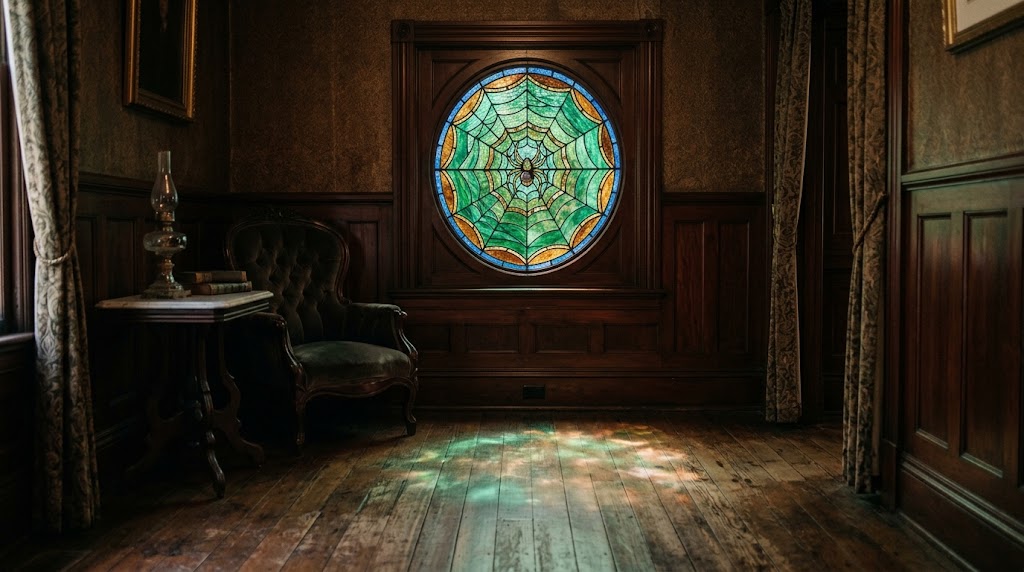 A custom Tiffany leaded stained-glass window installed in an interior wall facing a windowless dark storage corridor.
The Great 1906 Rupture and Sarah’s Death
At 5:12 AM on April 18, 1906, the Great San Francisco Earthquake shook northern California with catastrophic violence.
The shaking collapsed the mansion’s towering seven-story observation tower and heavily damaged the front grand wing. Sarah was trapped inside the opulent Daisy Bedroom when the doorframe shifted, requiring servants to pry her out with crowbars.
Interpreting the seismic destruction as an omen that the spirits were furious with the lavish vanity of the front quarters, Sarah immediately ordered the entire thirty-room front section boarded up with heavy timber. The rooms remained untouched for the remainder of her life, with fine carpets rolled up and grand pianos left to collect dust.
Construction continued relentlessly across other wings until September 5, 1922, when Sarah passed away in her sleep at age 83. Upon receiving the news, the carpenters stopped work mid-swing, leaving nails half-driven into wallboards that remain visible to this day.
Expedition Field Guide: How to Visit the Winchester Estate
The Winchester Mystery House operates as a designated California Historical Landmark and world-renowned museum.
Location & Transit
- Address: 525 S Winchester Boulevard, San Jose, CA 95128.
- Transit from San Francisco: Take the Caltrain southbound from San Francisco 4th & King Station to San Jose Diridon Station (approximately 60–75 minutes). From the station, hail a 10-minute rideshare directly to the front ticket pavilion on Winchester Boulevard.
- Driving: Located just off Interstate 280 (Winchester Blvd exit), directly across from the Santana Row retail district.
Visitor Protocols & Tour Selection
- Choose Your Tour Depth:
- The Mansion Tour: The classic 65-minute guided walkthrough covering 110 accessible rooms, switchback stairs, and key architectural oddities.
- The Explore More Tour: A specialized trek through the raw, unrestored spaces—venturing into attics, the historic basement, outbuildings, and earthquake-damaged sections (requires sturdy closed-toe shoes and hard hats).
- Unhinged Flashlight Tours: Hosted seasonally during autumn and on Friday the 13ths, offering immersive night tours navigated purely by handheld lantern light.
- Mobility Awareness: Due to the historic maze-like architecture, narrow stairways, and tight turns, only the ground floor is wheelchair accessible. Visitors must be prepared to walk roughly one mile and climb several dozen steps during the full tour.
- No Photography Delays: Handheld phone photography without flash is permitted, but touching fragile historic wallpaper, brass locks, or antique furnishings is strictly monitored by docents.
The Verdict
Was Sarah Winchester an eccentric genius indulging an uninhibited fortune, a victim of exploitative spiritualist charlatans, or a grieving mother desperately weaving a wooden tapestry to protect herself from the ghosts of industrial warfare? Stepping through her bewildering corridors, one realizes that the Winchester Mystery House is the ultimate monument to the labyrinth of the human mind: endless, enigmatic, and forever unfinished.