Beneath the bustling historic thoroughfare of South Bridge in Edinburgh’s Old Town lies an entirely forgotten subterranean district carved out of nineteenth-century darkness: The Edinburgh Vaults (also known as the South Bridge Vaults).
Stepping off the cobblestones of the Royal Mile and descending stone spiral staircases into the foundations of the bridge, the ambient hum of streetcars and bagpipers fades completely. In its place is an oppressive subterranean chill, the rhythmic sound of moisture dripping down soot-blackened stone arches, and an absolute pitch-black void illuminated only by handheld lanterns.
Constructed between 1785 and 1788 to span the steep Cowgate gorge, the monumental 19-arch limestone bridge enclosed approximately 120 subterranean chambers stacked across multiple descending tiers. Conceived as dry workshops and storage cellars for tradesmen, the vaults spiraled into an underground underworld of catastrophic poverty, crime, and clandestine trade, before being sealed shut with stone and forgotten for nearly a century.
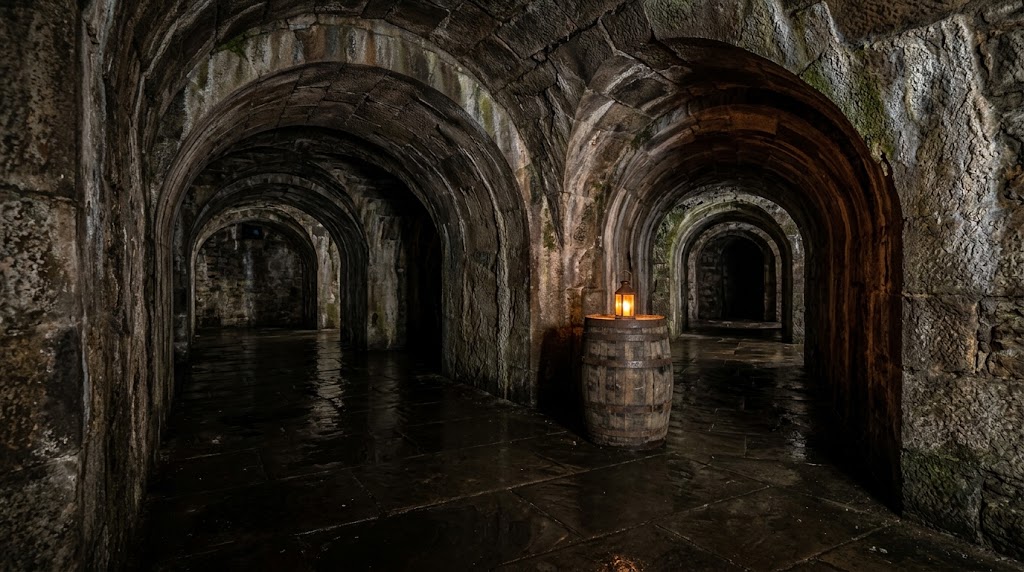 Inside the 18th-century South Bridge Vaults: cavernous barrel-vaulted stone arches lit by lone amber lanterns.
An Engineering Dream Turned Subterranean Nightmare
In late 18th-century Edinburgh, the city was bursting at its seams within medieval perimeter walls. The construction of the South Bridge was celebrated as an Enlightenment engineering triumph:
- The Bridge of Nineteen Arches: Designed by architect Alexander Laing, the bridge bridged the deep valley between Old Town and the burgeoning University district. Only one arch (spanning the Cowgate street) was left exposed; the remaining eighteen arches were boxed in by four-story stone tenements, creating subterranean hollows.
- The Merchant Colony: In 1788, the upper vaults were leased to respectable cobblers, coopers, goldsmiths, and wine importers.
- The Porous Collapse: The engineering lacked one critical element: waterproofing. The bridge deck had been paved with stone pavers directly over crushed rubble without bitumen seals. Rainwater and contaminated municipal street runoff began seeping continuously through the ceilings, ruining grain, rusting iron tools, and breeding toxic black mold. Within a decade, all legitimate businesses abandoned the vaults.
Descent into the Abyss: The Underworld of the 1800s
By the turn of the nineteenth century, as legitimate commerce evacuated, Edinburgh’s most destitute populations moved into the unventilated chambers:
- The Squalid Slums: Fleeing famine and eviction, destitute Highland peasants and Irish immigrants crammed into the windowless damp chambers. Entire families lived in 12-by-12-foot stone rooms with no natural light, no drainage, and open braziers burning coal and tallow, filling the stagnant air with poisonous carbon monoxide.
- Criminal Underbelly: The vaults became an autonomous red-light district. Unregulated drinking taverns (shebeens), illegal gambling rings, and unlicensed whisky stills operated freely, protected from municipal constables who refused to navigate the pitch-black maze.
- The Legend of Burke and Hare: During the 1820s, Edinburgh was the global capital of medical anatomy. To feed the voracious demand of medical lecturer Dr. Robert Knox for fresh cadavers, infamous serial killers William Burke and William Hare murdered at least sixteen victims in the surrounding tenements. Local folklore strongly holds that the pair used the labyrinthine South Bridge Vaults to conceal bodies before wheeling them out under cover of night to the dissecting rooms of Surgeon’s Square.
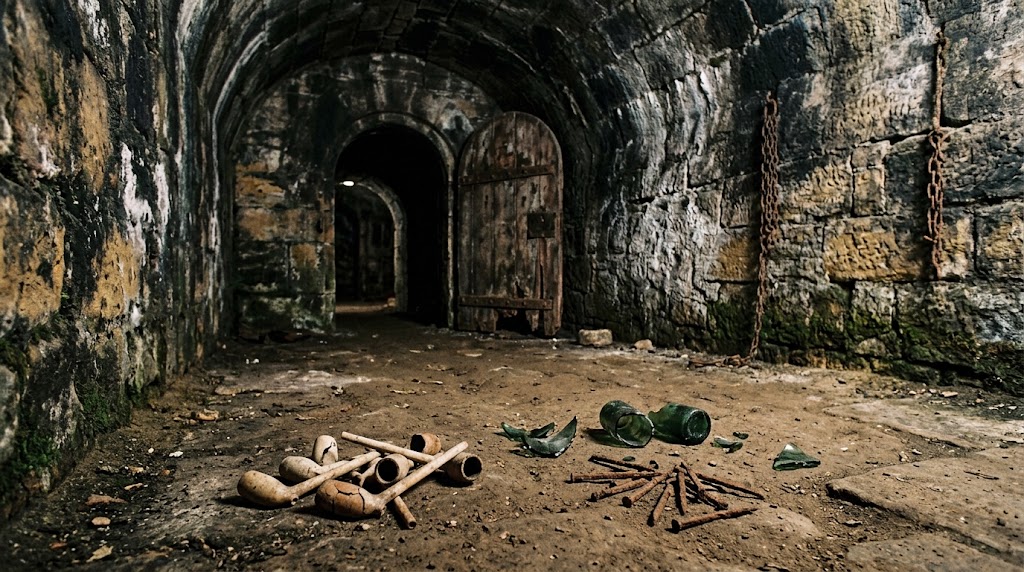 A damp subterranean corridor where stagnant air, limestone efflorescence, and centuries of soot coat the walls.
The Great Sealing and the 1980s Rediscovery
Around 1860, appalled by rampant cholera, typhus, and criminal impunity, Edinburgh municipal authorities conducted a final clearance of the subterranean slums.
Workers shoveled hundreds of tons of rubble, ash, and soil into the passages, cementing solid stone barricades across every access hatchway. Over the next century, road crews repaved South Bridge, and the memory of the subterranean chambers completely vanished from living memory.
The Modern Breakthrough (1985)
The vaults re-entered the historical record through pure chance. In 1985, former Scottish international rugby player Norrie Rowan discovered a hidden cellar door while renovating his nearby tavern (The Tron Tavern). Crawling through a breach in the masonry, he found himself standing inside an endless complex of untouched 18th-century chambers.
Excavating the vaults by hand with wheelbarrows over several years, Rowan and archaeologists uncovered astonishing time capsules of everyday survival:
- Enamel medicine phials and hand-blown gin bottles from the 1800s.
- Children’s leather shoe soles preserved in anaerobic clay mud.
- Crude stone hearths surrounded by oyster shells—the cheap survival food of Edinburgh’s working class.
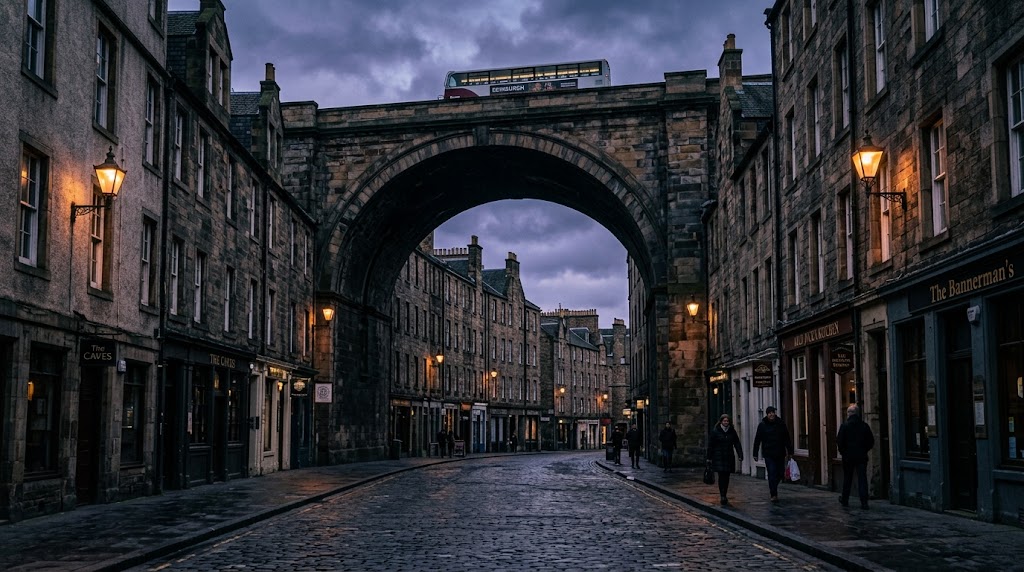 The sole visible stone arch of South Bridge spanning over the Cowgate, concealing eighteen massive sealed arches beneath modern buildings.
Paranormal Lore and Modern Dark Tourism
Because of its tragic history of disease, deprivation, and violent crime, the South Bridge Vaults have become one of the premier dark tourism and paranormal research destinations in the world.
Guides and visitors frequently report intense temperature plummets, phantom auditory anomalies (including the disembodied sound of crying children and dragging timber), and encounters with distinct localized apparitions—most famously the “Watcher” (a hostile male presence reported in the furthest unlit chambers) and the playful spirit of a 19th-century chimney boy named “Jack”.
In 2001, a landmark scientific study led by British psychologist Dr. Richard Wiseman examined the site, documenting that self-reported paranormal experiences correlated consistently with environmental cues such as high magnetic field anomalies, damp acoustic traps, and deep low-frequency sound reverberations.
Expedition Field Guide: How to Journey Beneath Edinburgh
The South Bridge Vaults are accessible exclusively through authorized historical and heritage tour companies due to structural safety regulations.
Meeting Points & Booking
- Location: Most expeditions depart from the Royal Mile (High Street) near St Giles’ Cathedral.
- Authorized Tour Operators:
- Mercat Tours: Operates exclusive access to the Blair Street Underground Vaults (the deepest, most extensively excavated section of the complex, focusing heavily on social history).
- Auld Reekie Tours: Grants access to the Niddry Street Vaults, featuring a preserved 18th-century stone coven room and raw, unpaved conditions.
- Advance Reservation: Evening and late-night slots sell out weeks in advance, especially during the August Edinburgh Fringe Festival and Halloween season.
Essential Visitor Protocols
- Appropriate Footwear: The floors of the vaults are authentic compacted clay, loose rubble, and wet historic cobblestones. Never wear open-toed shoes, sandals, or heels; wear sturdy, waterproof walking shoes or boots.
- Claustrophobia & Air Quality: The chambers have no natural ventilation and feature high humidity. While completely safe for general tours, individuals with severe asthma, dust sensitivities, or acute claustrophobia should opt for surface-level Old Town historical tours instead.
- No Unsupervised Exploration: Never stray away from the guide’s lantern light. The complex has zero mobile phone reception and several passages contain sudden drops, uneven stone thresholds, and sealed dead-ends.
The Verdict
The Edinburgh Vaults are a profound reminder that history is multilayered. While the Georgian facades above celebrate the heights of Scottish architectural elegance, the dark stone caverns beneath preserve the desperate resilience of those forgotten by it—a subterranean monument to the fragility of human fortune.