Deep in the heart of Pennsylvania’s anthracite coal region lies a municipality that officially no longer exists: Centralia. Once a bustling Appalachian mining borough of more than 1,000 residents, Centralia today is an eerie, desolate grid of empty paved roads, curbs leading nowhere, and thermal vents silently releasing noxious gases into the mountain air.
Beneath the cracked asphalt, a subterranean coal fire has raged uninterrupted across hundreds of acres of labyrinthine mining tunnels since May 1962. Geologists estimate that enough fuel remains trapped in the anthracite seams to keep the underground inferno burning for another 250 years.
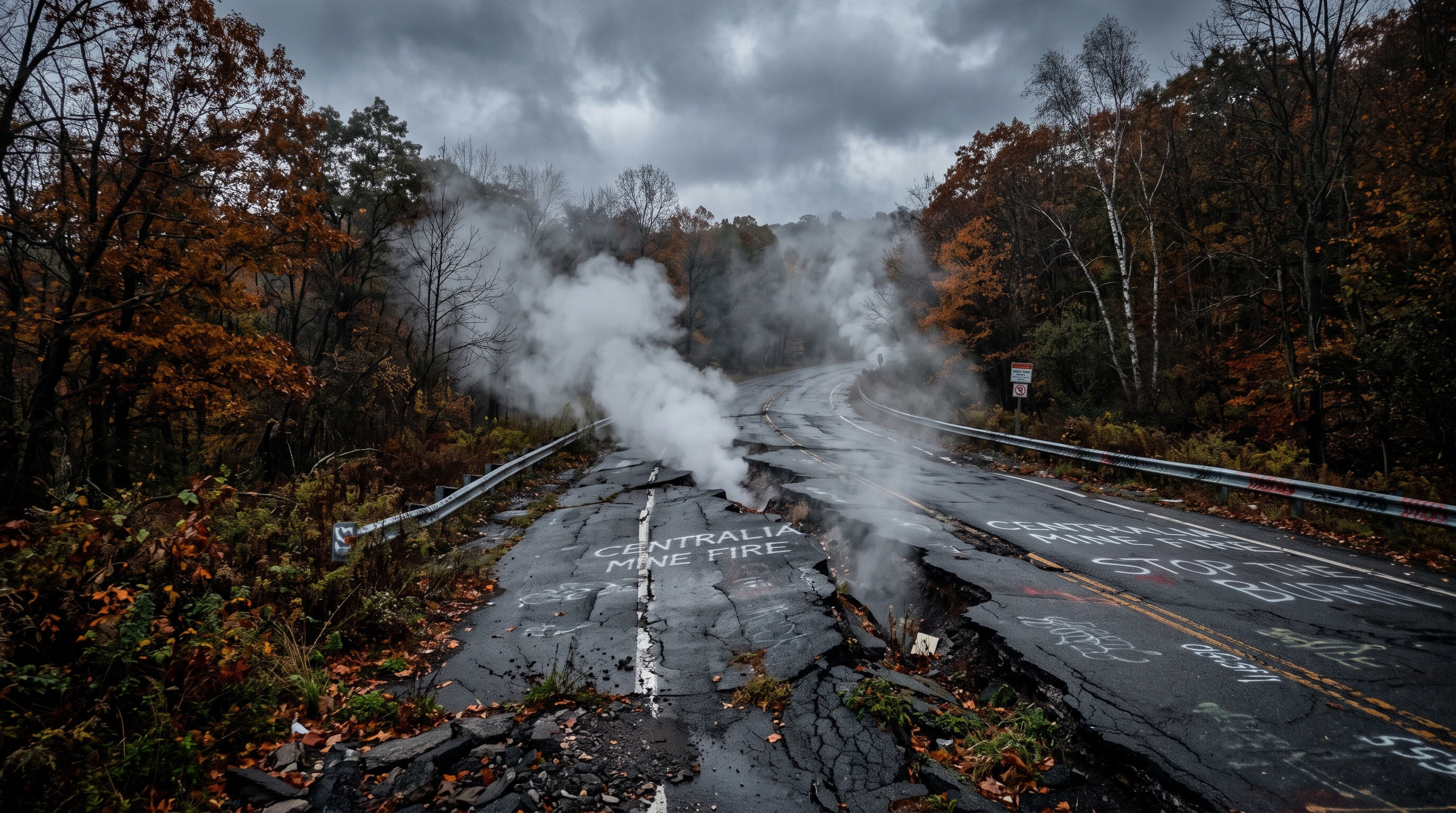 Steam and toxic sulfur gases venting through deep asphalt fissures on the abandoned outskirts of Centralia.
The Spark: How a May 1962 Fire Sealed a Town’s Fate
Centralia’s catastrophe began with a routine civic maintenance task on Memorial Day weekend in 1962. The borough council hired local volunteer firefighters to clean up an illegal 50-foot-deep garbage landfill situated inside an abandoned strip mine pit.
The firefighters set the trash mound ablaze to incinerate the waste, subsequently dousing the flames with water hoses. Unbeknownst to the crew, an unsealed opening in the bottom of the pit connected directly to the Buck Mountain coal seam—a rich, interconnected network of abandoned underground mining shafts:
- The Subterranean Ignition: The fire burrowed into the coal vein, igniting anthracite rocks hundreds of feet below the surface.
- Invisible Spread: For years, officials attempted to quench the fire with surface excavators, clay seals, and non-combustible fly-ash flushing. Each intervention failed as the fire leaped through hidden fissures into adjacent chambers.
- The Gas Infiltration: By the 1970s, underground temperatures soared to over 400°C (750°F). Toxic concentrations of carbon monoxide, carbon dioxide, and sulfur dioxide began seeping into home basements, forcing families to sleep with battery-powered gas monitors by their pillows.
The Turning Point: The 1981 Sinkhole Incident
The danger transitioned from an invisible environmental nuisance into an acute crisis on Valentine’s Day in 1981.
Twelve-year-old Todd Domboski was walking across his grandmother’s backyard when the ground suddenly dissolved beneath his boots. A subterranean sinkhole, four feet wide and nearly 150 feet deep, collapsed beneath him as hot steam boiled up from the cavern.
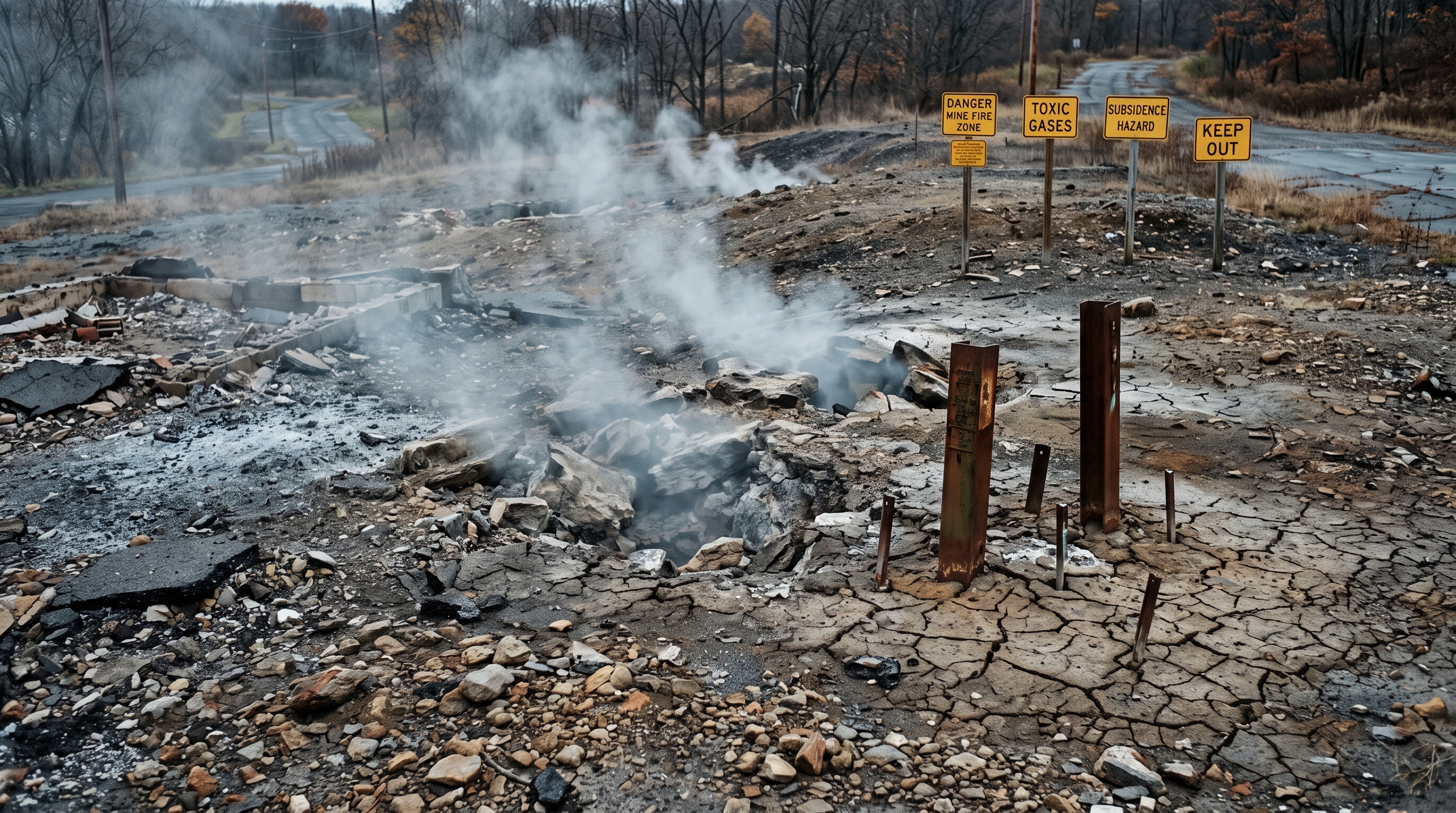 White steam escaping natural rock fissures where residential neighborhoods once stood before the federal buyouts.
The boy survived by clinging desperately to an exposed tree root before his cousin pulled him to safety. When inspectors tested the chasm, the plume of hot steam registered lethal levels of carbon monoxide.
Following nationwide media attention, the United States Congress authorized a $42 million federal relocation package in 1983. More than 1,000 residents accepted government buyouts, their homes systematically demolished to eliminate fire hazards. In 1992, the Commonwealth of Pennsylvania declared eminent domain over every property in the borough, revoking its zip code (17927).
The Surviving Bastion: St. Peter and Paul
While the lower town has been largely erased into grassy meadows intersected by empty sidewalks, one iconic landmark remains fully standing above the burn zone: the Assumption of the Blessed Virgin Mary Ukrainian Greek Catholic Church.
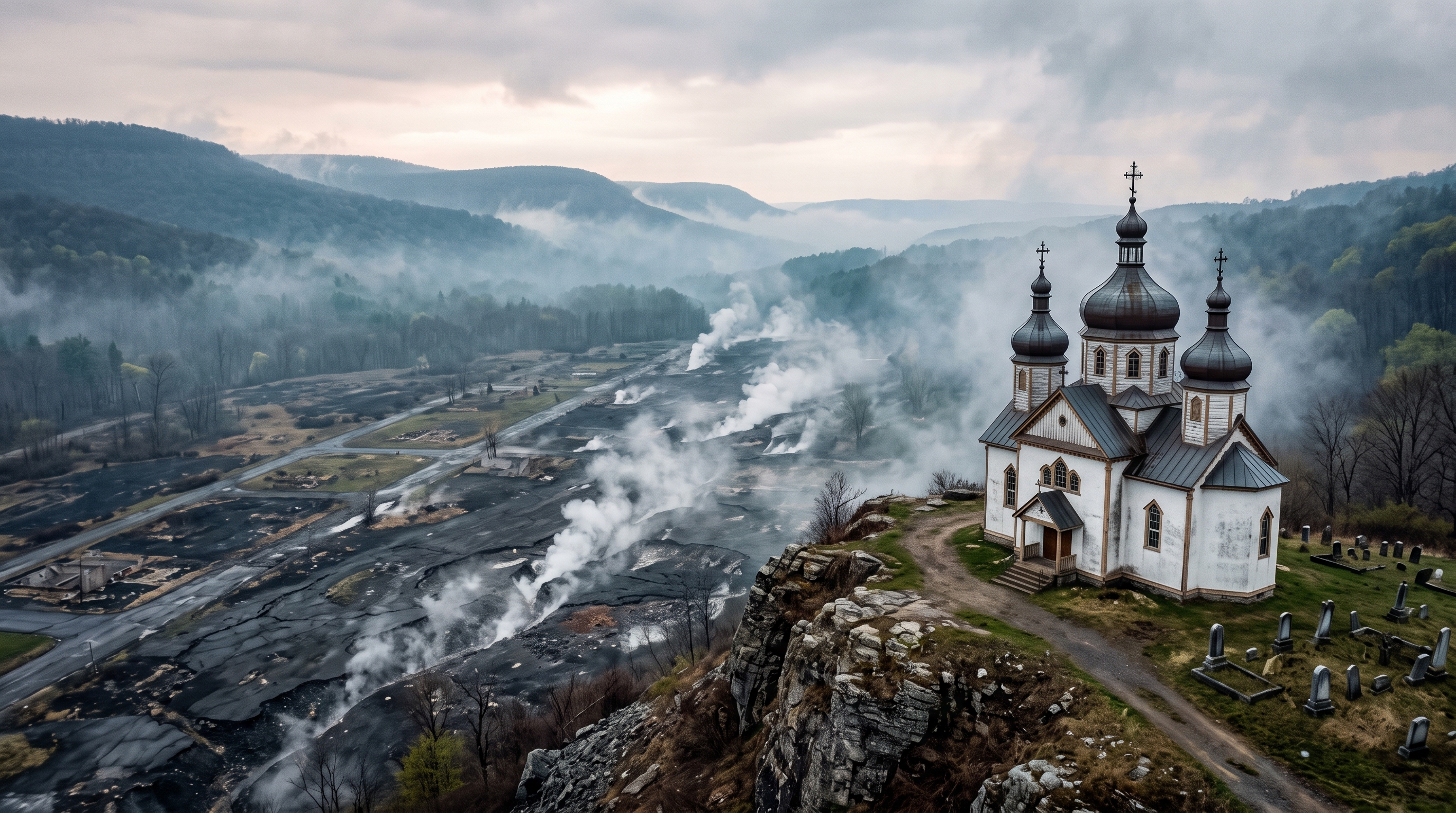 The lone white Ukrainian Catholic church perched on an elevated ridge above the subterranean burn perimeter.
Built in 1911 on a solid limestone and granite ridge north of the valley, the church sits directly outside the underground coal seam path. Surveyors drilled exploratory boreholes around the church foundations and discovered solid, unheated rock. Today, it stands as a solitary white-domed beacon overlooking the smoldering ghost valley below, still hosting weekly Sunday services for parishioners across the county.
Expedition Field Guide: Hazards and Travel Realities
Centralia draws thousands of urban explorers, photographers, and fans of the Silent Hill franchise every year. However, visiting this unstable landscape requires strict caution.
Critical Environmental Hazards
- Lethal Asphyxiation: Low-lying steam plumes often carry high concentrations of carbon monoxide and carbon dioxide. Inhaling these gases in ravines or hollows can induce rapid disorientation, unconsciousness, and death.
- Ground Subsidence & Sinkholes: The fire continues to hollow out underground support pillars. What appears to be solid grassy earth can collapse without warning into boiling ash pits. Never step near steaming fissures or sinkhole edges.
- The Closure of Graffiti Highway: The infamous 0.75-mile buckled stretch of Route 61, historically covered in visitor graffiti, was permanently buried under thousands of tons of dirt mounds by the private landowner in 2020 to prevent mass trespassing and vandalism.
Responsible Exploration Code
- Remain strictly on paved municipal roads that remain open to through traffic (such as State Route 61 and Locust Avenue).
- Respect the private property rights of the handful of remaining elderly residents who won a lifetime right to occupy their homes in a 2013 settlement with the state.
- Pack out all trash and leave the remaining historical remnants undisturbed.
The Verdict
Centralia is a haunting physical monument to the unforeseen chain reactions of human industry. To stand in its quiet meadows, where wind rustles through the birch trees while the ground beneath your boots breathes sulfur and steam, is to witness an environmental ghost story that will outlive generations to come.