Rising out of the hyper-arid coastal sands of southern Namibia, ten kilometers inland from the Atlantic port of Lüderitz, lies a surreal monument to human greed and natural impermanence: Kolmanskop (Coleman’s Hill).
Once one of the wealthiest enclaves on the African continent per capita, Kolmanskop today is a silent, sun-bleached ghost town. The howling winds of the Namib—the oldest desert on Earth—have systematically reclaimed every drawing room, bowling alley, and operating theater, driving massive waves of fine golden sand through shattered windows and door frames.
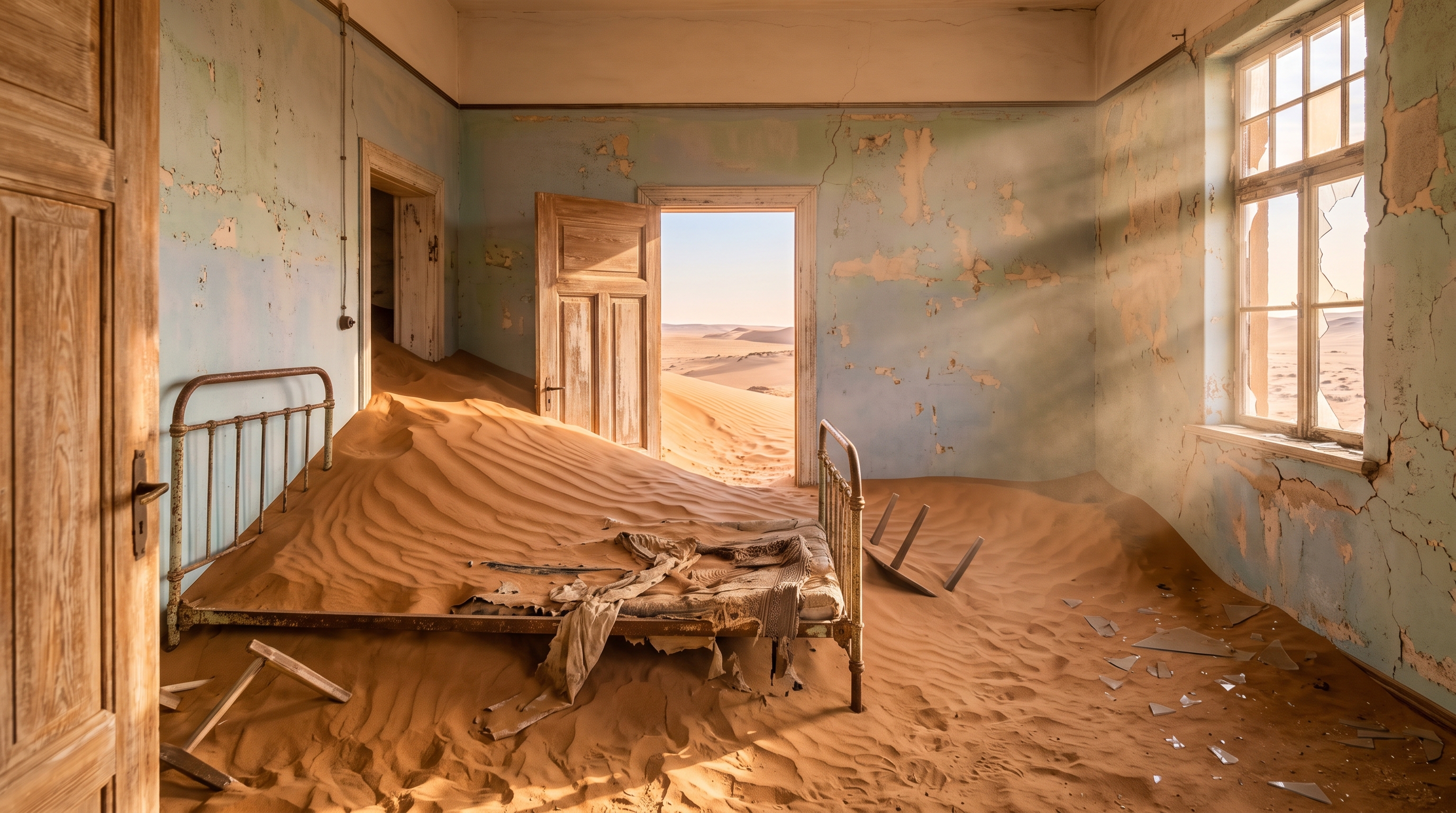 Rippling golden sand dunes sweeping through the cracked wooden doorways of an abandoned German colonial manor.
The Glittering Mirage: The 1908 Diamond Boom
Kolmanskop’s meteoric rise began in April 1908. A local rail worker named Zacharias Lewala was shoveling drifting sand from the railway tracks when he noticed a cluster of translucent pebbles catching the morning sun. He handed one to his supervisor, August Stauch, who tested it against glass: it was a raw diamond of exceptional quality.
Within months, the German Imperial Government declared the entire region a prohibited exclusion zone (Sperrgebiet), reserving thousands of square kilometers exclusively for diamond extraction:
- Diamonds by Moonlight: In the early years, gravel deposits were so dense with gems that workers crawled on their stomachs under the moonlight, picking raw diamonds directly off the desert floor.
- European Luxury in the Wasteland: Wealth poured into the settlement. Despite having no natural freshwater source, German engineers constructed an ornate town replicating a Bavarian village—complete with electric power grids, a champagne cellar, a ballroom, an ice-making plant, and a bowling alley (Kegelbahn).
- The First X-Ray in Southern Africa: The Kolmanskop hospital imported the very first diagnostic X-ray machine in southern Africa. While used for medical treatment, its primary function was security: screening miners daily to detect ingested diamonds.
The Exodus: Swallowed by the Sperrgebiet
Kolmanskop’s glory was dazzling, but brief. By the late 1920s, the shallow surface gravels were thoroughly depleted. The death knell struck in 1928, when vastly richer diamond fields were discovered 270 kilometers to the south near the mouth of the Orange River (Oranjemund).
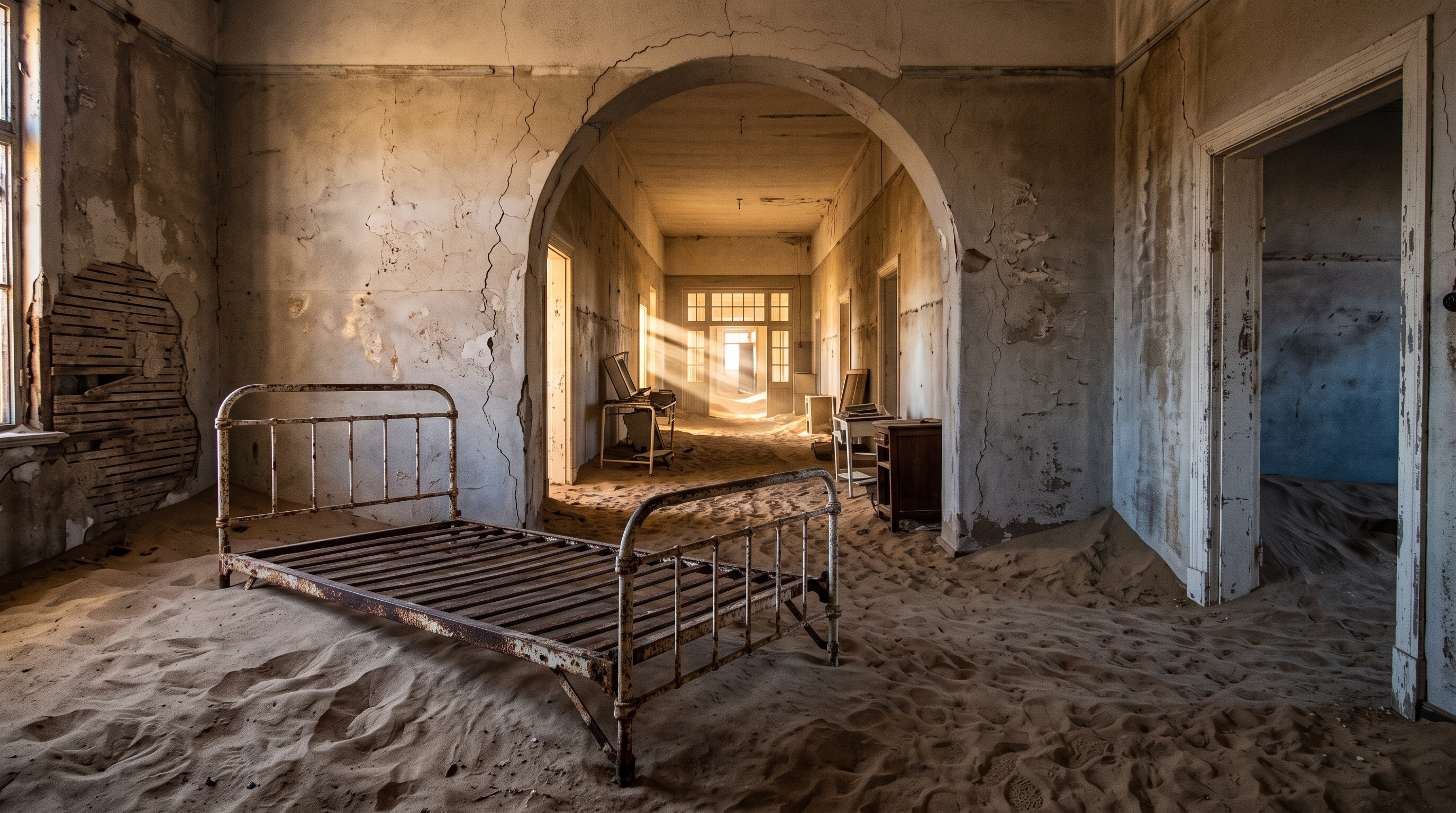 Rusted gurneys and crumbling plaster in the abandoned Kolmanskop hospital, slowly buried by desert storms.
Families packed their heirlooms and abandoned their luxury homes to follow the new mining frontier. By 1956, the last resident shuttered their doors, leaving the town completely deserted.
Without human maintenance, the extreme environment took over. Blistering daytime heat, freezing coastal night fogs, and fierce Atlantic winds pulverized glass and stripped paint, while towering sand dunes moved steadily through open doorways, filling interior rooms up to the ceilings.
Walking the Sands: An Anatomical Decay
Exploring Kolmanskop today feels like stepping inside an architectural Salvador Dalí canvas:
- The Architect’s Villa: The grandest two-story residences showcase intact Victorian molding and peeling turquoise floral wallpaper, with interior dunes rising steeply enough that visitors must crouch to enter upper rooms.
- The Kegelbahn: The community skittle bowling alley still features its long wooden lanes, flanked by sandbars pushing through the perimeter walls.
- The Butcher & Ice Factory: The facility that once produced block ice for domestic refrigerators now stands hollowed out, its rusted refrigeration machinery half-entombed in calcified sand.
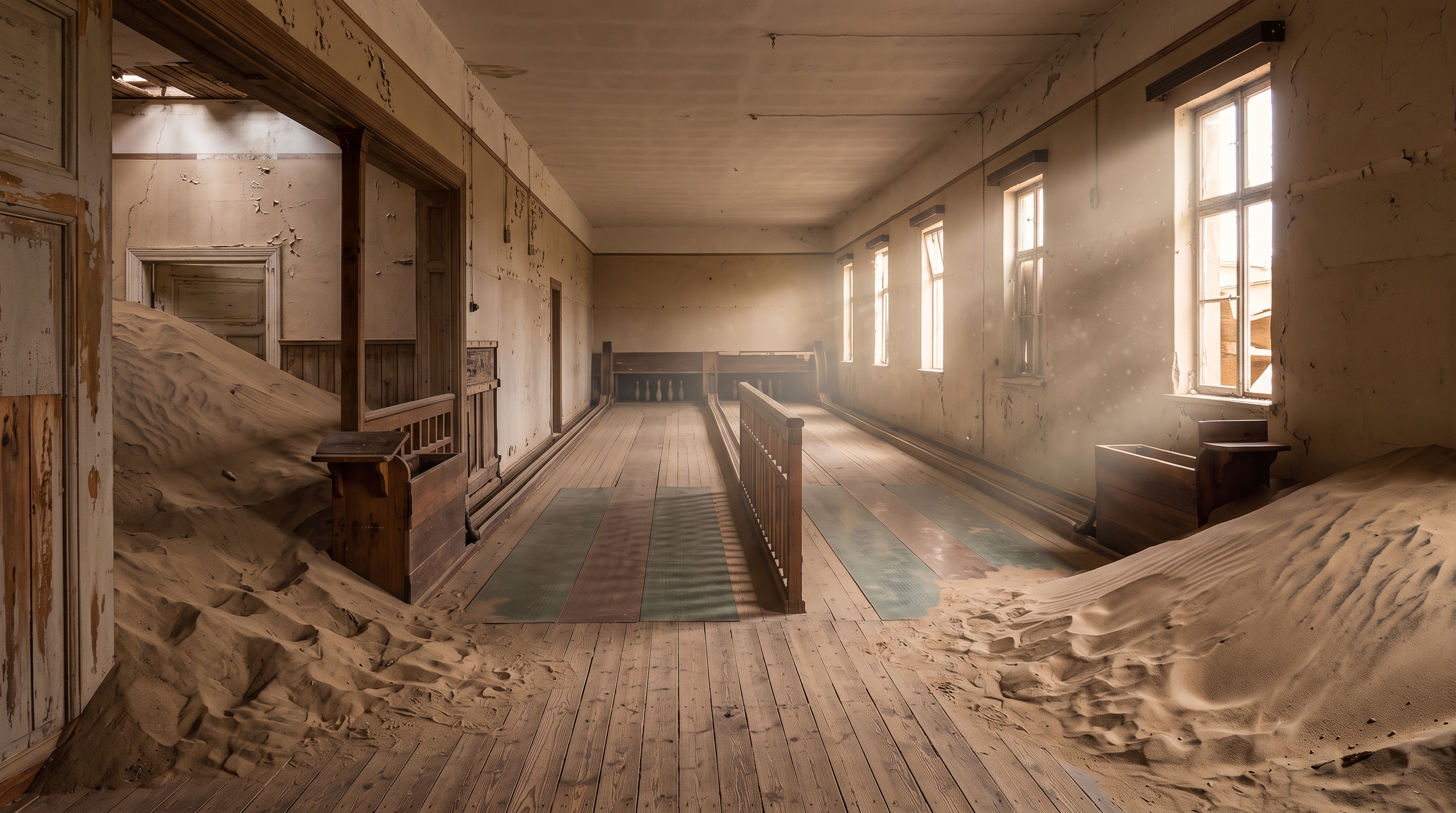 The historic community hall where classical concerts and theatrical performances were staged in the heart of the desert.
Expedition Field Guide: Navigating the Sperrgebiet
Visiting Kolmanskop requires crossing into Namibia’s restricted diamond territory, which demands specific logistical preparation.
Permits & Hours
- Standard Permits: The ghost town is open to the public daily from 08:00 AM to 01:00 PM. Permits can be bought at the entrance gate or in advance from tourism offices in Lüderitz.
- Photographer’s Golden Hour Permit: Serious photographers can purchase an extended permit that grants access from sunrise to sunset. This is crucial for capturing the soft morning and late-afternoon sidelight casting dramatic shadows across the dune-filled rooms.
Hazards & Wilderness Rules
- The South-Westerly Gale: By midday, high winds (the Lüderitz gale) regularly sweep across the desert floor, creating abrasive sandstorms that can permanently scratch camera lenses and irritate eyes. High-grade optical lens protection and sealed camera bags are essential.
- Venomous Desert Fauna: Drifting dunes provide shelter for native desert reptiles, including the horned adder (Bitis caudalis) and black spitting cobras. Watch hand placement when climbing over sand dunes or stepping through dark door frames.
- Fragile Structural Decay: Floorboards beneath the sand are rotted by century-old coastal humidity. Avoid stepping onto weakened balconies or walking beneath sagging ceilings.
The Verdict
Kolmanskop is a haunting visual parable about the transience of wealth. In a landscape where human beings once traded champagne for diamonds in air-conditioned opulence, the silent, relentless desert has had the final word—turning an empire of stone and glass into an ocean of quiet golden dust.