Across the blinding, hyper-arid desert plains of southern Peru, thirty kilometers south of the oasis city of Nazca, the silence is broken only by the steady rush of dry Pacific winds. Here, scattered across cracked desert loam under an unforgiving Andean sun, lies one of the most astonishing open-air necropolises on Earth: Chauchilla Cemetery (Cementerio de Chauchilla).
Unlike conventional archaeological ruins where human remains are sealed inside museum glass cases or buried deep underground, Chauchilla is an open-air sanctuary of death.
Looking down into sunken, mud-brick (adobe) burial pits sheltered beneath simple wooden canopy roofs, travelers come face-to-face with the original inhabitants of the Nazca and Ica-Chincha civilizations (dating from approximately 200 to 1000 AD). Clothed in weathered textiles and propped into seated, upright postures facing the eastern horizon, these thousand-year-old mummies stare out into the desert with visible teeth, leathery desiccated skin, and extraordinarily preserved thick plaits of long human hair cascading down their shoulders.
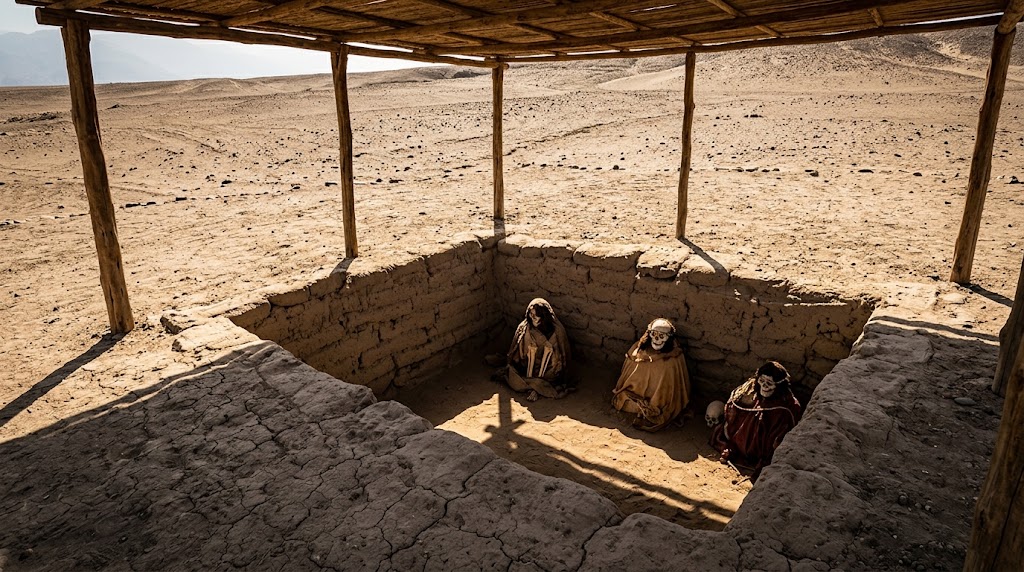 An open-air mud-brick burial chamber at Chauchilla Cemetery, where ancient Nazca mummies sit facing the rising sun.
The Natural Laboratory of the Atacama-Sechura Aridity
How did delicate human hair, cotton textiles, and organic tissue survive ten centuries without artificial refrigeration or deep underground chambers?
The answer lies in the extreme climatology of the Peruvian coastal desert:
- The Rainless Void: The region sits in the rain shadow of the towering Andes mountains to the east, while the cold Humboldt Current running along the Pacific coast chills oceanic air, preventing cloud condensation. Decades frequently pass without a single drop of measurable rain.
- The Embalming Resin: Ancient Nazca embalmers combined nature’s dryness with sophisticated ritual mortuary science. Corpses were bathed in natural tree resins and vegetable oils, wrapped tightly in multiple layers of hand-spun llama wool and cotton embroidery, and seated within sun-baked clay-brick chambers.
- The Solar Orientation: Every individual was deliberately buried facing East—toward the rising sun and the high peaks of the Andes—a sacred alignment reflecting Andean cosmological beliefs in rebirth, agricultural fertility, and ancestral solar communion.
The Plunder of the Huaqueros
For nearly a century, Chauchilla was not a tranquil archaeological reserve; it was an epicenter of ruthless black-market looting:
- The Grave Robbers: During the mid-20th century, treasure hunters known locally as huaqueros descended upon the unprotected desert. Armed with steel probes and shovels, they smashed through adobe tomb walls seeking gold pectoral plates, turquoise bead necklaces, and world-renowned polychrome Nazca ceramic vessels.
- The Bone Fields: Treating human bodies as worthless debris, the looters tore apart sacred textile bundles and scattered thousands of skeletons across the open desert. For decades, the windswept sands surrounding Chauchilla were horrifyingly blanketed with bleached ribs, fractured craniums, and tattered cotton shrouds shimmering under the desert sun.
- Legal Sanctuary (1997): Following intense international outcry and decades of degradation, the Peruvian government declared Chauchilla a legally protected national archaeological zone in 1997. Archaeologists painstakingly gathered the scattered remains, reconstructed the ancestral mud-brick pits, and returned the mummies to their rightful resting chambers under protective wooden ramadas.
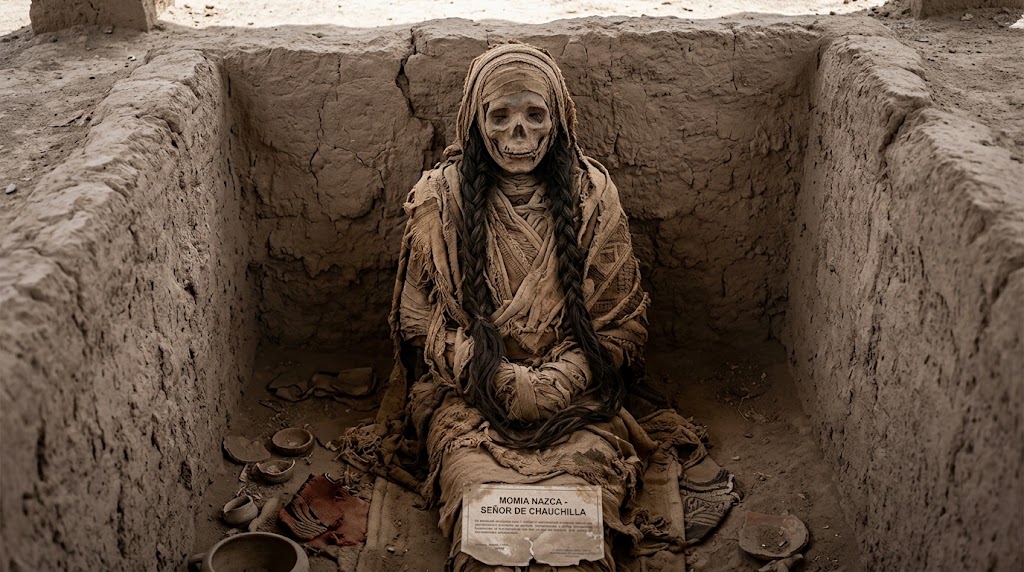 A seated Nazca mummy within an adobe pit: notice the remarkably intact braided dark hair and hand-woven cotton robes.
The Hair That Defied a Millennium
The most arresting sight at Chauchilla is the human hair.
Because keratin protein is highly resistant to natural decomposition when shielded from moisture, the hair of these ancient individuals remains almost as lustrous and structural as the day they died:
- The Braids and Dreadlocks: Many mummies display intricate three-strand braids, elaborate topknots, and corded extensions that measure over two meters in length—a status symbol denoting high social standing, religious shamanic authority, or warrior prowess.
- The Facial Features: Although soft flesh has dehydrated down to the bone, several mummies retain parchment-like cheek skin, dark eyebrow lines, and fully intact dental arches with teeth naturally stained by a lifetime of chewing coca leaves mixed with lime.
The Surrounding Landscape: Fragmented History
Stepping along the marked desert pathways between the twelve excavated burial pits, you realize the desert floor itself is an open archaeological layer:
- Pottery Shards: Walking along the perimeter trails, travelers can spot countless fragments of original 1,500-year-old Nazca pottery resting untouched in the sand—bearing characteristic mineral pigments of ochre, terracotta, and black iron depicting stylized condors, killer whales, and geometric deities.
- Strict Preservation: Visitors are strictly required to remain on cleared stone-bordered paths. Stepping off-trail or collecting a single ceramic fragment or bone splinter is a federal offense under Peruvian cultural patrimony law.
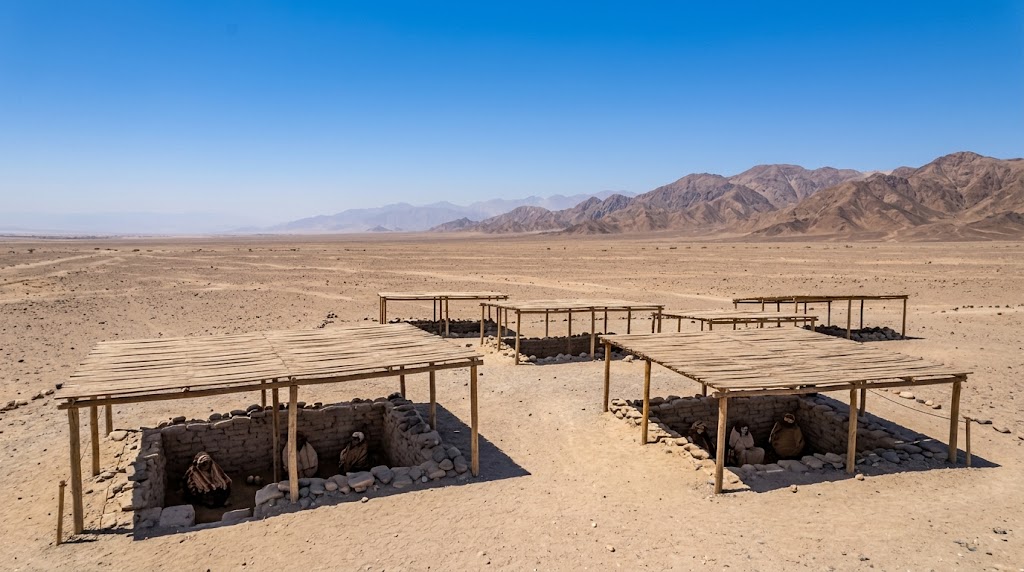 The vast Nazca desert surrounding Chauchilla, where low timber roofs shield sacred adobe tombs against blowing desert sand.
Expedition Field Guide: How to Journey to Chauchilla
Visiting Chauchilla Cemetery is straightforward when combined with a classic overland tour of southern Peru and the Nazca Lines.
Transit & Logistics
- Base City: The nearest town is Nazca, located roughly 450 kilometers south of Lima along the iconic Pan-American Highway (Carretera Panamericana Sur). Comfortable long-distance coaches (such as Cruz del Sur) connect Lima, Ica, and Arequipa to Nazca daily.
- Reaching the Site: From Nazca town center, Chauchilla lies 30 kilometers south. The final seven kilometers diverge onto an unpaved desert dirt track. Private taxis or organized half-day agency tours can be hired directly from Nazca hotels.
- Operating Hours & Entry: Open daily from 9:00 AM to 5:00 PM. A modest entrance fee (approx. 8–10 Peruvian Soles) is collected at the municipal visitor desk.
Essential Visitor Protocols
- Extreme Desert Heat & Hydration: Midday temperatures in the Nazca basin routinely exceed 35°C (95°F) with intense UV radiation and zero natural shade. Bring at least two liters of water, broad-brimmed sun hats, high-SPF sunscreen, and polarized sunglasses to cut through blinding ground glare.
- Hire an Accredited Local Guide: While you can walk the site independently, an accredited Quechua or local archaeologist guide provides invaluable historical context regarding Nazca funeral rituals, cranial modification practices, and post-mortem textile weaving.
- Respect Sacred Remains: Remember that Chauchilla is an ancient cemetery. Maintain solemn decorum, do not yell, and never lean over the protective ropes to photograph or touch skulls. Drones are prohibited without prior permits from the Ministry of Culture.
The Verdict
Chauchilla Cemetery is one of South America’s most humbling dark tourism encounters: an ancient sanctuary where mortality is laid bare beneath an infinite blue sky. Looking into the hollow gaze of ancestors who walked this earth when imperial Rome was collapsing, travelers are confronted by the haunting fragility of human civilization—and the enduring dignity of the ancient dead.