Rising out of the churning, pewter-gray swells of the outer Thames Estuary, roughly nine miles off the coast of Kent and Essex, stands a sight that appears plucked directly from an H.G. Wells apocalyptic illustration: the Maunsell Sea Forts.
Perched on towering four-legged hollow concrete stilts thirty feet above the waterline, these colossal octagonal iron fortresses resemble mechanical alien invaders striding through the North Sea. Known individually as the Red Sands Fort and the Shivering Sands Fort, these decommissioned military citadels were constructed during the darkest months of the Second World War to defend London from Nazi air and naval encirclement.
Decommissioned in the 1950s, seized by anti-establishment pirate radio broadcasters during the counterculture boom of the 1960s, and ravaged by eight decades of salt spray and gale storms, the Maunsell Forts stand today as monumental, rusted time capsules of wartime ingenuity and maritime isolation.
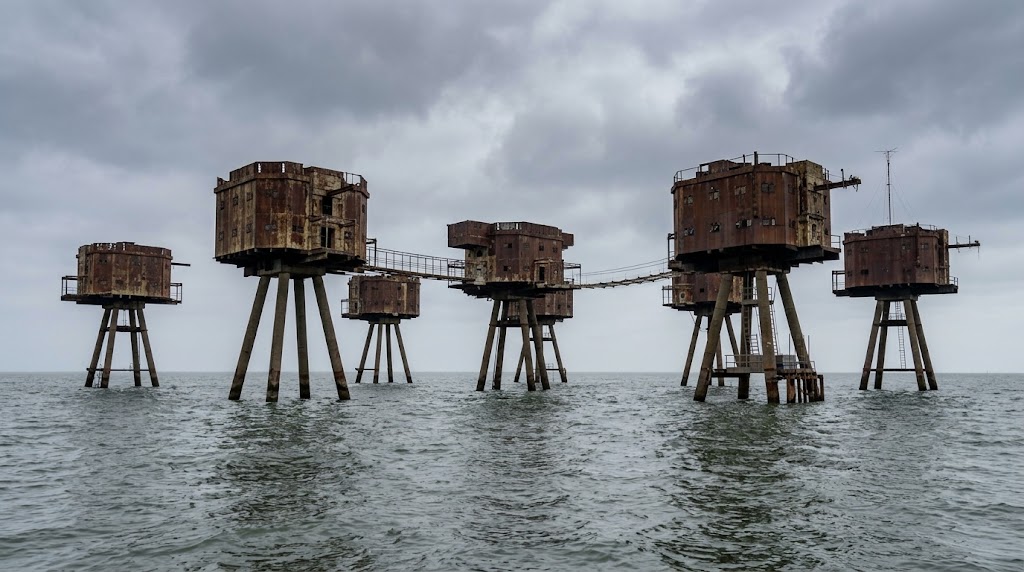 The Red Sands Fort: seven interconnected octagonal steel towers standing on reinforced concrete legs nine miles offshore.
The London Blitz: A Desperate Maritime Defense
In 1940 and 1941, during the height of the Blitz, the Port of London was Britain’s economic juggernaut, handling thousands of cargo vessels supplying the island nation with food, fuel, and munitions.
To choke this vital lifeline, the German Luftwaffe began covert low-altitude nocturnal sorties, dropping acoustic and magnetic parachute mines directly into the shallow, muddy shipping channels of the Thames Estuary. Conventional Royal Navy patrol craft could not effectively detect or counter these rapid low-level aerial drops.
Enter visionary civil engineer Guy Maunsell:
- The Engineering Marvel: Maunsell conceived an audacious defense blueprint—prefabricated military forts constructed dry in onshore London docks, towed miles out into the open sea by tugboats, and deliberately scuttled onto sandbanks.
- The Army Fort Architecture: Completed between 1942 and 1943, each Army Fort installation was an offshore archipelago consisting of seven separate steel towers arranged in an interlocking cluster. A central Bofors command and radar tower was surrounded by five heavy 3.7-inch anti-aircraft gun towers, connected to an outlying searchlight tower via precarious tubular steel catwalk bridges.
- Combat Record: The forts proved lethal to the enemy. Over their active service life, the Thames Estuary naval and army forts shot down twenty-two German aircraft, intercepted thirty V-1 flying flying bombs (“doodlebugs”), and destroyed a German torpedo boat.
Life on the Stilts: 120 Men in an Offshore Crucible
Stationed aboard these sea platforms were crews of roughly 120 soldiers and naval personnel:
- The Steel Bastions: Troops slept on canvas hammocks suspended inside double-walled steel-plate living quarters inside the tower heads. Fresh water was stored in massive hollow concrete stilts below, while diesel generators provided continuous electrical power for heavy radar equipment and artillery cranes.
- Psychological Strain: Life on the forts was governed by relentless isolation, deafening winter gales, and chronic seasickness. Waves striking the hollow pylons during storms sent deep, reverberating sonic groans through the metal bunks, leaving soldiers feeling as if they were trapped inside a floating bell.
When the Ministry of Defence officially decommissioned the Army forts in 1956, the artillery was removed, personnel were ferried back to dry land, and the structures were abandoned to the tides.
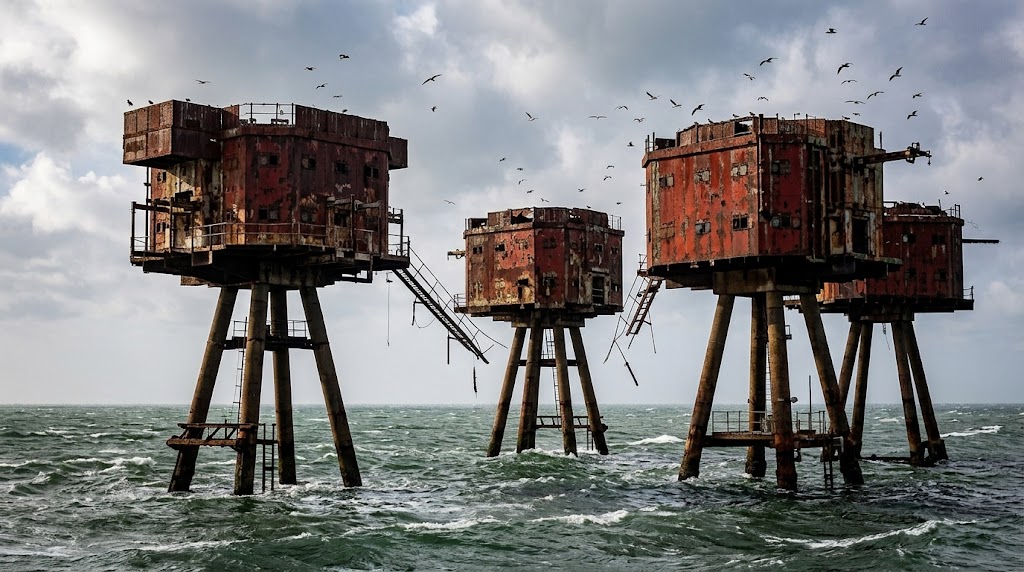 Weathered iron cladding and collapsed catwalks: eight decades of Atlantic salt spray slowly eroding structural steel.
The 1960s Outlaws: The Pirate Radio Revolution
In the 1960s, the abandoned forts found a wild, rebellious second life during the golden era of British Pirate Radio:
- The Airwave Monopoly: The state-run BBC held a strict monopoly over British radio broadcasting, allocating only a few hours per week to modern rock ‘n’ roll, rhythm and blues, and pop music.
- The Unregulated Sanctuary: Recognizing that the Maunsell Forts lay outside British three-mile territorial waters (at the time), rebellious entrepreneurs and underground disc jockeys sailed offshore and occupied the empty steel towers to broadcast unlicensed rock music twenty-four hours a day.
- The Radio City Saga: Legendary eccentric rocker and politician Screaming Lord Sutch established Radio Sutch on Shivering Sands in 1964, which soon evolved into Radio City under manager Reg Calvert. In 1966, a rival offshore radio operator led an armed boarding party that stormed Shivering Sands and held the tower hostage—a dispute that culminated weeks later in the tragic fatal shooting of Calvert on the British mainland.
- The Birth of Sealand: Simultaneously, another Maunsell naval platform—HM Fort Roughs—was occupied by retired British Army Major Roy Bates, who declared the platform the independent sovereign state of the Principality of Sealand in 1967.
By late 1967, the British government passed the Marine, &c., Broadcasting (Offences) Act, effectively criminalizing offshore pirate radio and sealing the fate of the towers.
Corrosion, Collapse, and the Struggle to Save Red Sands
Decades without routine cathodic protection or maintenance have taken a severe toll:
- The 1963 Ship Collision: In dense fog on June 7, 1963, the coastal cargo ship Ribersborg struck Shivering Sands, severing one of the gun towers and sending it crashing into the ocean, leaving Shivering Sands with only six standing structures.
- Catwalk Ruptures: The steel lattice suspension bridges connecting the towers rusted through and plunged into the estuary waters decades ago, severing physical transit between individual platforms.
- Project Redsand: In recent years, maritime preservationists and civil engineers formed the Project Redsand Trust, aiming to prevent the total structural collapse of the Red Sands cluster. Volunteer teams have successfully stabilized exterior ladders, refurbished the roof of the central command tower, and conducted ultrasonic thickness testing to determine if the fort can eventually be restored as a museum and offshore eco-station.
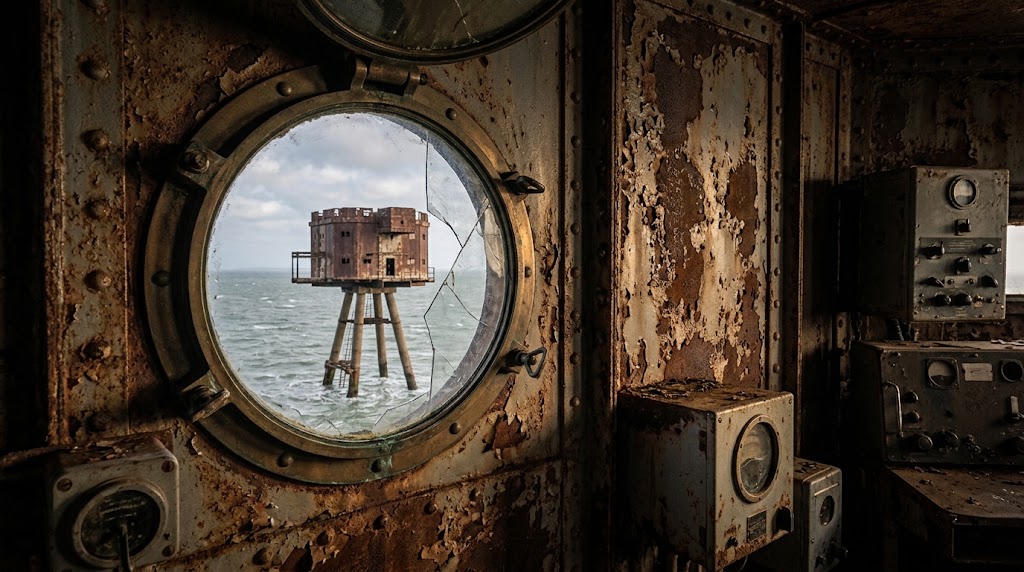 Looking out from inside the rusted interior of a command tower through a circular bronze porthole toward adjacent gun towers.
Expedition Field Guide: How to Encounter the Forts
Because the Maunsell Forts are situated miles out in open tidal waters and are structurally hazardous, stepping foot aboard them is illegal and extremely dangerous. However, marine boat charters offer thrilling up-close photographic encounters.
Coastal Departure Points & Charters
- From Kent: Maritime excursion vessels depart seasonally (May through September) from Whitstable Harbour and Herne Bay. Historic tugboats and sightseeing cruisers (such as the Thames Sailing Barge Greta or local Whitstable boat trips) run dedicated 3-to-4-hour round-trip voyages to Red Sands.
- From Essex: Coastal charters and rib boats operate out of Southend-on-Sea and Queenborough, offering tours out to Shivering Sands and the nearby shipwreck of the SS Richard Montgomery (an unexploded WW2 munitions ship).
Maritime Safety & Navigation Protocols
- Weather Dependency: The Thames Estuary is notoriously unpredictable. Strong tides, sandbank shallows, and suddenly rolling North Sea fog mean that charter bookings are strictly subject to last-minute tidal and weather clearances.
- Never Attempt to Board: Climbing the rusted emergency ladders hanging from the pylons is strictly prohibited under British maritime jurisdiction. Pylons are coated in slippery algae, ladders are compromised by interior iron rot, and upper floor decking is prone to catastrophic collapse.
- Telephoto Optics: Pack a quality telephoto lens (70–200mm or greater) with optical image stabilization, as boat decks continually roll in estuary swells. Waterproof dry bags for camera gear are essential to shield against salt spray.
The Verdict
The Maunsell Sea Forts are unmatched monuments of industrial defiance—steampunk sentinels of iron and concrete that resisted the Third Reich, hosted a rock ‘n’ roll revolution, and continue to withstand the relentless currents of the North Sea. Looming against the coastal horizon, they stand as an unforgettable tribute to British wartime resolve and the raw, untamable power of the ocean.