Jutting out into the roaring swells of the Southern Ocean on the southeastern tip of Tasmania lies one of the most geographically formidable penal fortresses ever devised: Port Arthur.
Framed by the tranquil, sapphire waters of Carnarvon Bay and manicured English oak gardens, the site today presents an arresting paradox: colossal, roofless sandstone ruins that resemble a romantic ruined abbey from Victorian poetry. But beneath this pastoral beauty lies a century of unmitigated colonial brutality.
Established in 1830 under Lieutenant-Governor George Arthur in what was then known as Van Diemen’s Land, Port Arthur served as the British Empire’s ultimate destination for recidivist convicts—men and boys who had re-offended after arriving in Australia. It was engineered not simply as a place of incarceration, but as an inescapable “machine for grinding rogues honest.”
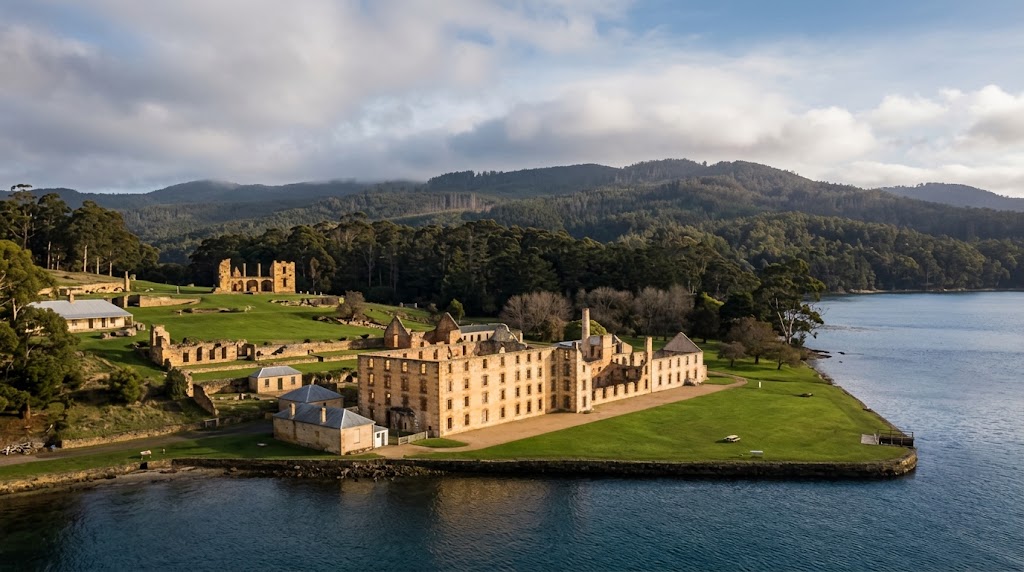 The imposing Penitentiary ruin of Port Arthur standing along the coastal waters of Carnarvon Bay in Tasmania.
The Natural Prison: Sharks and the Dog Line
Port Arthur was an inescapable open-air cage dictated entirely by geography:
- The Moat of the Southern Ocean: The penal settlement sat at the base of the rugged Tasman Peninsula, surrounded on three sides by treacherous oceanic currents, frigid Antarctic waters, and Great White sharks. Deliberate rumors were circulated among convicts that the waters were so thick with maneaters that swimming meant instant evisceration.
- Eaglehawk Neck: The only terrestrial escape route was a narrow sandbar just 100 meters (330 feet) wide connecting the peninsula to the Tasmanian mainland.
- The “Dog Line”: Across this neck of sand, military authorities established an impassable defensive gauntlet. Ferocious mastiffs were chained to wooden posts spaced mere paces apart, flanked by platforms built over shallow tidal shallows so dogs could detect anyone swimming along the perimeter. Sentry boxes and armed redcoat soldiers manned the line day and night, ensuring virtually zero unauthorized passage.
Only a handful of convicts ever successfully crossed Eaglehawk Neck, the most famous being Billy Hunt, who attempted to crawl past the guard line disguised beneath the skin of a kangaroo—only to surrender when half-starved sentries aimed their muskets at him hoping for fresh meat for dinner.
The Shift from Flesh to Mind: The Separate Prison
During its early decades, Port Arthur relied on relentless manual labor and physical torture: convicts felling ancient eucalyptus gums while wearing heavy iron leg chains, enduring up to 100 lashes from the nine-tailed whip (cat-o’-nine-tails).
However, by 1848, influenced by British penological reforms and the Pennsylvania solitary model, Port Arthur pioneered the Separate Prison:
- Sensory Deprivation: Physical lashings were replaced by absolute psychological isolation. Convicts were referred to exclusively by their cell numbers rather than names.
- The Mask of Anonymity: Whenever an inmate stepped outside his solitary cell, guards forced him to wear a heavy canvas hood with two small eyeholes cut out, preventing prisoners from seeing, recognizing, or acknowledging fellow human beings.
- The Partitioned Chapel: Even Sunday religious worship was an exercise in solitude. Inside the prison chapel, convicts were led into individualized, vertical wooden stalls called “pews” that concealed their bodies entirely from their peers. Inmates could see only the minister preaching from the pulpit high above.
This relentless silence drove dozens of prisoners into severe insanity, leading the colonial government to construct the adjacent Lunatic Asylum in 1867.
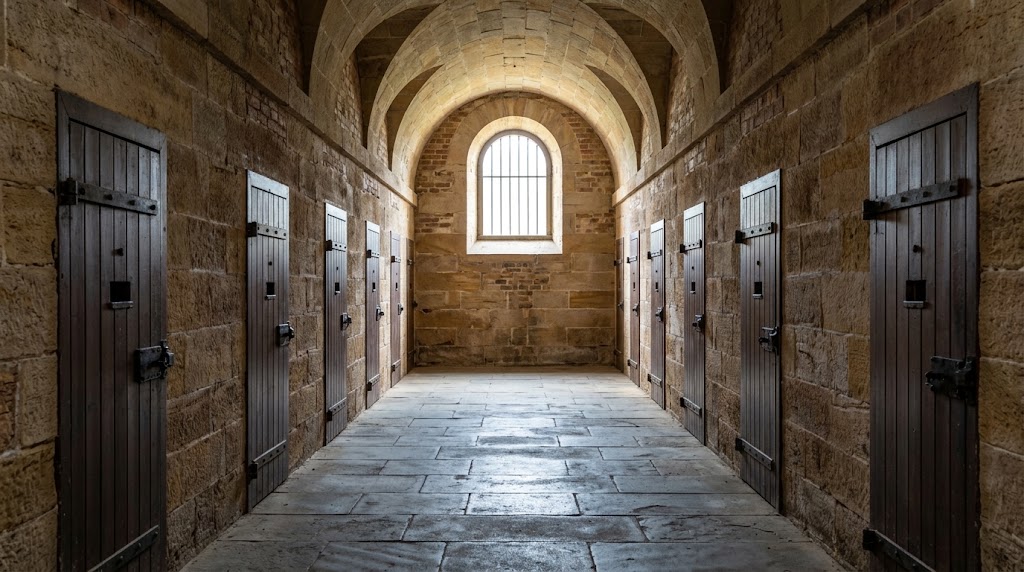 Inside the cruciform halls of the Separate Prison, where complete sensory deprivation and mandatory silence were enforced.
Point Puer and the Isle of the Dead
Port Arthur was an expansive network of specialized penal institutions across the bay:
- Point Puer (1834–1849): Situated across the water stood the first purpose-built juvenile prison in the British Empire. Over 3,000 boys—some as young as nine years old, transported from London streets for stealing handkerchiefs or pieces of cheese—endured harsh military discipline and industrial labor to learn trades like stone-cutting and shipbuilding.
- The Isle of the Dead (Oyster Cove): A short boat ride offshore sits a tiny, forested island cemetery containing over 1,100 burials. The island’s geography mirrors 19th-century class divisions: the high southern ridge is crowned with ornate carved headstones honoring military officers, civil staff, and their families, while the lower, swampy northern slopes contain the unmarked mass graves of hundreds of convicts buried in plain timber boxes without names.
The Great Fires and Modern Heritage
Port Arthur was officially closed in 1877, and the settlement was renamed Carnarvon in an attempt to distance the community from its dark convict stigma.
In 1895 and 1897, devastating Tasmanian bushfires tore through the peninsula, incinerating the timber roofs and wooden interior floors of the grand Penitentiary, the Gothic Church, and hospital wards. The fires stripped the structures down to their golden-brown sandstone masonry, creating the haunting skeletal ruins visible today.
In 2010, Port Arthur was inscribed as a UNESCO World Heritage Site as one of eleven Australian Convict Sites, recognized as an extraordinary physical document of global mass migration, colonial carceral systems, and convict labor.
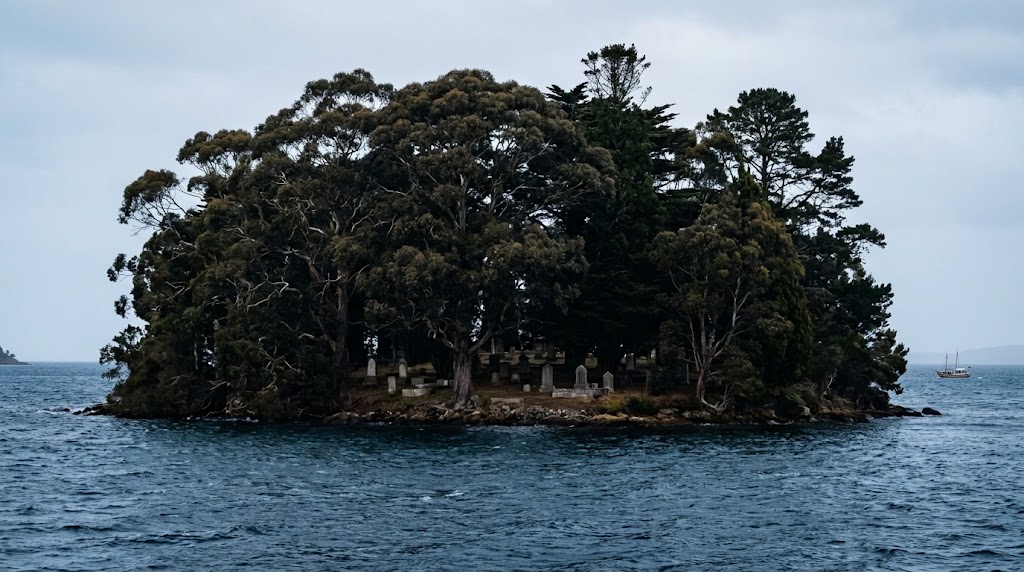 The Isle of the Dead: the secluded island cemetery where over a thousand convicts rest in unmarked soil.
Expedition Field Guide: How to Journey to Port Arthur
Port Arthur is Tasmania’s premier historical destination, located approximately 90 minutes southeast of Hobart.
Transit & Driving Route
- By Car: Drive southeast from Hobart along the Arthur Highway (A9) through Sorell and Dunalley. The 95-kilometer drive takes roughly 1.5 hours through coastal eucalyptus reserves and pastoral farmland.
- Shuttle & Tours: Daily coach shuttles (such as the Port Arthur Day Tour or Pennicott Wilderness Journeys) depart from the Hobart waterfront, often combining the penal site with visits to the towering dolerite cliffs of Tasman Arch and Devil’s Kitchen.
Visitor Protocols & Site Navigation
- Allow a Full Day: Spanning over 100 acres with thirty historic buildings and ruin walks, thoroughly exploring Port Arthur requires 4 to 6 hours. General admission tickets are valid for two consecutive days and include a guided walking tour and a harbor boat cruise around the Isle of the Dead.
- The Isle of the Dead Excursion: Book the specialized ferry landing pass to walk ashore the Isle of the Dead. Guided walking tours on the island provide intimate historical narratives of the convicts and free settlers interred beneath the gum trees.
- Historic Lantern Ghost Tours: Operating after dark several nights a week, these iconic tours lead visitors through unlit cellblocks, the ruined hospital, and the Separate Prison by candlelight, recounting 19th-century convict folklore and verified historical tragedies.
- Tasmanian Maritime Weather: Antarctic weather fronts sweep over the Tasman Peninsula with little warning. Pack thermal layers, a waterproof windbreaker, and flat walking boots for gravel tracks and stone ruins.
The Verdict
Port Arthur stands as an unvarnished testament to the human spirit under colonial oppression. Surrounded by the serene majesty of Tasmanian waters, its weathered sandstone walls remind travelers of the extraordinary endurance of the men and boys whose blood, sweat, and suffering laid the foundational stones of modern Australia.