Rising sheer from the desolate, moon-like badlands (calanchi) of the southern Italian region of Basilicata stands an unforgettable architectural ghost: Craco.
Perched precariously atop a 400-meter (1,300-foot) limestone cliff overlooking the Cavone River valley, Craco appears from a distance to be carved directly out of the mountain bedrock. Clustered around a monolithic square Norman tower, stacked stone palazzos, medieval arched alleyways, and baroque church bell towers cling to the sheer ridge in dramatic, gravity-defying tiers.
Yet beneath this medieval magnificence lies complete desolation. Windows are hollow eye sockets framing empty sky, iron balconies hang warped over eroded precipices, and stone staircases lead into empty space. Once home to thousands of souls over a millennium, Craco was swiftly abandoned after catastrophic landslides fractured its geological foundations, leaving one of Europe’s most breathtaking medieval citadels suspended in eternal silence.
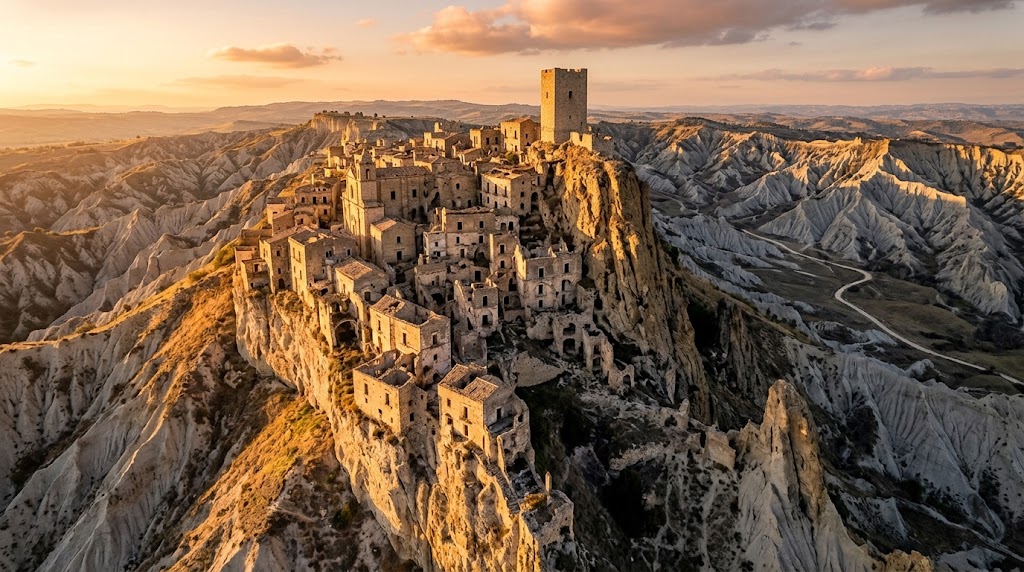 Craco’s skyline: centuries of stone masonry cascading down the limestone cliff above the eroded clay calanchi.
A Millennium on the Edge: Byzantine Roots to Feudal Power
Craco’s origins are forged in ancient frontier survival:
- The Byzantine Monks (8th Century): The earliest settlement was founded by Basilian monks who cultivated wheat fields in the river valley below and carved hermit grottos into the limestone cliffside.
- The Norman Bastion (1040 AD): Recognizing the site’s strategic vantage point over the Gulf of Taranto, Norman conqueror Arnaldo da Bradano fortified the summit. By 1040, workers erected the commanding Torre Normanna (Norman Watchtower), turning the rocky promontory into an impregnable defensive garrison against Saracen raids.
- Feudal Flourishing: Under the rule of the Sanseverino family during the 13th to 16th centuries, Craco expanded into a prosperous agricultural citadel. Aristocrats erected monumental stone palaces (Palazzo Grossi, Palazzo Carbone), universities operated within its walls, and four elaborate Catholic monastic churches were consecrated.
The town weathered the Black Death in 1656, Napoleonic occupations, and brutal 19th-century conflicts against the Briganti (mountain guerrillas resisting the unification of Italy). However, the cataclysm that destroyed Craco came from beneath its own foundations.
The Fragile Earth: Landslides, Waterworks, and the 1963 Exodus
Geologically, Craco was built upon a ticking environmental time bomb:
- The Pliocene Clay (Calanchi): The mountain consists of brittle limestone sitting atop pliable, water-soluble Pliocene clay. Over millennia, deforestation and torrential seasonal rains carved the surrounding hills into knife-edge clay ravines known locally as calanchi.
- The Engineering Failure: In the late 1950s and early 1960s, regional municipal engineers attempted to modernize the ancient town by installing modern subterranean water pipes, concrete retaining walls, and sewage mains. The drilling fractured ancient geological drainage paths, saturating the subterranean clay stratum with water.
- The 1963 Catastrophe: In December 1963, a massive hillside rupture gave way. Millions of tons of clay sheared away, collapsing residential districts, cracking sixteenth-century palace foundations, and sending centuries-old stone houses sliding into the gorge below.
Authorities issued mandatory evacuation decrees. Thousands of residents had to gather what belongings they could carry and abandon their ancestral homes, relocated down into the valley to the newly constructed concrete settlement of Craco Peschiera.
The tragedy deepened in 1972 when a torrential flood caused secondary cliff destabilizations. The coup de grâce arrived on November 23, 1980, when the devastating Irpinia Earthquake (6.9 magnitude) struck southern Italy, shattering the remaining structural integrity of the town and sealing Craco’s abandonment forever.
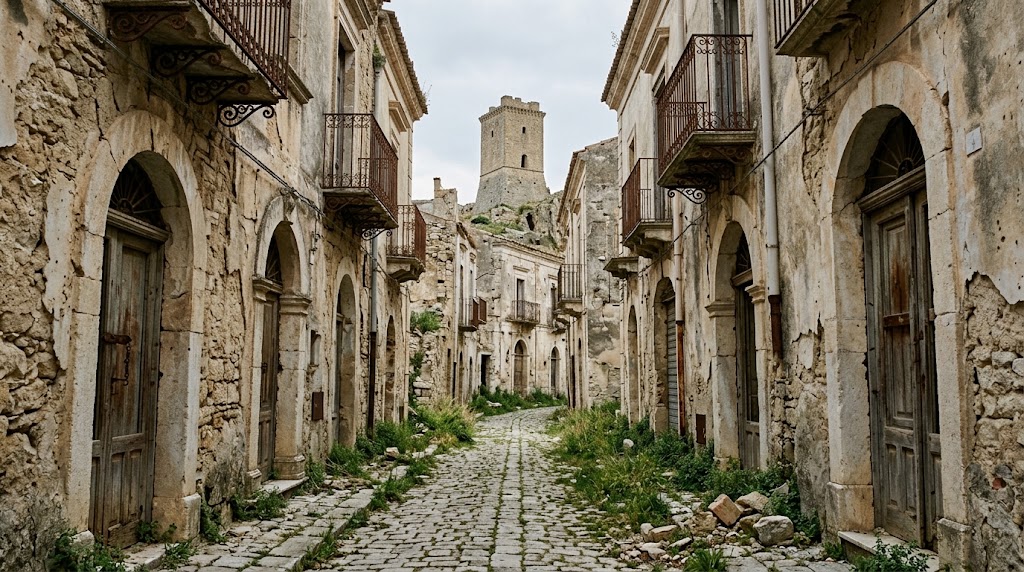 The Norman Tower looming over crumbling stone facades, narrow alleys, and cracked archways.
The Cinematic Purgatory: Hollywood’s Preferred Ruin
Craco’s haunting, untouched medieval patina made it an irresistible magnet for international filmmakers seeking an authentic, apocalyptic backdrop:
- The Passion of the Christ (2004): Director Mel Gibson selected Craco’s bleak stone backdrop to film the iconic scene where Judas Iscariot hangs himself in despair after betraying Jesus Christ. Judas hangs suspended from a desolate tree framed against the eerie, sun-baked stone buildings of Craco.
- Quantum of Solace (2008): In the 22nd James Bond film, agent 007 (Daniel Craig) and Giancarlo Giannini are filmed driving through the dramatic badlands and sweeping winding roads below the ghostly ruins of Craco.
- Other Notable Epics: The town served as the ancient Biblical landscapes in Bruce Beresford’s King David (1985) starring Richard Gere, and the mythic setting for Paolo and Vittorio Taviani’s The Sun Also Shines at Night (1990).
The Hollow Sanctuary: Inside the Architectural Ruins
To walk through Craco’s secured ruins today is to navigate an open-air archaeological cross-section of medieval Italian life:
- Chiesa Madre di San Nicola: The town’s primary parish church still retains its vaulted baroque dome, though rainwater and wind have stripped away interior ornamentation. Delicate fragments of sky-blue and gilded plasterwork cling to damp walls, while hollow niches that once held marble statues of saintly patrons look down upon cracked marble flagstones.
- Palazzo Grossi: A sprawling 15th-century baronial residence characterized by monumental arched doorways, wrought-iron balconies jutting precariously over the ravine, and partially collapsed fresco ceilings depicting floral and mythological motifs.
- The Norman Tower: Sitting at the summit pinnacle, the tower’s stone battlements remain intact. From its lookout platform, sentries could spot approaching armadas in the Ionian Sea twenty miles away.
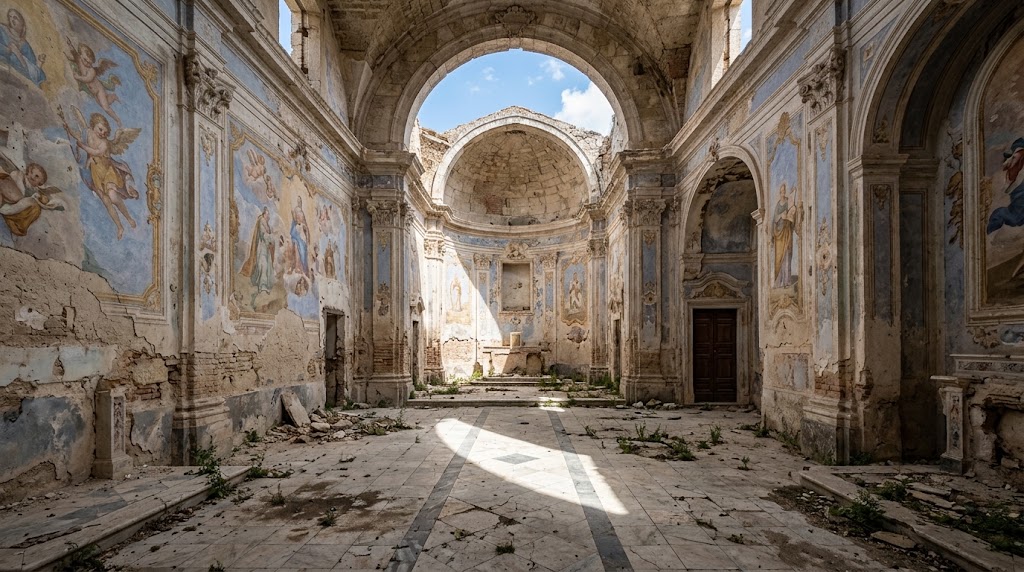 Inside a ruined church: faded wall frescoes, structural cracks, and sunlight illuminating ancient flagstones.
Expedition Field Guide: How to Visit Craco Legally
Because spontaneous landslides and falling masonry remain active hazards, wandering through Craco independently is strictly prohibited and enforced by perimeter gates and surveillance. The site is accessible exclusively via the authorized Craco Historic Park (Parco Museale Scenografico di Craco).
Location & Transit Directions
- Location: Province of Matera, Basilicata region, Southern Italy.
- By Car from Matera: Craco lies approximately 54 kilometers (34 miles) southwest of Matera (roughly a 50-minute drive). Take the SS407 Basentana highway westbound, exit toward Pisticci/Craco, and follow the SP103 winding through the dramatic badlands.
- By Car from Bari Airport: Fly into Bari Karol Wojtyła Airport (BRI), rent a car, and drive south for roughly two hours via the SS96 and SS407.
Mandatory Visitor Protocols
- The Craco Card & Hard-Hat Requirement: All visitors must register at the municipal visitor center (Centro Visite) in Craco Peschiera or at the summit gate. Every participant is issued a mandatory safety helmet (hard hat) and must follow an accredited local docent along secured, steel-meshed walkways.
- Terrain & Footwear: The paths involve steep, uneven historic cobblestones, rubble gradients, and exposed cliffside stairs. Sturdy hiking boots or closed-toe walking shoes with aggressive tread are strictly mandatory; anyone wearing sandals, canvas shoes, or heels will be denied entry.
- Summer Heat Preparedness: Basilicata’s summers are notoriously scorching, with daytime temperatures exceeding 38°C (100°F) and zero shade along the exposed stone ridge. Book morning tours (9:00 AM–11:00 AM), carry abundant water, and wear polarized sunglasses to deflect intense glare from the white clay hills.
The Verdict
Craco is not a modern amusement or a fabricated tourist park; it is a monumental testament to the delicate truce between human architecture and geology. Suspended between earth and sky above the fractured canyons of southern Italy, its crumbling stone towers stand as a haunting, timeless monument to a community that lived on the edge for a thousand years—until the mountain reclaimed its own.