Hidden beneath the limestone crags and dense beech forests of Mount Plješevica, straddling the rugged international frontier between Croatia and Bosnia-Herzegovina, lies the most ambitious and expensive subterranean military project in European history: Željava Airbase (Military Code Name: Objekat 505, or Klek).
Constructed in absolute state secrecy between 1948 and 1968 under the regime of Yugoslav President Josip Broz Tito, Željava was conceived as the impenetrable nerve center of Yugoslav airspace defense. With geopolitical tensions running high after Tito’s historic split from Stalin’s Soviet Union, the non-aligned nation prepared for total thermonuclear warfare.
Carved directly into living limestone bedrock, the underground fortress spanned 3.5 kilometers (2.2 miles) of interconnected subterranean tunnels, four reinforced entry portals contoured to the exact silhouette of supersonic fighter jets, and five external paved runways. Costing an estimated $6 billion (more than triple the annual defense budgets of most regional neighbors), Objekat 505 was engineered to absorb a direct, surface-level 20-kiloton nuclear strike without interrupting fighter jet scrambles.
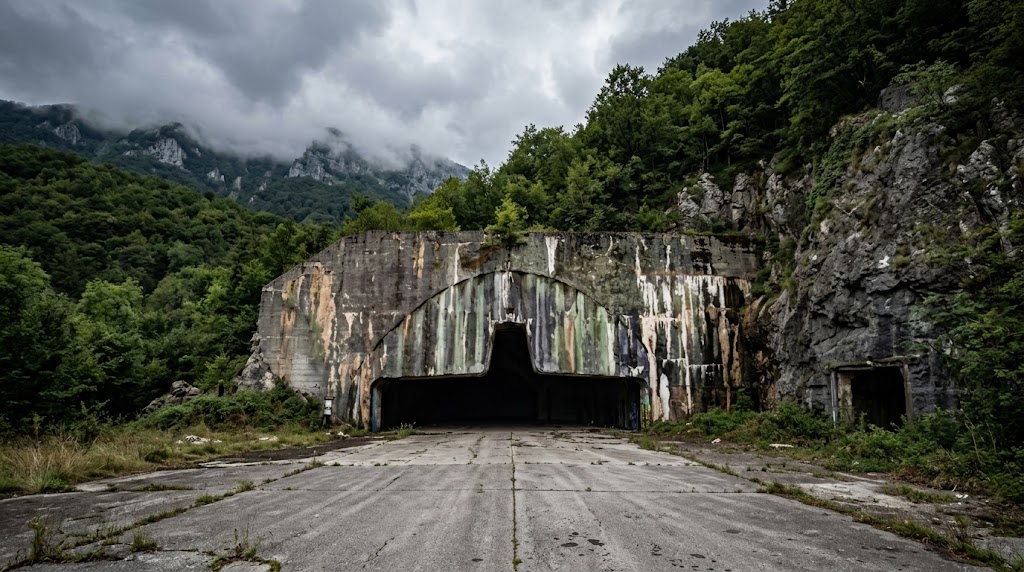 Tunnel Entrance No. 2: the iconic concrete aircraft profile portal bored directly into the limestone roots of Mount Plješevica.
The Subterranean City: Engineering the Unbreakable
Željava was not merely an aircraft bunker; it was an autonomous, subterranean ecosystem capable of surviving months of total planetary isolation:
- The MiG-21 Caverns: The vaulted galleries were wide enough to park, maintain, and arm up to fifty-eight Mikoyan-Gurevich MiG-21 interceptors and reconnaissance jets. Hydraulic lifts loaded live ordnance while high-pressure fuel pipelines fed subterranean refueling stations directly from a 20-kilometer underground fuel depot on Mount Pokoj.
- The Blast Portals: The four main entrances were guarded by monstrous, hermetically sealed hydraulic blast doors. Constructed of reinforced concrete and high-tensile steel slabs one meter thick and weighing 100 tons each, these sliding doors sealed the caverns against chemical agents, shockwaves, and thermal flash within seconds.
- Autonomous Survival: Deep within the mountain core sat a nuclear command center (Star), full surgical operating theaters, dormitories for over 1,000 personnel, independent water filtration reservoirs tapping subterranean mountain springs, and three diesel power stations delivering electricity for months.
The 1992 Scorch: 56 Tons of High Explosives
For more than two decades, Željava operated on constant high-alert readiness. But its end arrived not at the hands of NATO or the Warsaw Pact, but from the tragic implosion of Yugoslavia itself.
In spring 1992, as the Bosnian War erupted with brutal ferocity and the Yugoslav People’s Army (JNA) prepared to retreat from the Bihać pocket, military commanders faced a critical directive: prevent the supersonic fortress, its intact radar networks, and advanced runway systems from falling into the hands of the newly formed Army of the Republic of Bosnia and Herzegovina:
- The Sabotage: Specialized sapper units placed fifty-six metric tons of high-grade military explosives at strategic structural nodes throughout the underground complex: inside the blast door tracks, underneath runway intersections, and against the primary structural mountain ribs.
- The Detonation: In the early morning hours of May 16, 1992, the charges were detonated. The concussive blast shook the entire valley, triggering an artificial earthquake registered on seismic stations across the Balkans. Fireballs blasted out of the four portals, incinerating ventilation shafts and blowing runway concrete slabs dozens of feet into the air. Mount Plješevica held, but Objekat 505 was transformed into a charred, poisonous ruin.
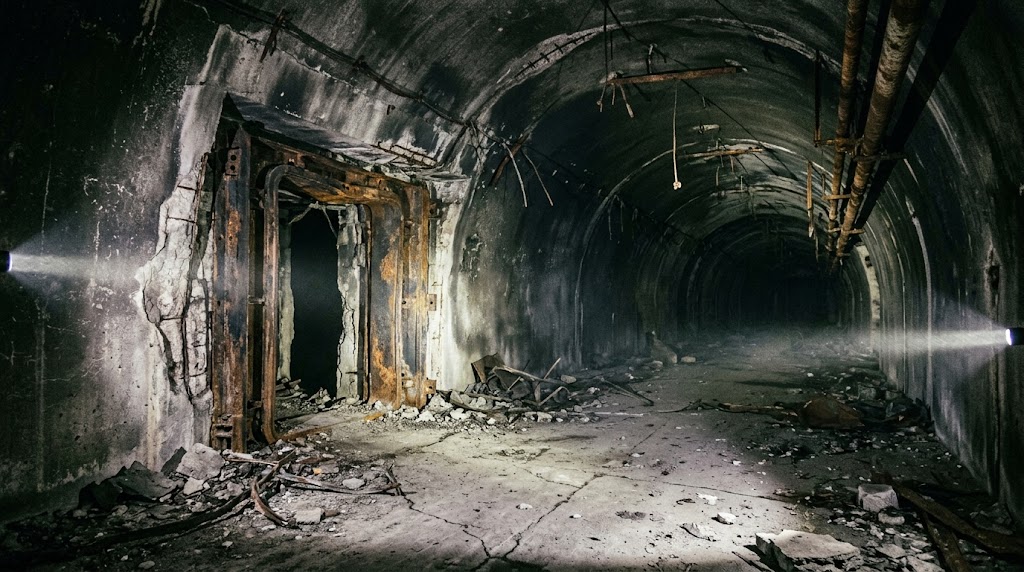 Inside the scorched galleries: fractured vault arches, thick layers of toxic soot, and rusted steel blast frames.
The Ghost on the Tarmac: The Douglas C-47 Dakota
Guarding the entrance road to the complex stands one of dark tourism’s most iconic aviation wrecks: a vintage Douglas C-47 Skytrain (Dakota) transport aircraft (Yugoslav Air Force serial number 71255).
Used for paratrooper drops and cargo transport before being permanently parked near the base gates as an instructional relic, the aircraft was riddled with shrapnel, bullet holes, and spray-painted graffiti during the 1990s conflict. Today, with its cockpit stripped, wings faded, and weeds climbing through its landing gear, the Dakota serves as a haunting welcoming sentinel to the ruined airbase.
Hazards of the Mountain: Radiation, PCBs, and Landmines
Exploring Željava is among the most hazardous urban exploration expeditions in the world, marked by severe physical and environmental hazards:
- The Landmine Peril (PAZI MINE): The dense forests, runway shoulders, and perimeter grounds surrounding Željava saw intense trench combat during the siege of Bihać. Hundreds of unexploded anti-personnel (PMA-2/PMA-3) and anti-tank mines remain buried in the unpaved grass along the runways. Venturing off paved concrete is life-threatening.
- Toxic Atmospheric Hazards: The 1992 detonations incinerated industrial electrical transformers, releasing heavy concentrations of carcinogenic Polychlorinated Biphenyls (PCBs), airborne asbestos fibers, and toxic heavy metal particulates that coat the tunnel floors in fine, easily disturbed gray dust.
- Ionizing Radiation: The complex housed americium-based early-warning ionization smoke detectors. The structural fires cracked these sensors, creating localized radioactive contamination hot zones within certain deep lateral galleries.
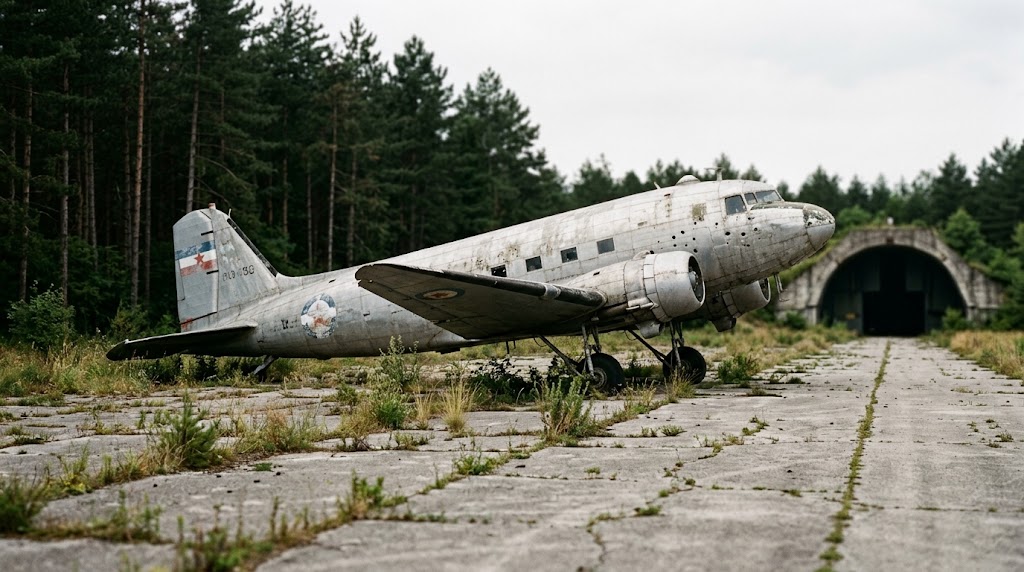 The legendary abandoned Douglas C-47 Dakota transport plane sitting along the entrance runway.
Expedition Field Guide: How to Encounter Željava Safely
While the subterranean tunnels pose grave respiratory and structural dangers, the surface runways and outer perimeter have become an accessible pilgrimage for aviation enthusiasts, motor clubs, and dark tourists.
Location & Crossing the Border
- Location: Border of Lika-Senj County, Croatia and the Una-Sana Canton, Bosnia-Herzegovina (near the village of Ličko Petrovo Selo and the city of Bihać).
- International Frontier Warning: The outer perimeter of the base, runways, and subterranean tunnels are literally sliced in half by the international border. Runway 1 and portions of the underground complex lie in Bosnia, while Runway 2, Runway 4, and the C-47 aircraft sit in Croatia.
- Passport Mandatory: Border police (particularly Croatian border patrols monitoring the external EU Schengen border) conduct continuous thermal drone and vehicle patrols. Always carry your valid passport; never attempt to cross through the woods or drive between runways into Bosnia without clearing official international border checkpoints (such as the Izačić crossing nearby).
Essential Safety & Equipment Protocols
- Never Step off the Paved Tarmac: Stay strictly on intact asphalt runways and cleared concrete access roads. Never step onto grass verges, dirt tracks, or overgrown ditches marked with red skull-and-crossbones mine signs (Pazi Mine).
- Tunnel Exploration Precautions: Entering the underground tunnels is not officially sanctioned and is entirely at your own risk. If stepping near the portals, you must wear a certified P100 / FFP3 particulate respirator mask, high-powered industrial flashlights (the subterranean darkness is absolute with zero ambient light), a safety hard hat, and sturdy steel-shank work boots to prevent puncture wounds from twisted rebar and broken glass.
- Bring Mobile Communications: There is zero cellular signal inside the mountain bedrock. Never enter the tunnels alone, and always notify someone on the outside before inspecting portal mouths.
The Verdict
Željava Airbase is a monumental tomb of Perang Dingin paranoia—a testament to what happens when supreme engineering genius is marshaled for absolute annihilation. Standing before its colossal mountain portals while winds howl down the cracked overgrown runways, you realize that not even six billion dollars of concrete and steel can outlast the fiery collapse of human ideology.