Just a short drive beyond the vibrant university town of Cluj-Napoca lies a woodland that has fascinated researchers, paranormal investigators, and intrepid hikers for decades: Hoia-Baciu Forest. Dubbed the “Bermuda Triangle of Transylvania,” this ancient oak grove spans roughly three square kilometers and holds a reputation far more unsettling than typical gothic folklore.
Here, science meets folklore, and centuries of superstition collide with documented environmental anomalies.
The Origins: The Shepherd Who Disappeared
The forest takes its name from a local shepherd named Baci. According to local lore, Baci ventured into the dense canopy with his flock of 200 sheep and was never seen again. Despite extensive search parties organized by surrounding villages, neither the shepherd nor a single trace of his flock was ever uncovered.
For generations, locals avoided the forest border entirely. Superstitions warned that those who stepped beyond the perimeter risked entering a purgatory between worlds, returning with severe amnesia—or failing to return at all.
The 1968 UFO Sensation
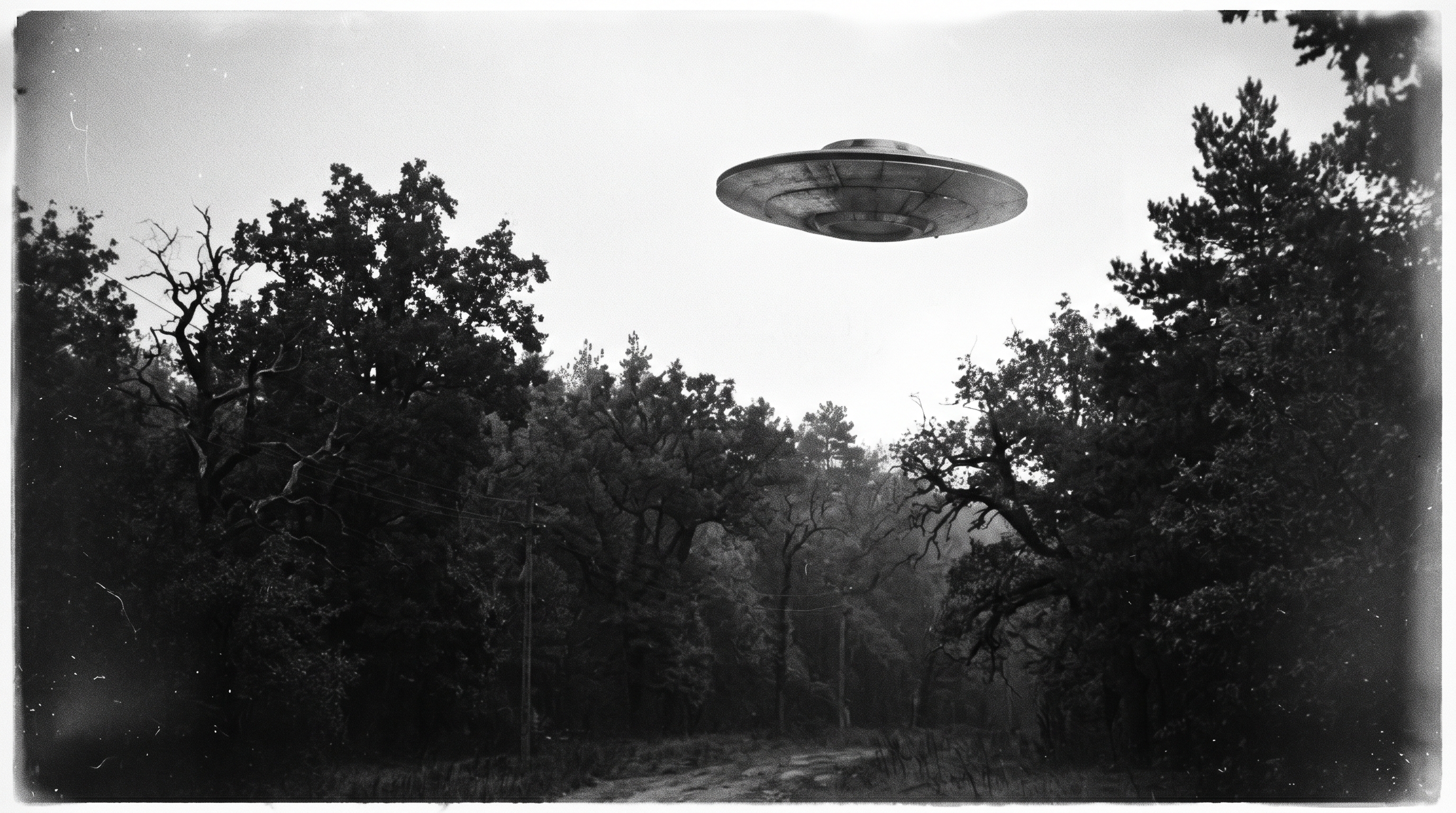 Archival representation of unexplained aerial phenomena documented above the Romanian tree line.
While folklore kept villagers at bay, global attention exploded in August 1968. Emil Barnea, a military technician, ignored local taboos and camped within the woods alongside his friends.
Archival representation of unexplained aerial phenomena documented above the Romanian tree line.
While folklore kept villagers at bay, global attention exploded in August 1968. Emil Barnea, a military technician, ignored local taboos and camped within the woods alongside his friends.
Midway through the afternoon, Barnea witnessed a strange metallic disc hovering silently above the tree line. Before it sped toward the clouds, he managed to capture several sharp photographs. Unlike many sensationalized claims of the era, Barnea had nothing to gain from the sighting—he risked his career and faced severe reprimands from the communist government for publicizing the event.
UFO researchers and photographic analysts worldwide verified the negatives, cementing Hoia-Baciu as an international hotspot for aerial enigmas.
Documented Anomalies: What Makes the Forest Eerie?
Beyond spectral tales, Hoia-Baciu presents physical characteristics that defy conventional botany and geology:
1. The Bent Oaks
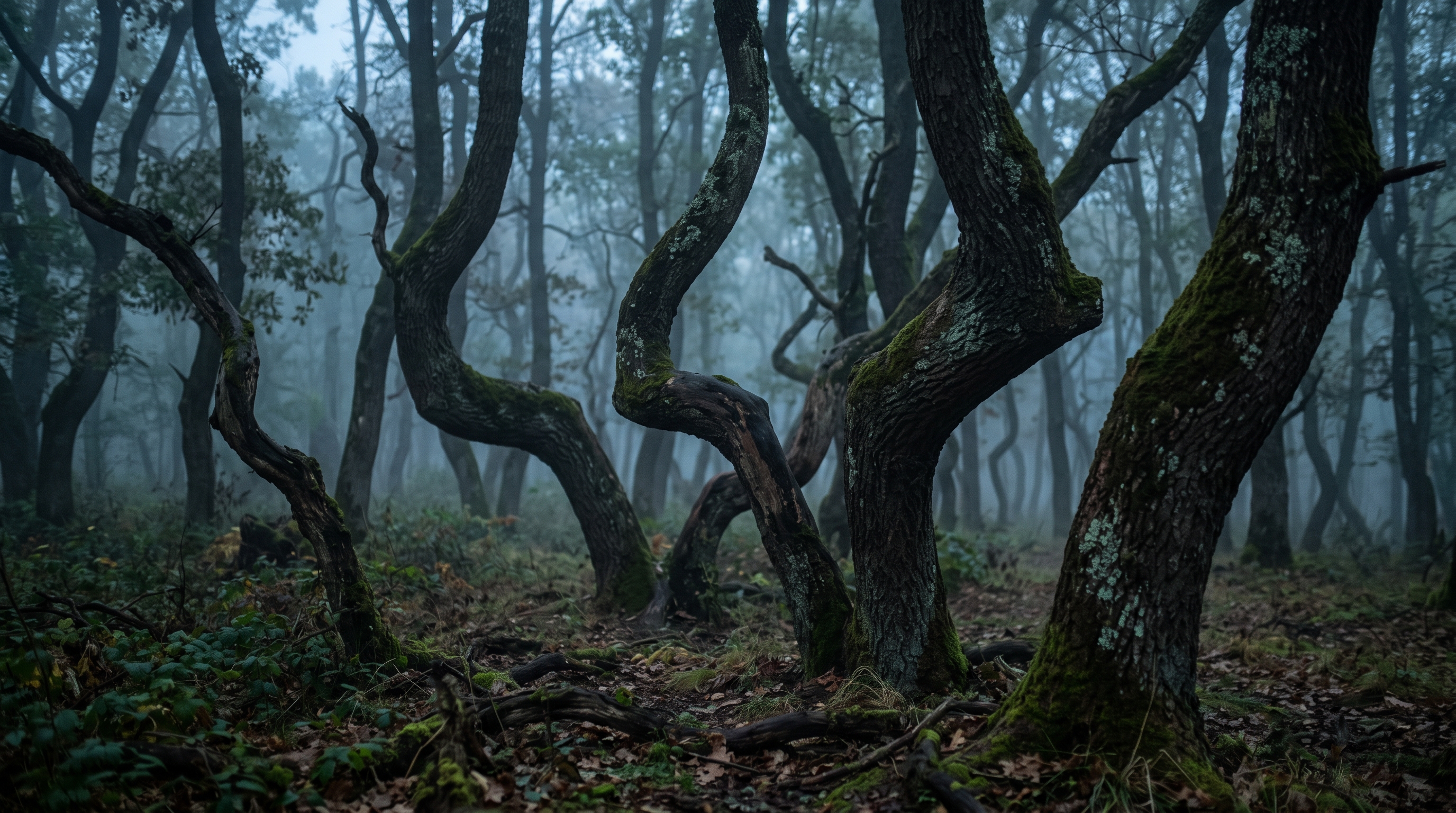
Throughout the southern rim of the woods, oak and beech trees do not grow straight toward the sunlight. Instead, entire groves spiral outward in synchronized 90-degree curves near the base, resembling petrified bone fragments or grasping claws. Botanists have examined these trunks, yet no concrete explanation—such as wind shear or abnormal fungal infections—accounts for the uniform warping.
2. The Dead Zone: Poiana Rotundă (The Round Meadow)
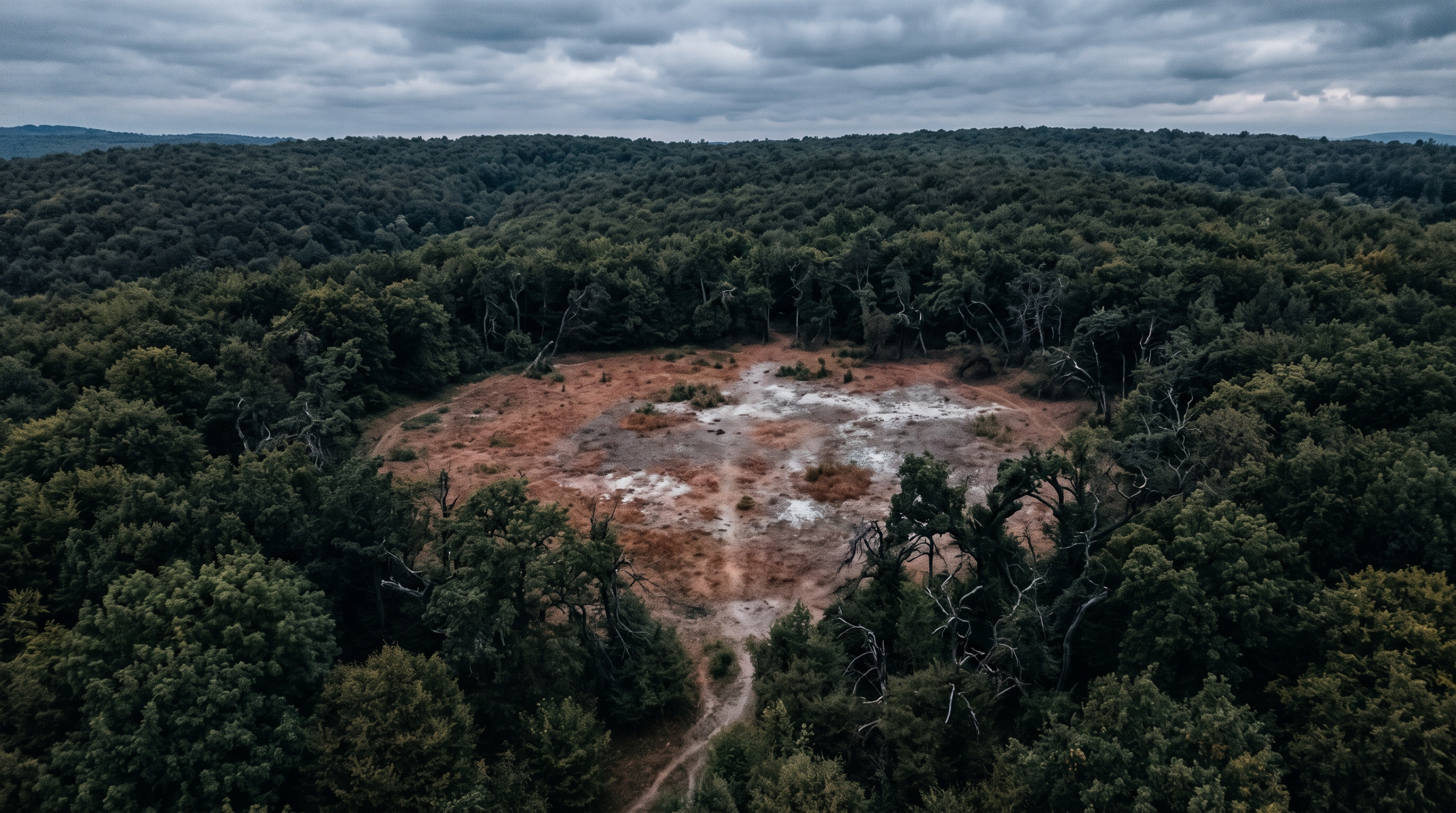 Poiana Rotundă: the enigmatic barren circle where vegetation mysteriously ceases to thrive.
Deep within the forest sits an almost perfect circular clearing where virtually no trees or tall vegetation grow. Soil core samples taken by Romanian biological institutes revealed normal pH levels and no toxic heavy metals, yet plant life remains stunted compared to the surrounding forest edge. Electronic compasses frequently spin out of calibration when crossing into the circle.
Poiana Rotundă: the enigmatic barren circle where vegetation mysteriously ceases to thrive.
Deep within the forest sits an almost perfect circular clearing where virtually no trees or tall vegetation grow. Soil core samples taken by Romanian biological institutes revealed normal pH levels and no toxic heavy metals, yet plant life remains stunted compared to the surrounding forest edge. Electronic compasses frequently spin out of calibration when crossing into the circle.
3. Physical Symptoms
Countless night-trekkers and certified guides have logged recurring physical reactions shortly after entering the perimeter:
- Sudden spikes of nausea and migraines
- Unexplained red rashes or burns on exposed skin
- Intense bouts of derealization and ambient dread
Expedition Field Guide: How to Visit
For travelers wanting to experience Hoia-Baciu firsthand, the woods are accessible year-round, but preparation is essential.
Getting There
- Base City: Cluj-Napoca, Romania. Cluj has an international airport with frequent low-cost flights from major European hubs like London, Frankfurt, and Vienna.
- Trailhead Access: Take a short 15-minute taxi or rideshare to the Ethnographic Park at the edge of the forest. From there, marked hiking trails enter directly into the trees.
Safety & Best Practices
- Hire a Local Guide: Never wander the interior at night without an experienced escort. Companies such as the Hoia-Baciu Project offer regulated nocturnal tours led by guides equipped with GPS trackers and first-aid kits.
- Download Offline Maps: Cellular reception drops sharply within the ravines. Rely on pre-downloaded offline satellite maps rather than cellular data.
- Gear Up for Terrain: The trail contains concealed tree roots, steep muddy ravines, and wild boars during mating seasons. Sturdy hiking boots and high-lumen flashlights are non-negotiable.
The Verdict
Whether Hoia-Baciu is an active focal point of magnetic anomalies or simply a masterpiece of collective psychological suspense, stepping beneath its bent branches leaves an indelible impression. It remains one of Europe’s last true wildernesses where the unknown feels entirely within arm’s reach.