Beneath the sunlit boulevards, romantic cafés, and grand Haussmannian architecture of Paris lies a shadow world carved out of ancient limestone: The Paris Catacombs (Les Catacombes de Paris). Spanning hundreds of kilometers in an unmapped subterranean labyrinth, this underground network holds the carefully stacked skeletal remains of more than six million people—nearly three times the living population of the city above.
It is an empire of silence, mortality, and architectural macabre that has fascinated daredevils, historians, and occultists for more than two centuries.
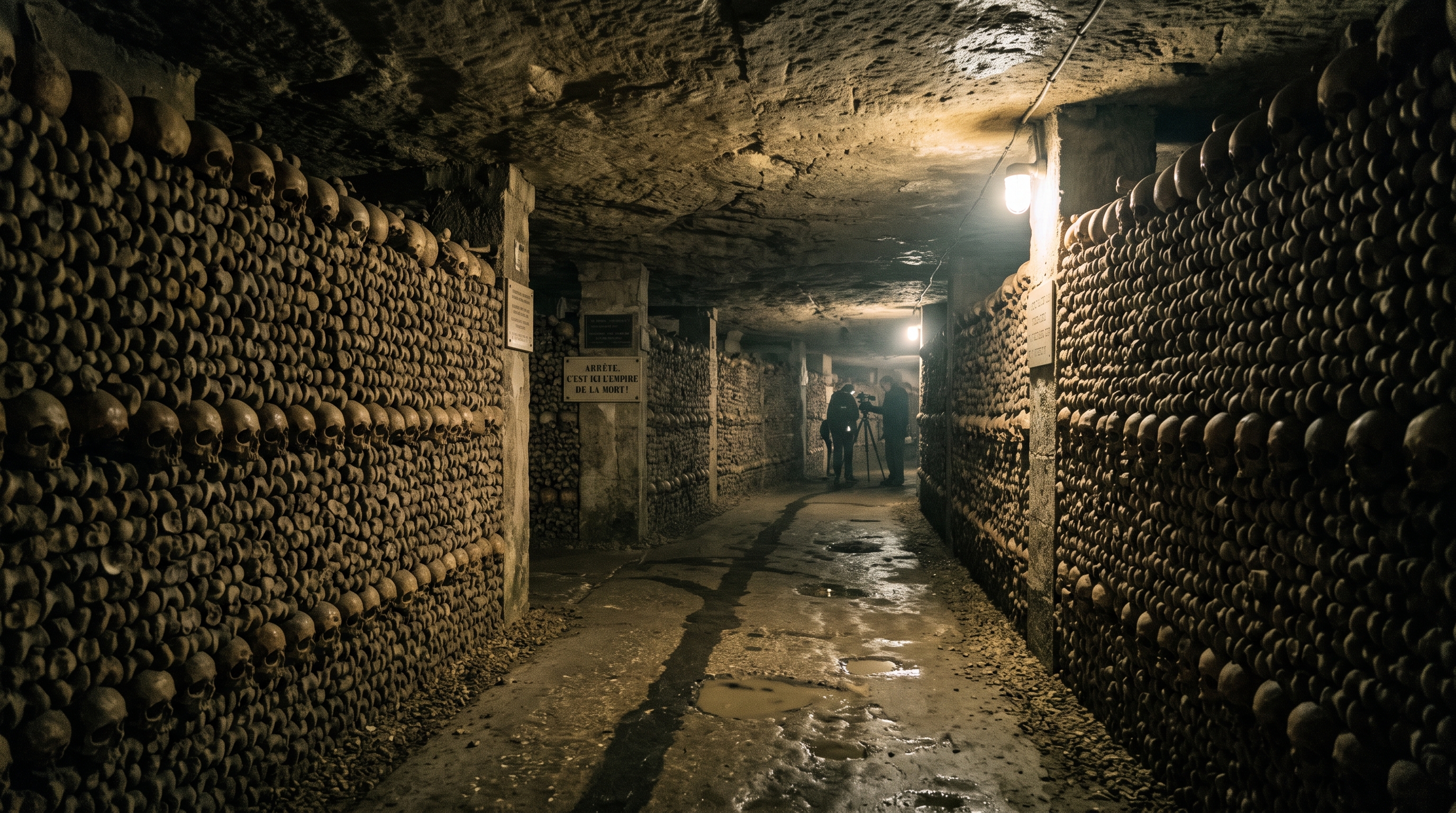 Dimly lit limestone galleries packed from floor to ceiling with the stacked femurs and skulls of over six million Parisians.
The Crisis: Why Paris Buried Its Dead Underground
The story of the Catacombs began not in mystery, but in public health catastrophe. By the late 18th century, Paris was suffocating beneath its own dead. The central parish cemetery, Saints-Innocents, had operated continuously for nearly a millennium, accumulating centuries of burials until the earth swelled into bloated mounds several meters high.
The crisis reached its peak in the spring of 1780:
- The Wall Collapse: Prolonged spring rainfall exerted unbearable hydrostatic pressure on the cemetery boundary, causing a stone basement wall of an adjacent residential property to burst inward, spilling decomposing corpses into private cellars.
- The Plague Risk: Noxious gases filled surrounding apartments, spoiling food, spreading bacterial sickness, and threatening a catastrophic urban epidemic.
- The Royal Edict: King Louis XVI issued an order shutting down inner-city cemeteries. To resolve the space shortage, royal engineers repurposed the subterranean limestone quarries beneath the southern outskirts of Paris, originally dug during the Roman era to build the Louvre and Notre-Dame.
Beginning in 1786, midnight processions of veiled bone wagons, covered in black velvet and escorted by chanting priests, began hauling centuries of exhumed skeletons into the subterranean shafts.
From Bone Pit to Mausoleum: The Art of the Macabre
Initially, the bones were simply dumped into quarry pits through ventilation shafts. However, in 1810, Hégésippe Héricart de Thury, the Inspector General of Quarries, undertook an ambitious transformation of the bone depository into a visitable monument of reflection.
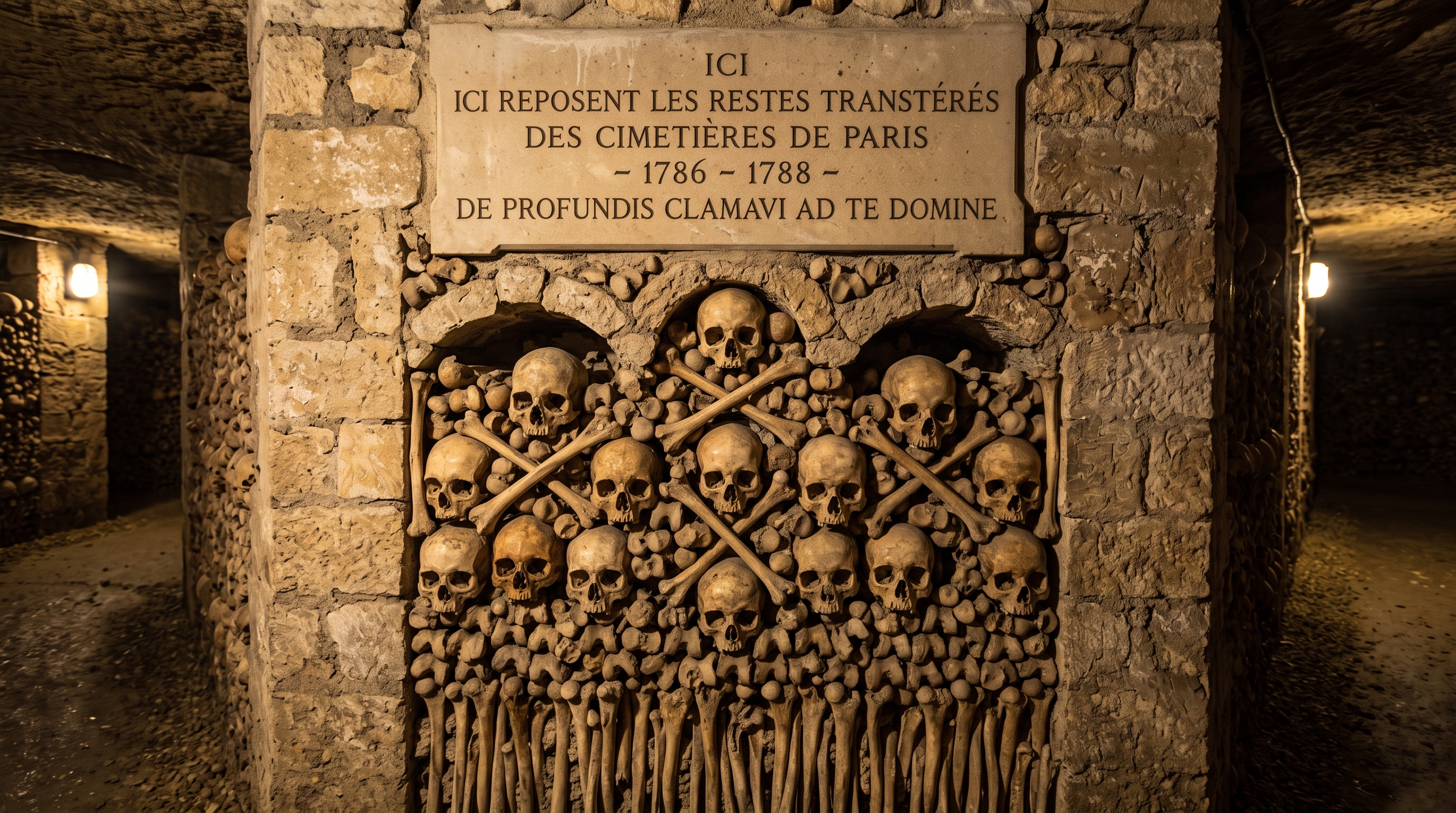 Skulls and long bones meticulously configured into geometric patterns and monumental facades.
Workers arranged the femurs, tibias, and skulls into tight decorative facades, hiding loose bone fragments behind ornate walls of skeletal masonry. Classical inscriptions, poetry, and philosophical warnings about mortality were carved into limestone tablets along the corridors, including the famous entrance greeting:
“Arrête! C’est ici l’empire de la Mort.”
(Halt! This is the empire of Death.)
The Forbidden Network: Cataphiles and Secret Societies
While the official city museum showcases a carefully monitored 1.5-kilometer route, the greater underground quarry network (les carrières de Paris) covers roughly 300 kilometers beneath multiple arrondissements. Entering these non-public sections is illegal under French law, yet it has fostered a legendary subculture known as Cataphiles:
- Unmapped Tunnels: Trekkers navigate unlit, partially flooded tunnels, crawling through century-old choke points to explore hidden quarry rooms.
- Underground Society: Over decades, cataphiles have built clandestine meeting spots, sculpture halls, and even unauthorized movie theaters complete with electricity stolen from the city grid.
- The Subterranean Police: The Paris Police Prefecture deploys a dedicated specialized unit (les cataflics) that patrols tunnel shafts to evict trespassers, deter illegal rave parties, and rescue disoriented explorers who face death from hypothermia or battery failure in pitch-black conditions.
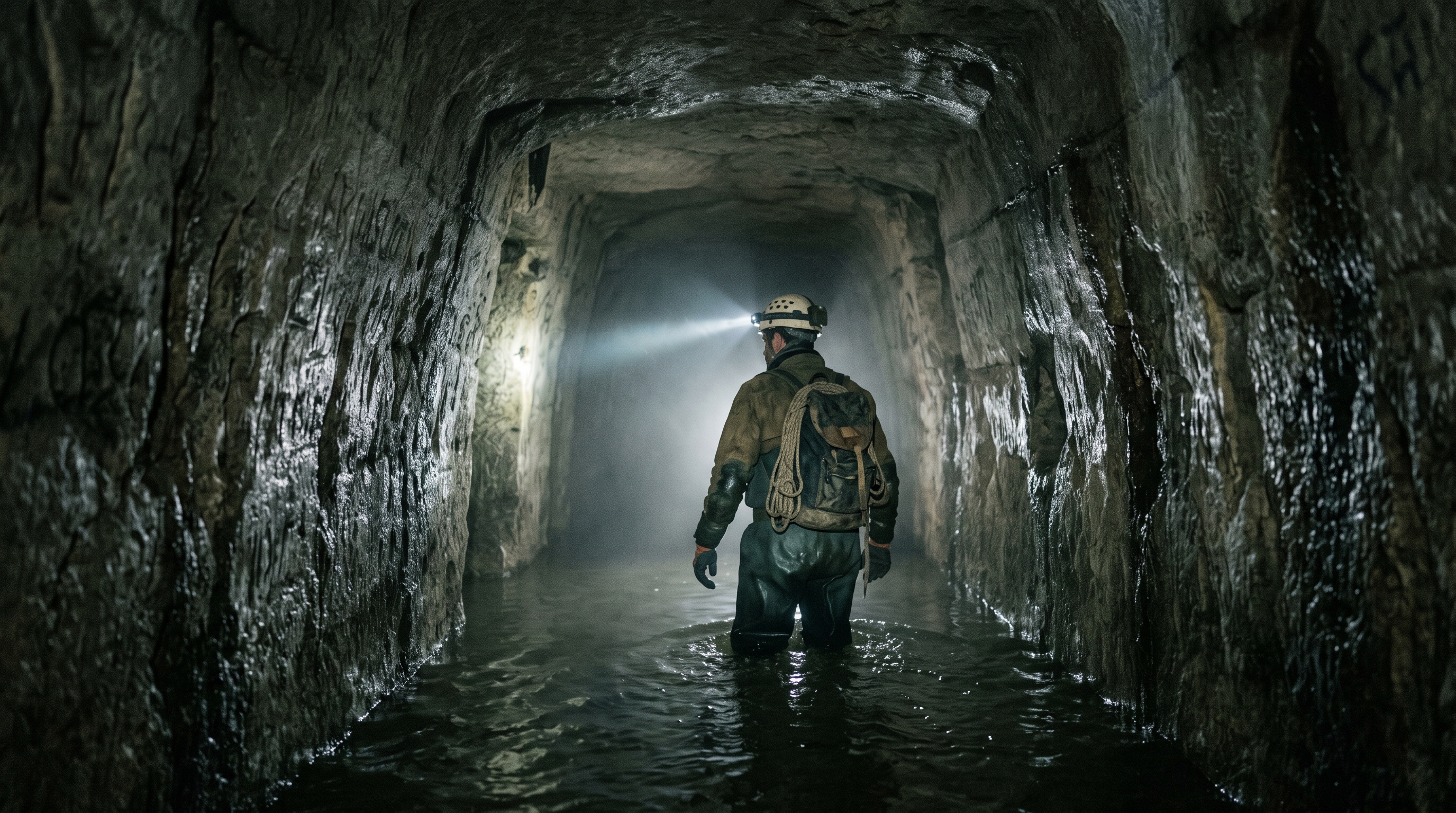 Beyond the tourist path: narrow, unmapped quarry corridors where only experienced cataphiles dare navigate.
Expedition Field Guide: How to Visit Legally
Exploring the legitimate historical ossuary is an unforgettable experience, but advance planning is mandatory.
Planning Your Descent
- Location: 1, Avenue du Colonel Henri Rol-Tanguy, 75014 Paris (Place Denfert-Rochereau metro/RER station).
- Booking: You must purchase timed tickets online well in advance. General entrance tickets sell out days ahead due to a strict cap of 200 visitors inside at any given moment.
- Physical Demands: The tour is not wheelchair accessible. You must walk down 131 spiral stairs into the quarry and climb 112 stairs back to ground level.
- Climate & Gear: The catacombs maintain a constant, chilly temperature of 14°C (57°F) year-round with high humidity and water dripping from the ceiling. A warm jacket and sturdy non-slip footwear are mandatory.
The Verdict
The Paris Catacombs remind us that even the most glamorous cultural capitals are anchored upon the dust of forgotten generations. To walk through these quiet limestone tunnels is to leave the noise of modern Europe behind and stand face-to-face with the ultimate equalizer of human history.